
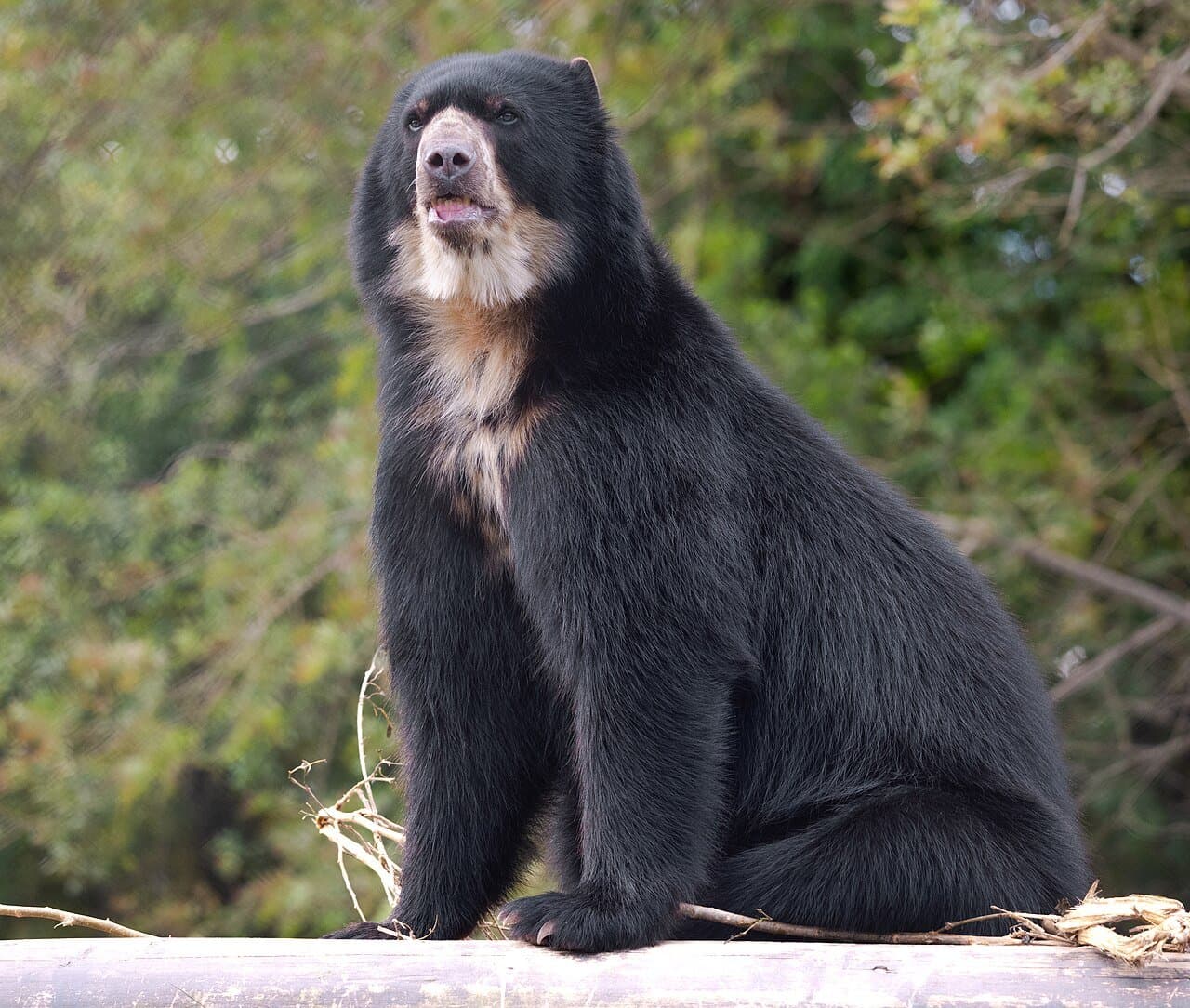
Andean Bear
Tremarctos ornatus
South America's only bear, a tree-climbing mountain bear with cream-colored 'spectacle' markings around its eyes.
Checking teacher reviews…
About the Andean Bear
Andean bears, also called spectacled bears, grow 5 to 6 feet long. Males can weigh up to 340 pounds, while females rarely top 180 pounds. Each bear's cream face and chest markings are different, like a fingerprint. They live in the Andes from Venezuela to Bolivia, in rainforests, cloud forests and dry forests. They eat fruit, bromeliads, berries, grasses and sometimes small animals.[1]
Quick facts
- Scientific name
- Tremarctos ornatus[1]
- Size
- 5 to 6 feet long; 2 to 3 feet tall at the shoulder.[1]
- Weight
- Males up to 340 pounds; females rarely over 180 pounds.[1]
- Lifespan
- Around 20 years in human care, sometimes into the early 30s.[1]
- Diet
- Omnivore. Fruits, bromeliads, berries, grasses, bulbs, cactus flowers and small animals.[1]
- Habitat
- Mountain forests, from rainforest and cloud forest to dry forest, and nearby grasslands.[1]
- Where it lives
- The Andes, from western Venezuela south to Bolivia.[1]
- Group life
- Solitary. Mostly active at night.[1]
- Babies
- One or more cubs, usually born between November and February.[1]
- Conservation status
- Vulnerable (IUCN Red List, assessed 2016).[2]
Fun facts
Vocabulary
- bromeliad
- A tropical plant with stiff leaves arranged in a rosette; pineapples are bromeliads.
- cloud forest
- A mountain forest that is often covered in clouds or mist.
- delayed implantation
- When a fertilized egg waits before it starts growing, so babies are born at a good time of year.
- arboreal
- Living mostly in trees.
- vulnerable
- A conservation label meaning a species faces a high risk of dying out in the wild.
See it in person
- Smithsonian's National ZooWashington, D.C. · American TrailSee this animal on the zoo's website ↗
These zoos had this animal when we gathered our information, but animals sometimes move. Check the zoo's website or contact the zoo before you visit.
Sources
- [1] Smithsonian's National Zoo & Conservation Biology Institute. “Andean bear.” https://nationalzoo.si.edu/animals/andean-bear (accessed 2026-10-08)
- [2] IUCN Red List of Threatened Species. “Tremarctos ornatus (Andean Bear).” https://www.iucnredlist.org/species/22066/123792952 (accessed 2026-10-08)
Facts last checked 2026-10-08.


