
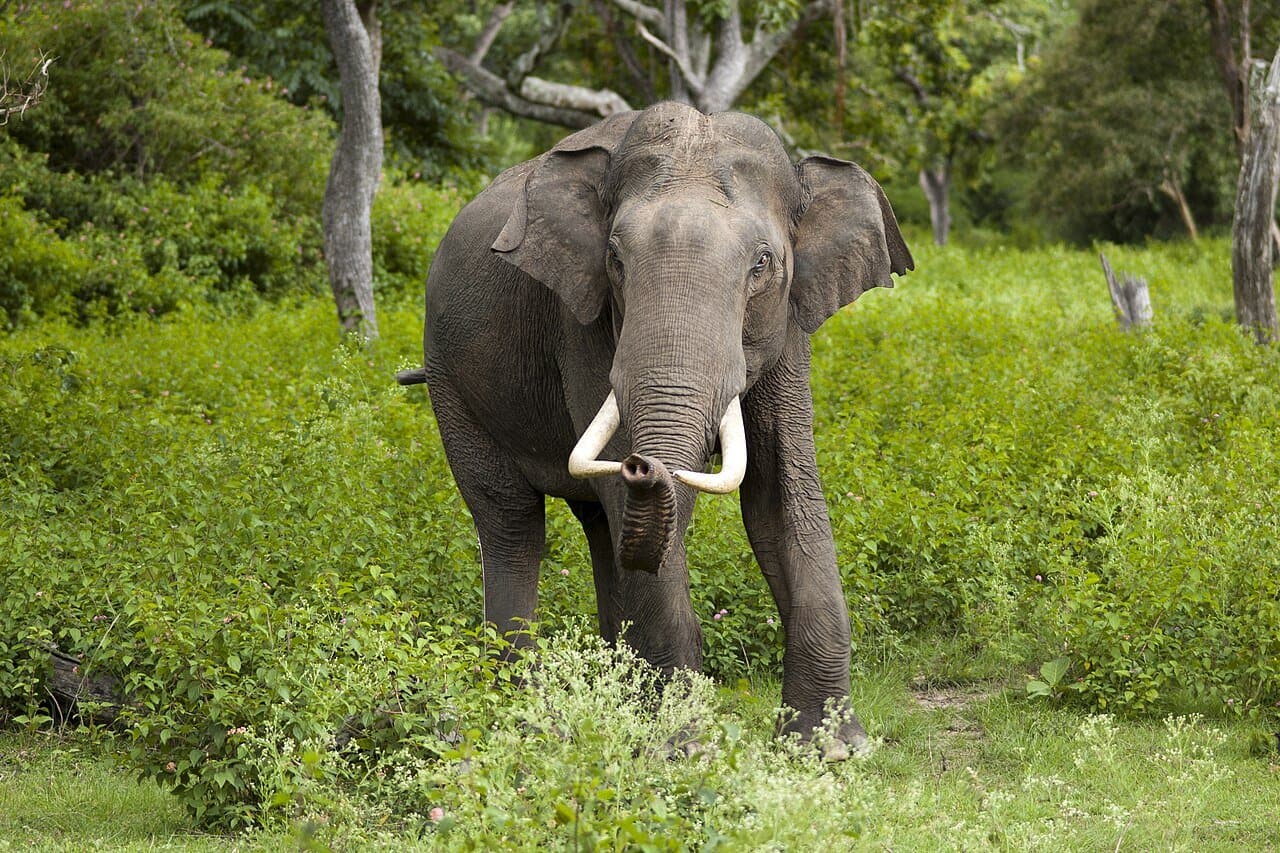
Asian Elephant
Elephas maximus
The largest land animal in Asia, a smart and social forest elephant that talks to its herd with deep rumbles.
Checking teacher reviews…
About the Asian Elephant
Asian elephants are slightly smaller than African elephants, but they still weigh 6,000 to 12,000 pounds and stand 6 to 12 feet tall at the shoulder. They live in forests with open grassy areas in India and Southeast Asia, including Sumatra and Borneo. They spend about three-quarters of each day eating or walking to food and water. Herds are made up of related females and their young. Only some males grow big tusks.[1]
Quick facts
- Scientific name
- Elephas maximus[1]
- Size
- 6 to 12 feet tall at the shoulder. Males are usually larger than females.[1]
- Weight
- 6,000 to 12,000 pounds.[1]
- Lifespan
- Often into their mid-50s; the median life expectancy for females is 47 years.[1]
- Diet
- Herbivore. Mostly grasses, plus leaves, roots, vines, twigs, bark and fruit.[1]
- Habitat
- Forests with open grassy glades.[1]
- Where it lives
- India and Southeast Asia, including Sumatra and Borneo.[1]
- Group life
- Herds of related females and their young. Adult males mostly live apart.[1]
- Babies
- Usually one calf after a 21.5- to 22-month pregnancy; calves weigh 150 to 350 pounds.[1]
- Conservation status
- Endangered (IUCN Red List, assessed 2019).[2]
Fun facts
Vocabulary
- herd
- A group of large animals, like elephants, that live and travel together.
- trunk
- An elephant's long nose and upper lip, used for breathing, smelling, drinking and grabbing.
- tusk
- A very long tooth that grows out of an animal's mouth.
- infrasound
- Sound too low for people to hear.
- endangered
- A conservation label meaning a species faces a very high risk of dying out in the wild.
See it in person
- Smithsonian's National ZooWashington, D.C. · Elephant TrailsSee this animal on the zoo's website ↗
These zoos had this animal when we gathered our information, but animals sometimes move. Check the zoo's website or contact the zoo before you visit.
Sources
- [1] Smithsonian's National Zoo & Conservation Biology Institute. “Asian elephant.” https://nationalzoo.si.edu/animals/asian-elephant (accessed 2026-10-08)
- [2] IUCN Red List of Threatened Species. “Elephas maximus (Asian Elephant).” https://www.iucnredlist.org/species/7140/45818198 (accessed 2026-10-08)
Facts last checked 2026-10-08.
