
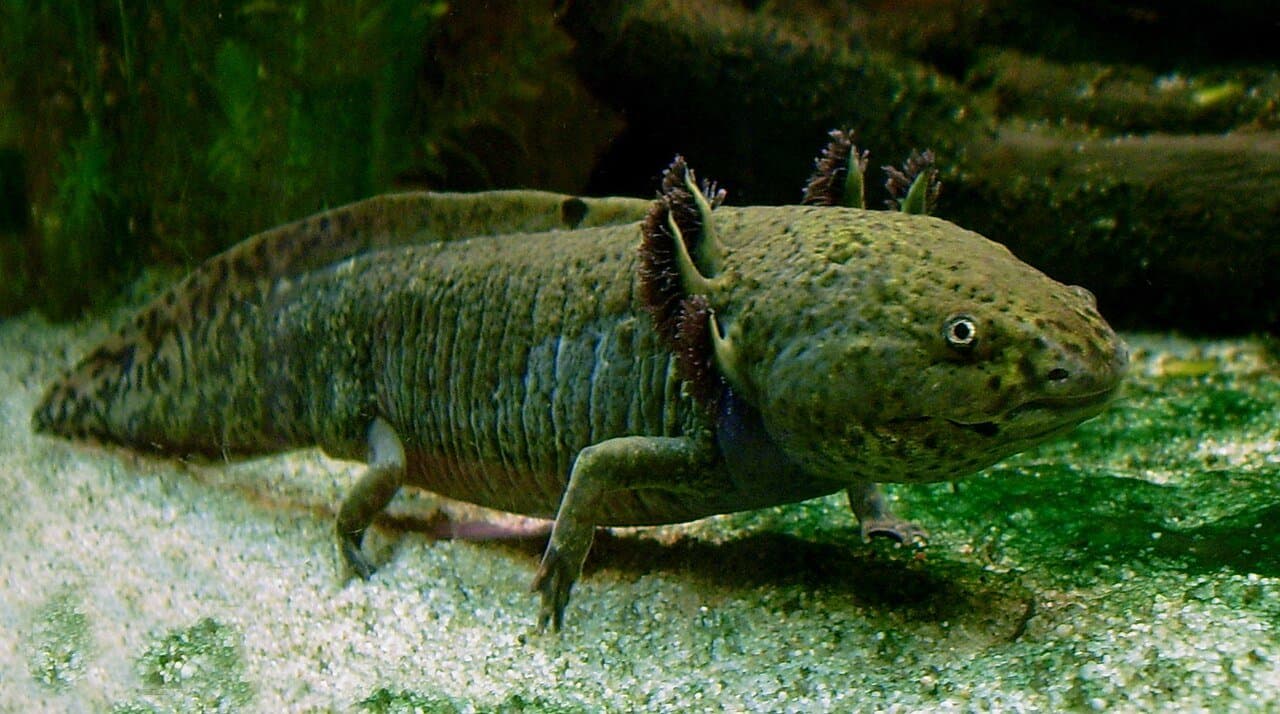
Axolotl
Ambystoma mexicanum
A Mexican salamander that keeps its feathery gills and stays in the water its whole life, famous for regrowing lost body parts.
Checking teacher reviews…
About the Axolotl
Axolotls are 9 to 12 inches long, and wild ones are dark grayish-green. Most salamanders go through metamorphosis and move onto land, but axolotls keep their young features as adults, including feathery outside gills and a finned tail. They once lived in high-altitude lakes near Mexico City; now they are found in just a few spots in and around Lake Xochimilco. They eat invertebrates, fish and other small animals.[1]
Quick facts
- Scientific name
- Ambystoma mexicanum[1]
- Size
- 9 to 12 inches long.[1]
- Lifespan
- Usually 5 to 6 years; up to 15.[1]
- Diet
- Carnivore. Invertebrates, other amphibians, fish and mollusks.[1]
- Habitat
- Freshwater lakes and canals.[1]
- Where it lives
- In and around Lake Xochimilco, Mexico City.[1]
- Group life
- Solitary. Active day or night.[1]
- Babies
- 100 to 300 eggs stuck to rocks or plants; hatch in 10 to 14 days.[1]
- Conservation status
- Critically Endangered (IUCN Red List, assessed 2019).[2]
Fun facts
Vocabulary
- neoteny
- Keeping young features as an adult.
- regenerate
- To regrow a lost body part.
- gills
- Body parts that let an animal breathe underwater.
- metamorphosis
- A big change in body form as an animal grows up, like a tadpole becoming a frog.
- critically endangered
- A conservation label meaning a species faces an extremely high risk of dying out in the wild.
See it in person
- San Francisco Zoo & GardensSan Francisco, California · AmphibiansSee this animal on the zoo's website ↗
These zoos had this animal when we gathered our information, but animals sometimes move. Check the zoo's website or contact the zoo before you visit.
Sources
- [1] San Francisco Zoo & Gardens. “Axolotl.” https://www.sfzoo.org/axolotl/ (accessed 2026-10-02)
- [2] IUCN Red List of Threatened Species. “Ambystoma mexicanum (Axolotl).” https://www.iucnredlist.org/species/1095/53947343 (accessed 2026-10-02)
Facts last checked 2026-10-02.

