
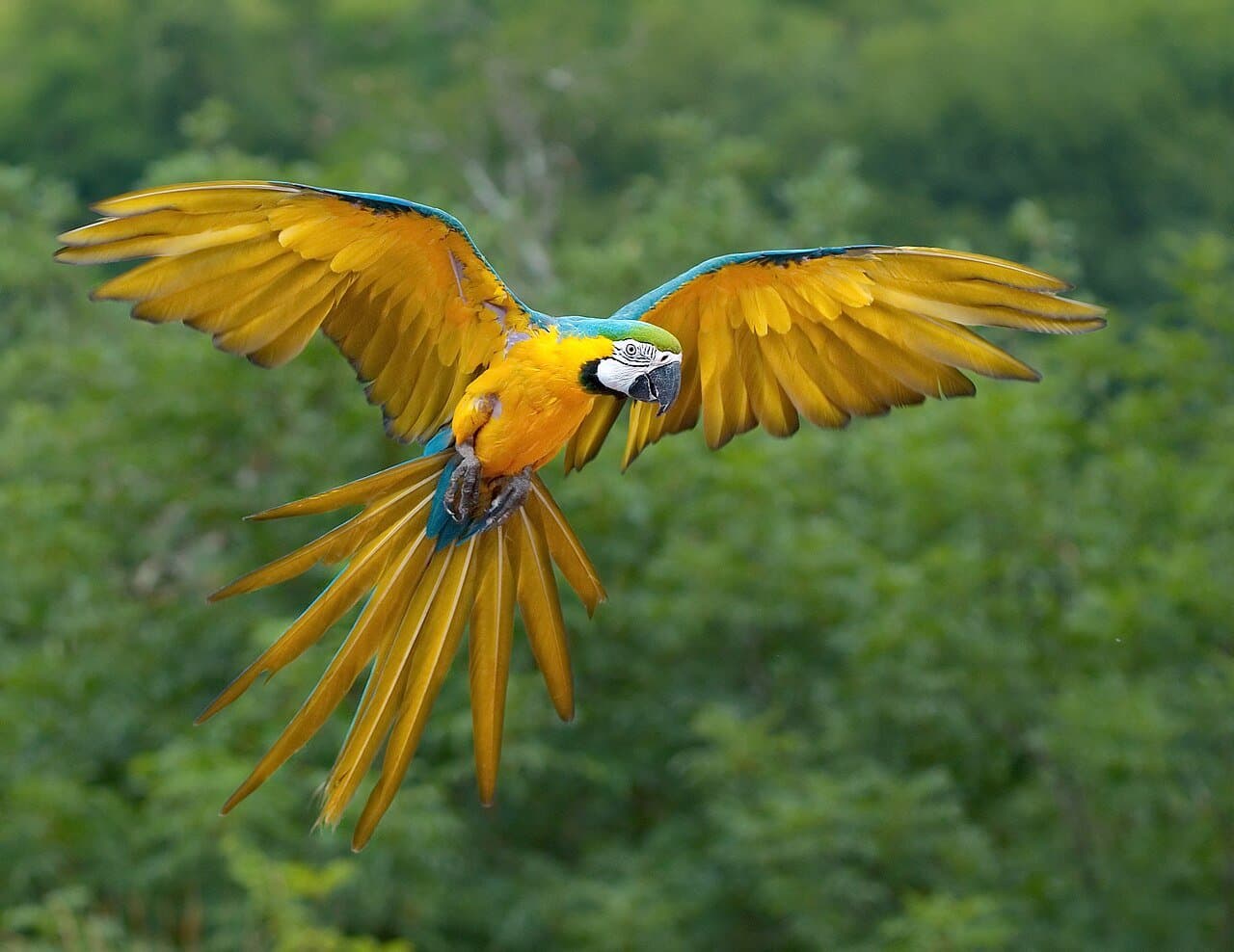
Blue-and-Yellow Macaw
Ara ararauna
A big blue-and-gold parrot of South American rainforests that mates for life and eats clay from riverbanks.
Checking teacher reviews…
About the Blue-and-Yellow Macaw
Blue-and-yellow macaws live in rainforests, especially near swamps and rivers, from Panama through much of South America. They are blue on the back and wings and yellow underneath, with a green forehead and a bare white face lined with black feathers. They eat mainly seeds, nuts and fruit. These macaws usually live in pairs but sometimes gather in flocks.[1]
Quick facts
- Scientific name
- Ara ararauna[1]
- Size
- 81 to 91.5 cm (32 to 36 inches) long, with a wingspan of 104 to 114 cm.[1]
- Weight
- 0.9 to 1.8 kg (about 2 to 4 pounds).[1]
- Lifespan
- Up to 50 years in the wild.[1]
- Diet
- Mainly seeds, nuts and fruit, plus clay from riverbanks.[1]
- Habitat
- Rainforests, especially near swamps and rivers.[1]
- Where it lives
- Panama and South America, including Venezuela, Colombia, Brazil, Bolivia and Paraguay.[1]
- Group life
- Mostly in pairs that mate for life. Sometimes gathers in flocks.[1]
- Babies
- 2 or 3 eggs, nested high in trees, hatch after 24 to 28 days.[1]
- Conservation status
- Least Concern (IUCN Red List, assessed 2018).[2]
Fun facts
Vocabulary
- macaw
- A large, long-tailed parrot from Central and South America.
- mimic
- To copy the sounds or actions of something else.
- toxin
- A poison made by a living thing.
- mate for life
- To stay with the same partner for as long as both live.
- reintroduce
- To return a species to a place where it used to live.
See it in person
- Montgomery ZooMontgomery, Alabama · South AmericaSee this area on the zoo's website ↗
- Zoo AtlantaAtlanta, Georgia · All AnimalsSee this animal on the zoo's website ↗
- Oakland ZooOakland, California · Tropical RainforestSee this animal on the zoo's website ↗
These zoos had this animal when we gathered our information, but animals sometimes move. Check the zoo's website or contact the zoo before you visit.
Sources
- [1] Animal Diversity Web, University of Michigan Museum of Zoology. “Ara ararauna (blue-and-yellow macaw).” https://animaldiversity.org/accounts/Ara_ararauna/ (accessed 2026-10-02)
- [2] IUCN Red List of Threatened Species. “Ara ararauna (Blue-and-yellow Macaw).” https://www.iucnredlist.org/species/22685539/131917270 (accessed 2026-10-02)
Facts last checked 2026-10-02.
More Parrots
 Blue-Fronted AmazonAmazona aestiva
 Blue-Headed MacawPrimolius couloni
 Blue-Throated MacawAra glaucogularis
 BudgerigarMelopsittacus undulatus
 Golden ConureGuaruba guarouba
 Green-Winged MacawAra chloropterus
 Hyacinth MacawAnodorhynchus hyacinthinus
 Military MacawAra militaris
 Red-Fronted MacawAra rubrogenys
 Red-Lored AmazonAmazona autumnalis (Salvin's amazon is the subspecies A. a. salvini)
 Yellow-Naped AmazonAmazona auropalliata