
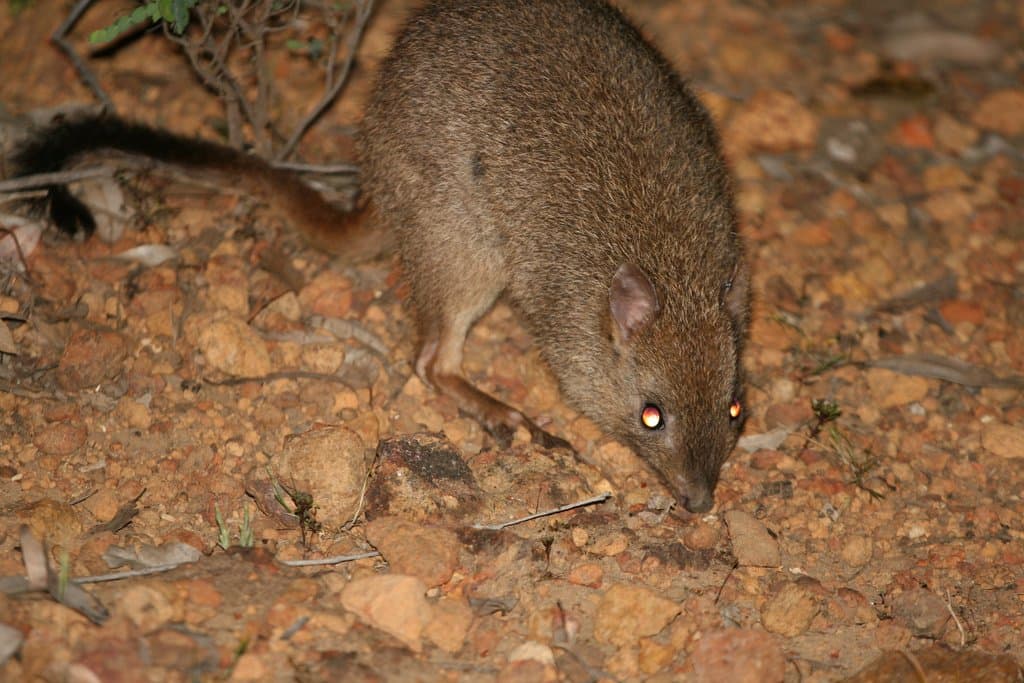
Brush-tailed Bettong
Bettongia penicillata
A small, hopping Australian marsupial, also called the woylie, that digs up underground fungi to eat.
Checking teacher reviews…
About the Brush-tailed Bettong
Brush-tailed bettongs, also called woylies, have bodies 11 to 18 inches long and tails 10 to 13 inches long. They hop on their back legs. They once lived across more than 60 percent of Australia but now survive mostly in a few reserves in the southwest. They eat mostly underground fungi, which they sniff out and dig up, plus bulbs, seeds, insects and resin.[1]
Quick facts
- Scientific name
- Bettongia penicillata[1]
- Size
- Body 11 to 18 inches, plus a 10- to 13-inch tail.[1]
- Lifespan
- 4 to 6 years in the wild; into the teens in human care.[1]
- Diet
- Mostly underground fungi, plus bulbs, seeds, insects and resin.[1]
- Habitat
- A handful of nature reserves.[1]
- Where it lives
- Southwestern Australia.[1]
- Group life
- Solitary. Nocturnal.[1]
- Babies
- Usually one young after a 21-day pregnancy; up to three a year.[1]
- Conservation status
- Near Threatened (IUCN Red List, assessed 2024).[2]
Fun facts
Vocabulary
- fungus
- A living thing such as a mushroom or mold that gets food from other material.
- marsupial
- A mammal whose babies finish growing in a pouch.
- prehensile
- Able to grab or wrap around things, like a tail that holds onto branches.
- nocturnal
- Active mainly at night.
- near threatened
- A conservation label meaning a species may soon be at risk of dying out if things don't improve.
See it in person
- Smithsonian's National ZooWashington, D.C. · Small Mammal HouseSee this animal on the zoo's website ↗
These zoos had this animal when we gathered our information, but animals sometimes move. Check the zoo's website or contact the zoo before you visit.
Sources
- [1] Smithsonian's National Zoo & Conservation Biology Institute. “Brush-tailed bettong.” https://nationalzoo.si.edu/animals/brush-tailed-bettong (accessed 2026-10-08)
- [2] IUCN Red List of Threatened Species. “Bettongia penicillata (Woylie).” https://www.iucnredlist.org/species/2785/258664485 (accessed 2026-10-08)
Facts last checked 2026-10-08.


