
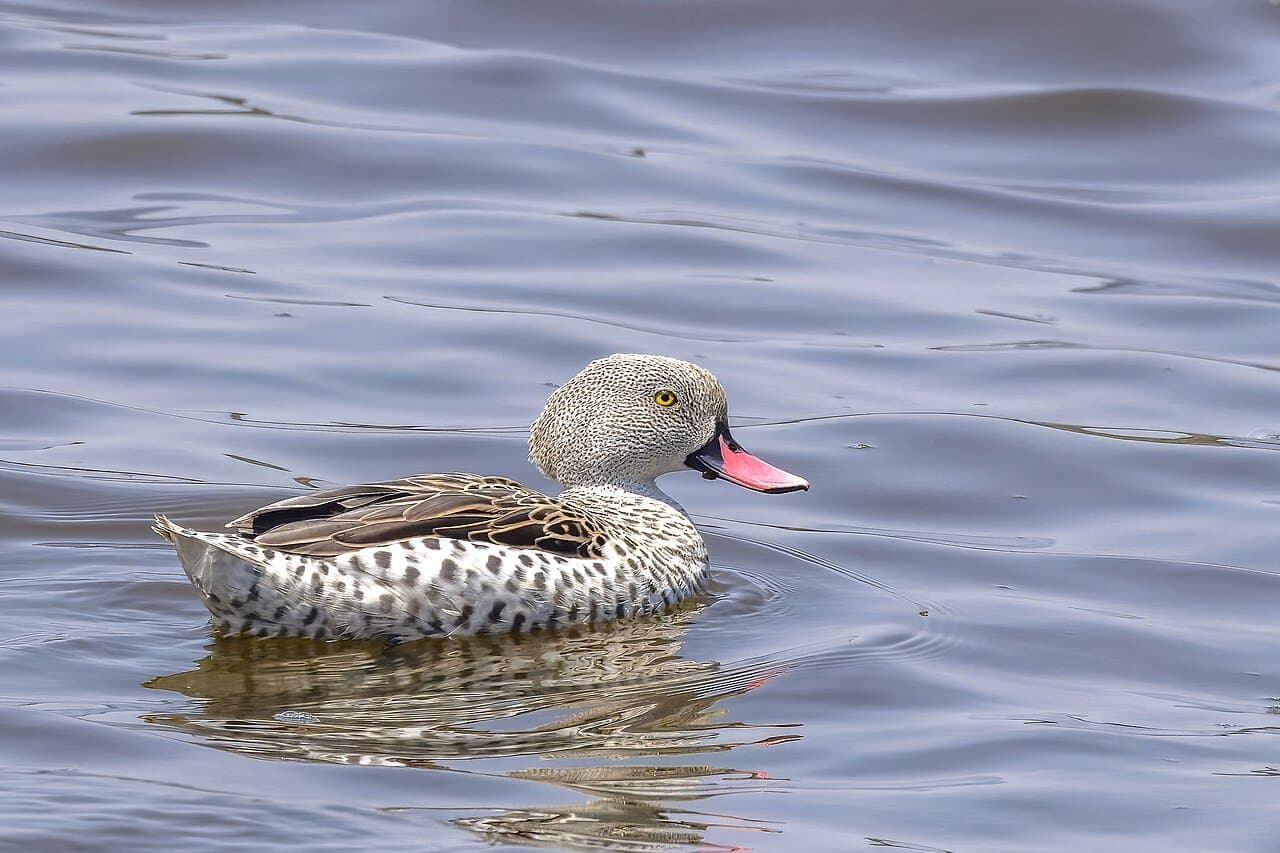
Cape Teal
Anas capensis
A small, speckled gray African duck with a pink bill that can dive and swim underwater with its wings folded.
Checking teacher reviews…
About the Cape Teal
Cape teals are about 14 inches long and weigh 11 to 18 ounces. They have pale, speckled gray feathers, a pink bill and reddish eyes. They live around shallow salty lakes, pools, rivers, flooded wetlands, coasts and lagoons across much of Africa. They eat pondweed stems, leaves and seeds, plus water insects, crustaceans and tadpoles.[1]
Quick facts
- Scientific name
- Anas capensis[1]
- Size
- About 14 inches long.[1]
- Weight
- 11 to 18 ounces.[1]
- Diet
- Omnivore. Pondweed, water insects, crustaceans and tadpoles.[1]
- Habitat
- Shallow salty lakes and pools, rivers, wetlands, coasts and lagoons.[1]
- Where it lives
- Much of eastern and southern Africa, from Chad and Ethiopia to South Africa.[1]
- Babies
- 7 or 8 eggs, incubated 25 to 26 days.[1]
- Conservation status
- Least Concern (IUCN Red List, assessed 2016).[2]
Fun facts
Vocabulary
- dabbling duck
- A duck that feeds at the water's surface instead of diving.
- brackish
- A little bit salty, like where a river meets the sea.
- filter feeding
- Straining tiny bits of food out of water.
- teal
- A kind of small duck.
- least concern
- A conservation label meaning a species is widespread and not at risk of dying out soon.
See it in person
- Omaha's Henry Doorly Zoo and AquariumOmaha, Nebraska · Hubbard Gorilla ValleySee this area on the zoo's website ↗
These zoos had this animal when we gathered our information, but animals sometimes move. Check the zoo's website or contact the zoo before you visit.
Sources
- [1] SeaWorld Parks & Entertainment. “Cape Teal.” https://seaworld.org/animals/facts/birds/cape-teal/ (accessed 2026-10-02)
- [2] IUCN Red List of Threatened Species. “Anas capensis (Cape Teal).” https://www.iucnredlist.org/species/22680145/92846056 (accessed 2026-10-02)
Facts last checked 2026-10-02.
More Waterfowl
 Abyssinian Blue-Winged GooseCyanochen cyanoptera
 Blue-Winged TealSpatula discors
 Egyptian GooseAlopochen aegyptiaca
 Ringed TealCallonetta leucophrys
 Ruddy DuckOxyura jamaicensis
 Southern ScreamerChauna torquata
 Spur-Winged GoosePlectropterus gambensis
 Swan GooseAnser cygnoides
 White-Faced Whistling DuckDendrocygna viduata