
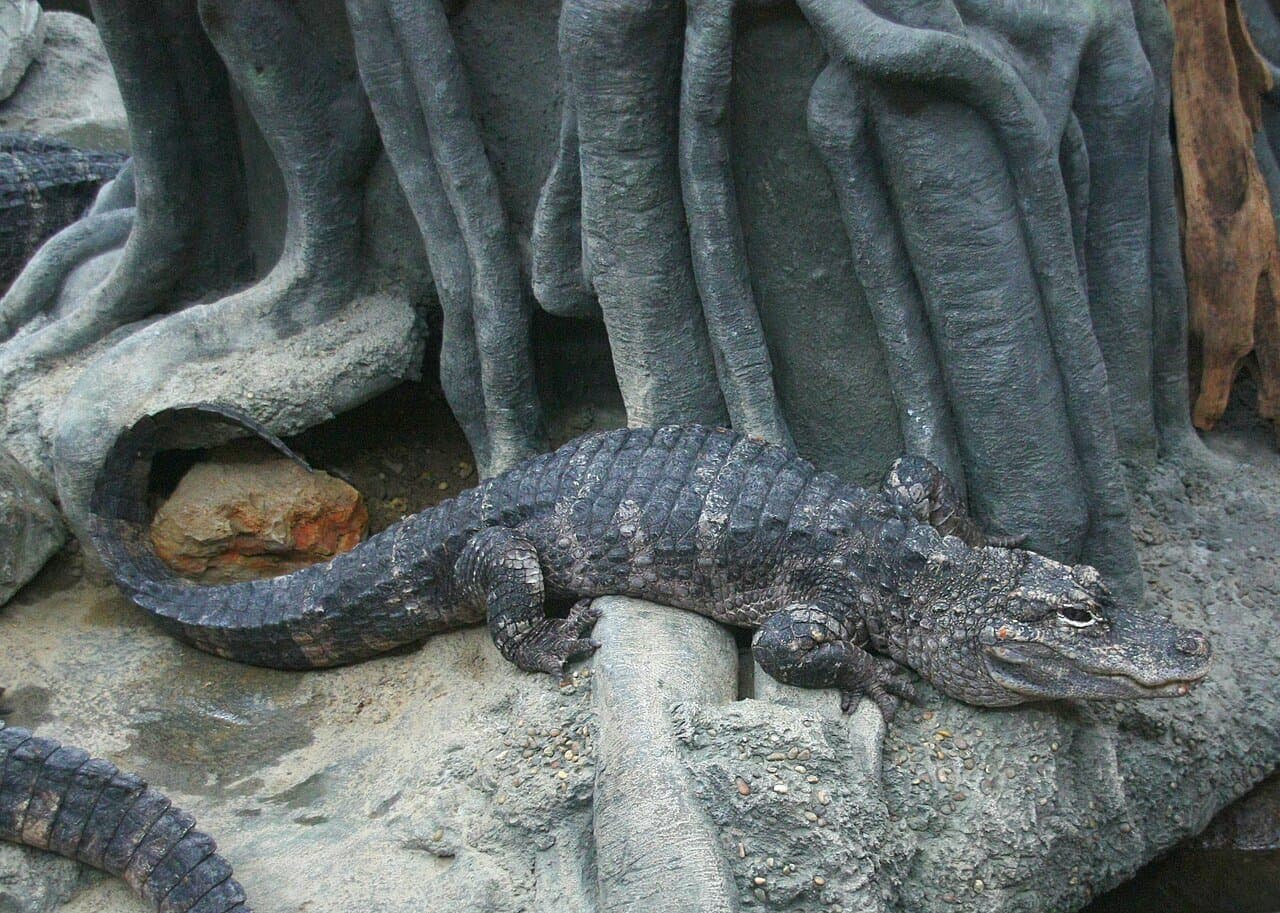
Chinese Alligator
Alligator sinensis
A small, critically endangered alligator from China's Yangtze River that digs long underground tunnels.
Checking teacher reviews…
About the Chinese Alligator
Chinese alligators usually grow to about 5 feet long, about half the size of the biggest American alligators, and most weigh less than 50 pounds. They have sturdy heads and slightly upturned snouts. They are the only alligators outside the Americas and live in slow fresh waters of the lower Yangtze River. Their blunt teeth crush snails, crabs and other shelled animals, and they also eat insects, fish, young ducks and rodents.[1]
Quick facts
- Scientific name
- Alligator sinensis[1]
- Size
- Usually about 5 feet; up to about 7 feet.[1]
- Weight
- Usually under 50 pounds; up to 85.[1]
- Lifespan
- Up to 70 years in human care.[1]
- Diet
- Snails, crustaceans, insects and fish, plus young waterfowl and rodents.[1]
- Habitat
- Slow-moving fresh water, lakes and marshes.[1]
- Where it lives
- The lower Yangtze River region of China.[1]
- Group life
- Mostly nocturnal; young may stay with their mother for years.[1]
- Babies
- Usually fewer than 2 dozen eggs, up to 4 dozen.[1]
- Conservation status
- Critically Endangered (IUCN Red List, assessed 2017).[2]
Fun facts
Vocabulary
- crocodilian
- A member of the reptile group that includes crocodiles, alligators, caimans and gharials.
- burrow
- A hole or tunnel an animal digs to live in.
- cold-blooded
- Having a body temperature that changes with the surroundings; also called ectothermic.
- nocturnal
- Active mainly at night.
- critically endangered
- A conservation label meaning a species faces an extremely high risk of dying out in the wild.
See it in person
- Smithsonian's National ZooWashington, D.C. · Reptile Discovery CenterSee this animal on the zoo's website ↗
These zoos had this animal when we gathered our information, but animals sometimes move. Check the zoo's website or contact the zoo before you visit.
Sources
- [1] Smithsonian's National Zoo & Conservation Biology Institute. “Chinese alligator.” https://nationalzoo.si.edu/animals/chinese-alligator (accessed 2026-10-08)
- [2] IUCN Red List of Threatened Species. “Alligator sinensis (Chinese Alligator).” https://www.iucnredlist.org/species/867/3146005 (accessed 2026-10-08)
Facts last checked 2026-10-08.


