
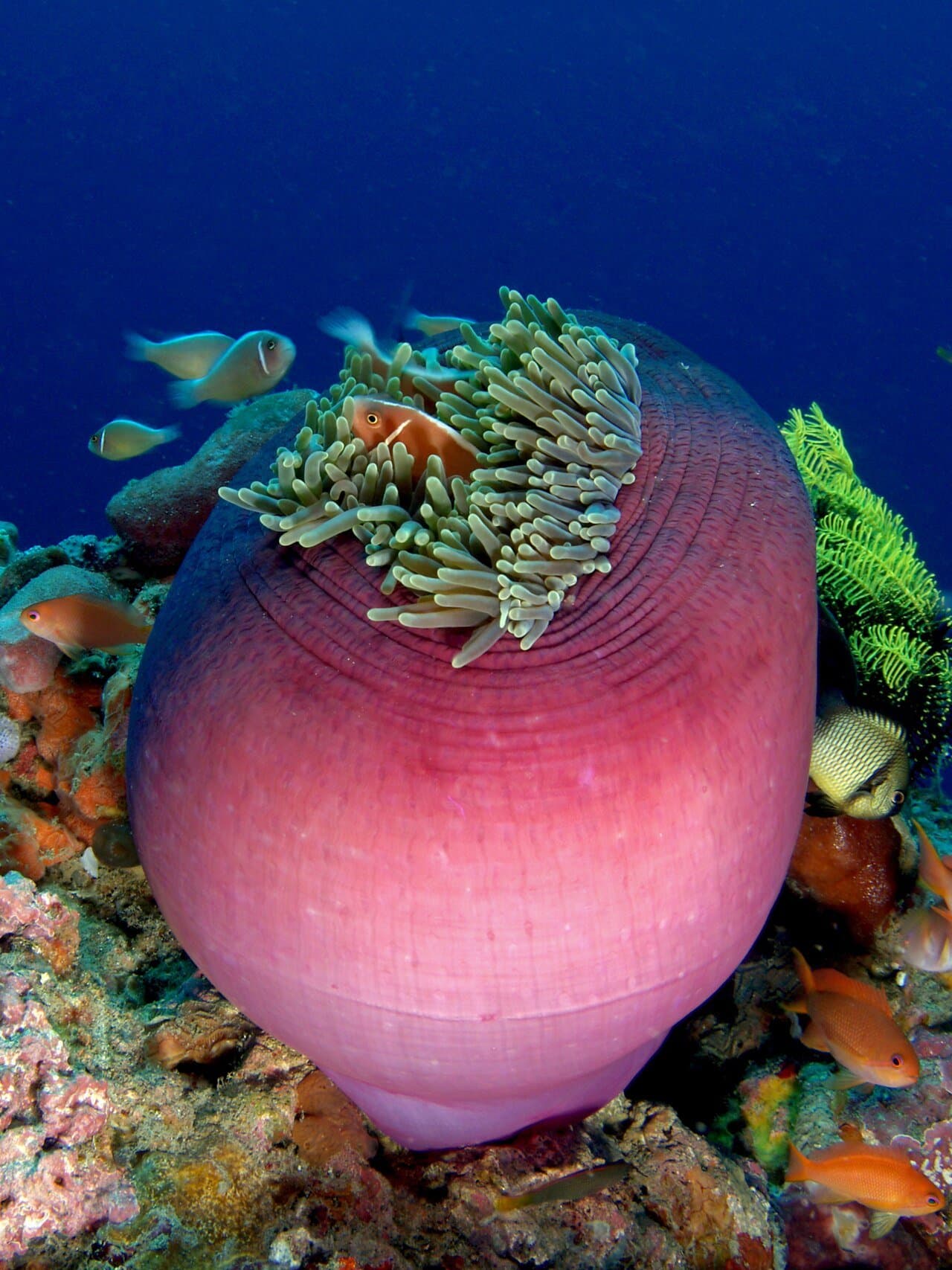
Corals and Sea Anemones
Class Anthozoa
Stinging, flower-like sea animals; reef-building corals create giant structures like the Great Barrier Reef.
Checking teacher reviews…
About the Corals and Sea Anemones
Corals and sea anemones belong to a group called Anthozoa. Like jellies, they are cnidarians, which means 'stinging needles,' and they have stinging cells. Their bodies are arranged in a circle around a central mouth. They live from shallow shores to deep ocean trenches, but reef-building corals live only in shallow tropical and subtropical waters. Many corals get food from tiny algae living inside them.[1]
Quick facts
- Scientific name
- Class Anthozoa[1]
- Diet
- Food from algae living inside them, plus plankton and small animals caught with stinging cells.[1]
- Habitat
- Oceans, from shallow shores to deep trenches; reefs in shallow tropical seas.[1]
- Where it lives
- Oceans worldwide, most in warm tropical waters.[1]
- Group life
- Corals often live in colonies of many polyps.[1]
- Babies
- New corals grow by budding, from broken pieces or from eggs.[1]
- Conservation status
- Varies by species. Coral reefs are threatened by disease, climate change, overfishing and pollution.[1]
Fun facts
Vocabulary
- polyp
- A small, tube-shaped animal with tentacles around its mouth.
- coral reef
- A huge structure built by colonies of tiny coral animals.
- cnidarian
- An animal with stinging cells, such as a coral, anemone or jelly.
- symbiosis
- A close relationship between two different kinds of living things that often helps both.
- invertebrate
- An animal without a backbone.
See it in person
- Smithsonian's National ZooWashington, D.C. · AmazoniaSee this animal on the zoo's website ↗
These zoos had this animal when we gathered our information, but animals sometimes move. Check the zoo's website or contact the zoo before you visit.
Sources
- [1] Smithsonian's National Zoo & Conservation Biology Institute. “Corals and sea anemones (Anthozoa).” https://nationalzoo.si.edu/animals/corals-and-sea-anemones-anthozoa (accessed 2026-10-08)
Facts last checked 2026-10-08.

