
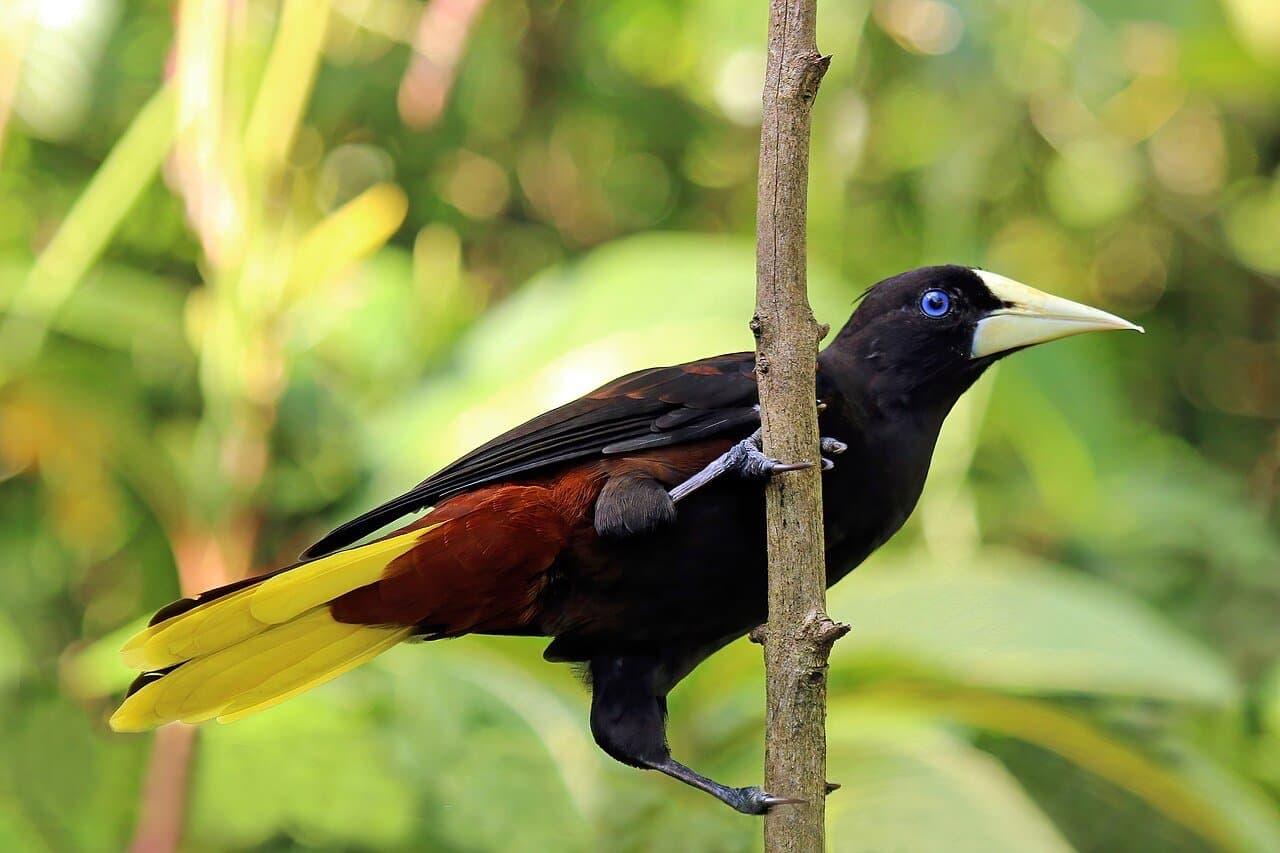
Crested Oropendola
Psarocolius decumanus
A black-and-yellow South American bird that weaves long hanging nests, with males that bow upside down to court females.
Checking teacher reviews…
About the Crested Oropendola
Crested oropendolas are 14 to 18 inches long and mostly black, with a chestnut rump, a bright yellow tail, a pale bill and blue eyes. They live along forest edges and clearings from Costa Rica to northeastern Argentina, including much of the Amazon. Females weave teardrop-shaped nests of palm leaves high in trees; some reach 6 feet long.[1]
Quick facts
- Scientific name
- Psarocolius decumanus[1]
- Size
- 14 to 18 inches long.[1]
- Weight
- 6 to 10.5 ounces.[1]
- Lifespan
- Up to 20 years in human care.[1]
- Diet
- Omnivore. Large insects, fruit, nectar and small animals.[1]
- Habitat
- Tropical lowland forest edges and clearings.[1]
- Where it lives
- Costa Rica to northeastern Argentina, including much of the Amazon.[1]
- Group life
- Flocks of 15 to 30 females and 3 or 4 males.[1]
- Babies
- Two eggs, incubated 17 to 19 days.[1]
- Conservation status
- Least Concern (IUCN Red List, assessed 2020).[2]
Fun facts
Vocabulary
- brood parasite
- A bird that lays its eggs in another bird's nest for them to raise.
- pendulum
- Something that swings back and forth from a fixed point.
- courtship
- Behavior animals use to attract a mate.
- colony
- A large group of animals of one kind that live or nest together.
- least concern
- A conservation label meaning a species is widespread and not at risk of dying out soon.
See it in person
- San Francisco Zoo & GardensSan Francisco, California · BirdsSee this animal on the zoo's website ↗
These zoos had this animal when we gathered our information, but animals sometimes move. Check the zoo's website or contact the zoo before you visit.
Sources
- [1] San Francisco Zoo & Gardens. “Crested Oropendola.” https://www.sfzoo.org/crested-oropendola/ (accessed 2026-10-02)
- [2] IUCN Red List of Threatened Species. “Psarocolius decumanus (Crested Oropendola).” https://www.iucnredlist.org/species/22723982/138239106 (accessed 2026-10-02)
Facts last checked 2026-10-02.


