
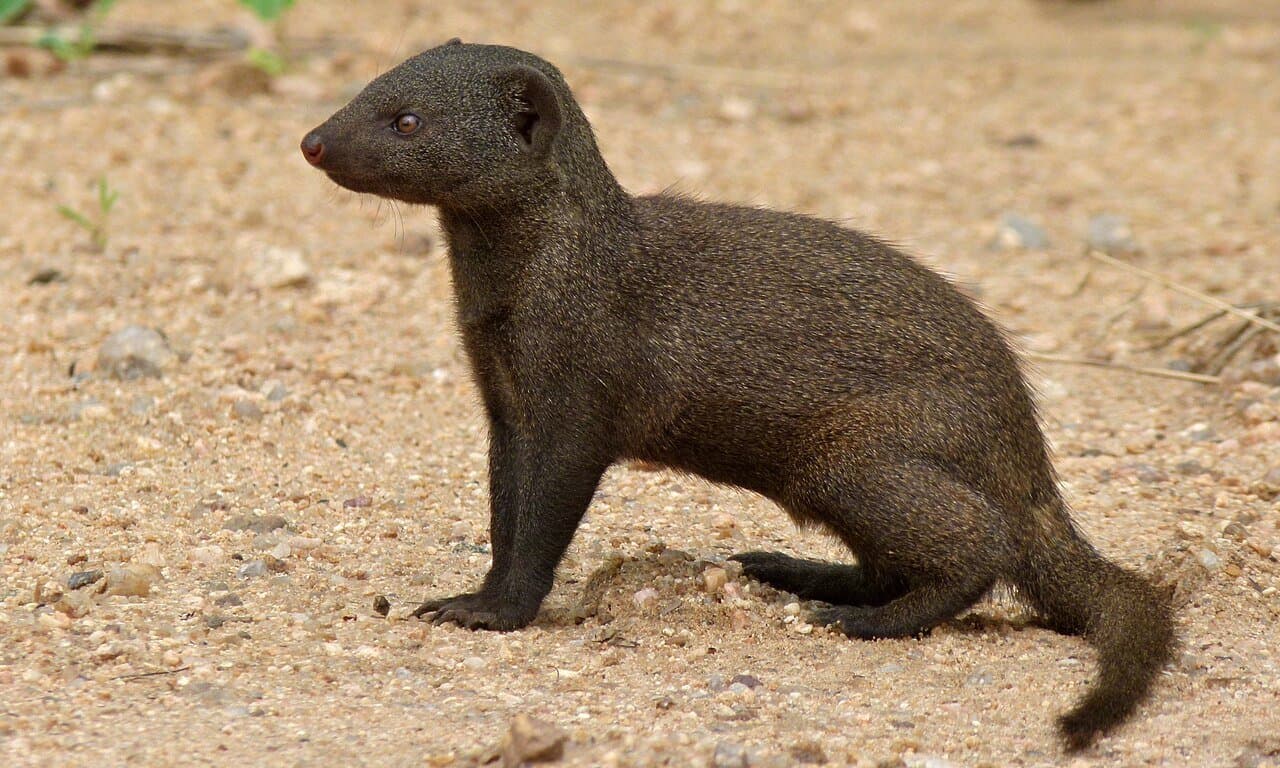
Dwarf Mongoose
Helogale parvula
Africa's smallest carnivore, a social mongoose that lives in packs led by a dominant female.
Checking teacher reviews…
About the Dwarf Mongoose
Dwarf mongooses are only 7 to 10 inches long, including the tail, and males weigh about 11 ounces. They are the smallest carnivores in Africa. They live in savannas, woodlands and scrub from Somalia and Ethiopia to South Africa and Namibia, often sleeping in termite mounds. They eat mostly insects, plus spiders, scorpions, small animals, eggs and fruit.[1]
Quick facts
- Scientific name
- Helogale parvula[1]
- Size
- 7 to 10 inches long, including a 4.7- to 8-inch tail.[1]
- Weight
- About 11 ounces; females slightly smaller.[1]
- Lifespan
- Up to 18 years.[1]
- Diet
- Mostly insects, plus spiders, scorpions, small animals, eggs and fruit.[1]
- Habitat
- Savannas, woodlands, brush and mountain scrub, often near termite mounds.[1]
- Where it lives
- Eastern and southern Africa, from Somalia and Ethiopia to South Africa and Namibia.[1]
- Group life
- Packs of about 12, up to 32. Active during the day.[1]
- Babies
- About 4 young after a 49- to 56-day pregnancy.[1]
- Conservation status
- Least Concern (IUCN Red List, assessed 2015).[2]
Fun facts
Vocabulary
- pack
- A group of animals that live and hunt together.
- matriarch
- A female who leads a family or group.
- diurnal
- Active mainly during the day.
- carnivore
- An animal that eats mostly meat.
- least concern
- A conservation label meaning a species is widespread and not at risk of dying out soon.
See it in person
- Smithsonian's National ZooWashington, D.C. · Small Mammal HouseSee this animal on the zoo's website ↗
These zoos had this animal when we gathered our information, but animals sometimes move. Check the zoo's website or contact the zoo before you visit.
Sources
- [1] Smithsonian's National Zoo & Conservation Biology Institute. “Dwarf mongoose.” https://nationalzoo.si.edu/animals/dwarf-mongoose (accessed 2026-10-08)
- [2] IUCN Red List of Threatened Species. “Helogale parvula (Common Dwarf Mongoose).” https://www.iucnredlist.org/species/41609/45206516 (accessed 2026-10-08)
Facts last checked 2026-10-08.
