
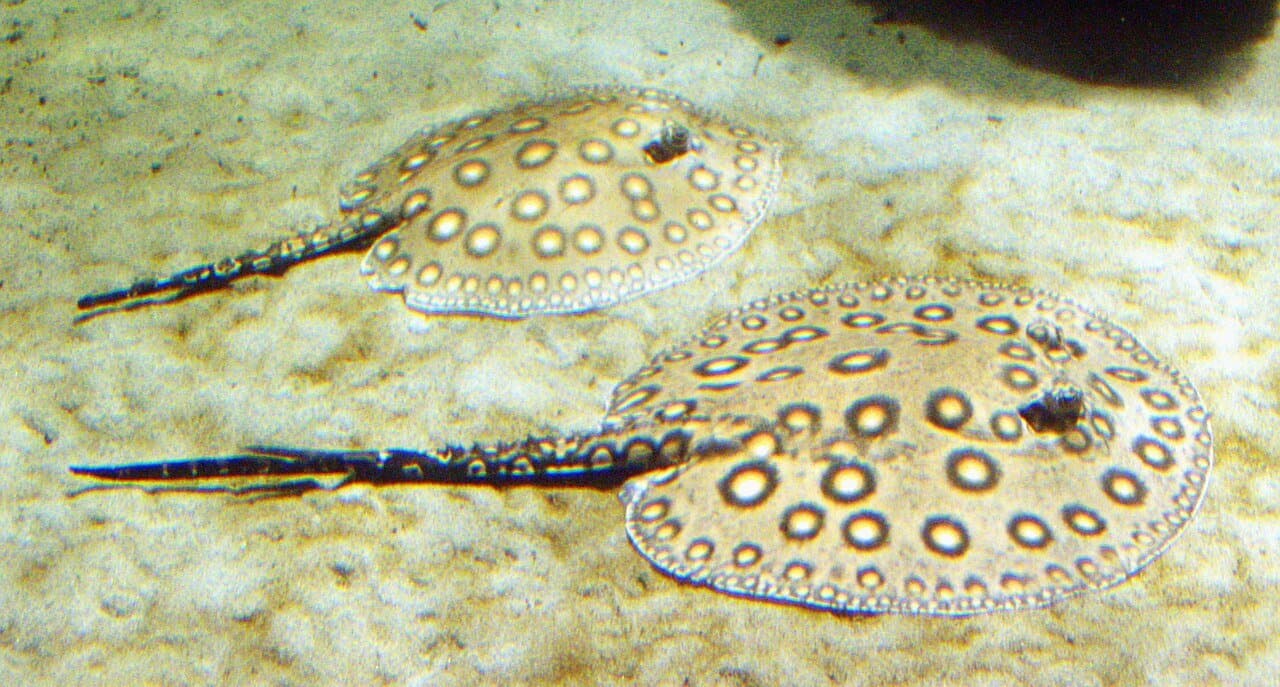
Freshwater Stingray
Potamotrygon species, including Potamotrygon motoro
One of the few rays that live in rivers instead of the ocean, a flat Amazon fish with a stinging tail spine.
Checking teacher reviews…
About the Freshwater Stingray
Freshwater stingrays can grow to about 18 inches across, with tails up to a foot long. Their eyes are on top of the body, and their mouths and gill slits are underneath. Unlike most rays, which live in the sea, they live in fresh water in the Amazon River system. They eat crustaceans and other invertebrates, crushing clams and mussels with strong jaws, and sometimes small fish.[1]
Quick facts
- Scientific name
- Potamotrygon species, including Potamotrygon motoro[1]
- Size
- Up to about 18 inches across; tail up to 1 foot.[1]
- Lifespan
- 5 to 10 years in human care.[1]
- Diet
- Crustaceans and other invertebrates, clams, mussels and sometimes small fish.[1]
- Habitat
- Fresh water.[1]
- Where it lives
- The Amazon River system in South America.[1]
- Babies
- 2 to 6 live pups, about once a year.[1]
- Conservation status
- Least Concern for Potamotrygon motoro (IUCN Red List, assessed 2024).[2]
Fun facts
Vocabulary
- cartilage
- A tough, bendy material that makes up the skeletons of sharks and rays.
- spiracle
- An opening behind a ray's eye that helps it breathe.
- freshwater
- Water that is not salty, like most rivers and lakes.
- ovoviviparous
- Having eggs that hatch inside the mother before the young are born.
- least concern
- A conservation label meaning a species is widespread and not at risk of dying out soon.
See it in person
- Smithsonian's National ZooWashington, D.C. · AmazoniaSee this animal on the zoo's website ↗
These zoos had this animal when we gathered our information, but animals sometimes move. Check the zoo's website or contact the zoo before you visit.
Sources
- [1] Smithsonian's National Zoo & Conservation Biology Institute. “Freshwater stingray.” https://nationalzoo.si.edu/animals/freshwater-stingray (accessed 2026-10-08)
- [2] IUCN Red List of Threatened Species. “Potamotrygon motoro (Ocellate Freshwater Stingray).” https://www.iucnredlist.org/species/39404/2923869 (accessed 2026-10-08)
Facts last checked 2026-10-08.
