
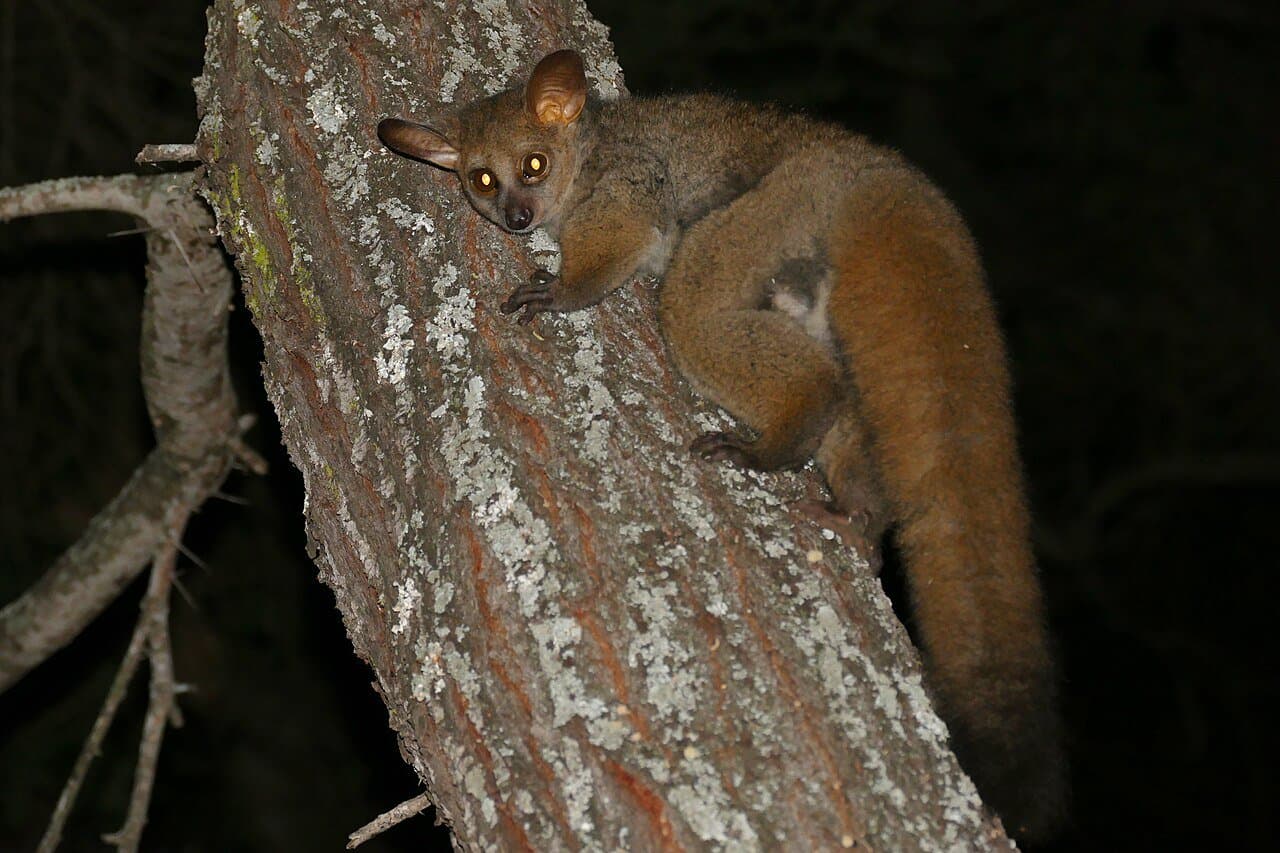
Greater Galago
Otolemur crassicaudatus
The largest bushbaby, a big-eared, woolly African primate that comes out at night to lick tree gum and catch insects.
Checking teacher reviews…
About the Greater Galago
Greater galagos, also called thick-tailed bushbabies, live in forests of East and southern Africa, from southern Sudan to South Africa and Angola. They are the largest galagos, about 12 to 15 inches long with a tail of 16 to 19 inches. Their fur is thick, woolly and silvery brown to gray. They eat mostly tree gum and sap, plus fruit and insects.[1]
Quick facts
- Scientific name
- Otolemur crassicaudatus[1]
- Size
- Body about 12 to 15 inches; tail 16 to 19 inches.[1]
- Lifespan
- More than 18 years in human care.[1]
- Diet
- Mostly tree gum and sap, plus fruit and insects.[1]
- Habitat
- Forests.[1]
- Where it lives
- East and southern Africa, from southern Sudan to South Africa and Angola.[1]
- Group life
- Sleeps in groups; forages alone at night.[1]
- Conservation status
- Least Concern (IUCN Red List, assessed 2018).[2]
Fun facts
Vocabulary
- bushbaby
- Another name for a galago, a small African primate.
- gum
- A sticky liquid that oozes from trees.
- arboreal
- Living mostly in trees.
- nocturnal
- Active mainly at night.
- primate
- A group of mammals that includes lemurs, monkeys, apes and humans.
See it in person
- Omaha's Henry Doorly Zoo and AquariumOmaha, Nebraska · Mahoney Kingdoms of the NightSee this area on the zoo's website ↗
These zoos had this animal when we gathered our information, but animals sometimes move. Check the zoo's website or contact the zoo before you visit.
Sources
- [1] Animal Diversity Web, University of Michigan. “Greater galago (Otolemur crassicaudatus).” https://animaldiversity.org/accounts/Otolemur_crassicaudatus/ (accessed 2026-10-02)
- [2] IUCN Red List of Threatened Species. “Otolemur crassicaudatus (Thick-tailed Greater Galago).” https://www.iucnredlist.org/species/15643/17963699 (accessed 2026-10-02)
Facts last checked 2026-10-02.