
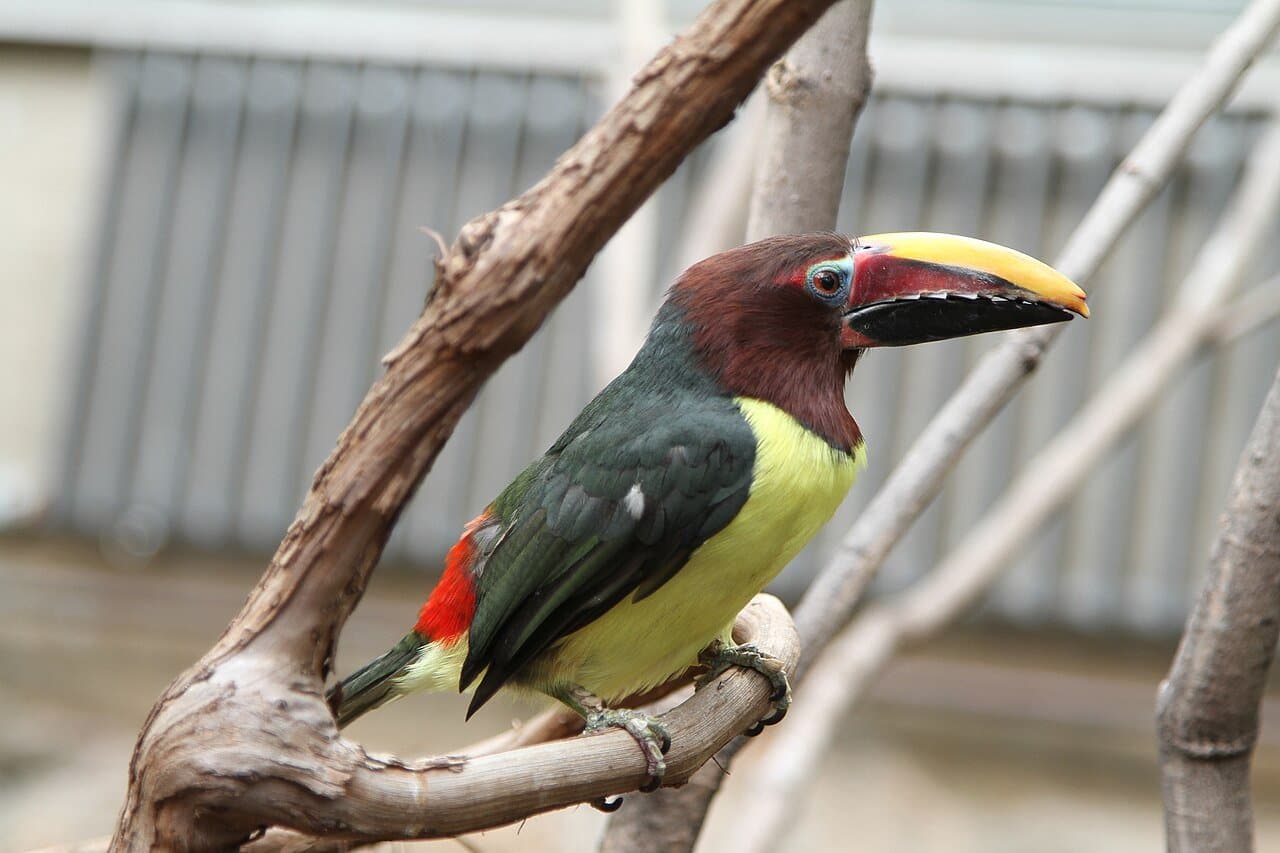
Green Aracari
Pteroglossus viridis
A small toucan from northeastern South America with a green back and a bright red, yellow and blue saw-edged bill.
Checking teacher reviews…
About the Green Aracari
Green aracaris are among the smallest aracaris, 12 to 16 inches long and 3.8 to 5.6 ounces. They have dark green backs, wings and tails and a large red, yellow and blue bill with a jagged edge. They live in tropical forests of Brazil, French Guiana, Guyana, Suriname and Venezuela, in small groups in the treetops. They eat fruit, insects, nuts, eggs and small animals.[1]
Quick facts
- Scientific name
- Pteroglossus viridis[1]
- Size
- 12 to 16 inches long.[1]
- Weight
- 3.8 to 5.6 ounces.[1]
- Diet
- Fruit, insects, nuts, eggs and small animals.[1]
- Habitat
- Tropical forests.[1]
- Where it lives
- Brazil, French Guiana, Guyana, Suriname and Venezuela.[1]
- Group life
- Small groups in the treetops.[1]
- Babies
- 2 to 4 eggs, incubated for 16 to 19 days.[1]
- Conservation status
- Least Concern (IUCN Red List, assessed 2024).[2]
Fun facts
Vocabulary
- serrated
- Having a jagged, saw-like edge.
- sexually dimorphic
- When males and females of a species look different.
- canopy
- The top layer of a forest, made of treetops.
- omnivore
- An animal that eats both plants and other animals.
- least concern
- A conservation label meaning a species is widespread and not at risk of dying out soon.
See it in person
- Smithsonian's National ZooWashington, D.C. · AmazoniaSee this animal on the zoo's website ↗
These zoos had this animal when we gathered our information, but animals sometimes move. Check the zoo's website or contact the zoo before you visit.
Sources
- [1] Smithsonian's National Zoo & Conservation Biology Institute. “Green aracari.” https://nationalzoo.si.edu/animals/green-aracari (accessed 2026-10-08)
- [2] IUCN Red List of Threatened Species. “Pteroglossus viridis (Green Aracari).” https://www.iucnredlist.org/species/22681994/264005053 (accessed 2026-10-08)
Facts last checked 2026-10-08.

