
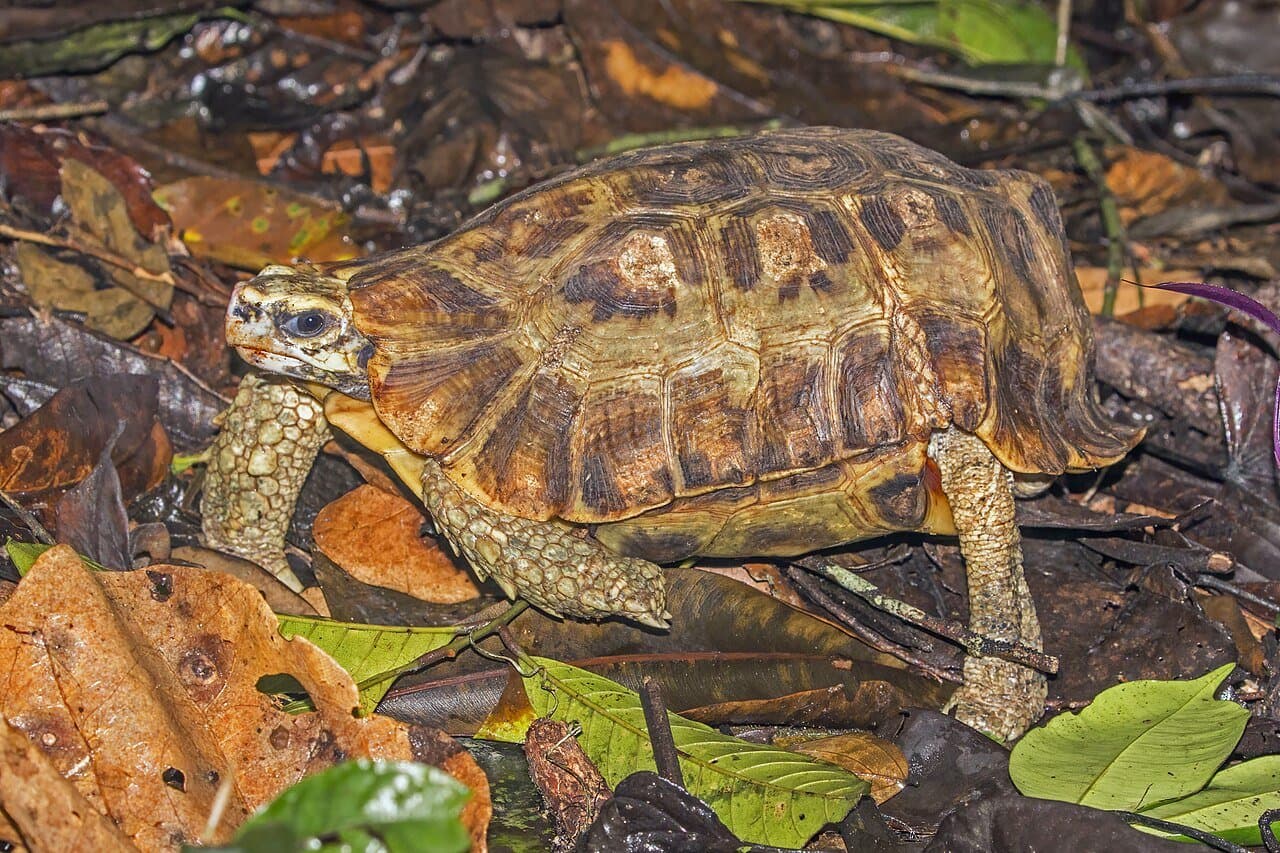
Home's Hinge-back Tortoise
Kinixys homeana
A small West African forest tortoise with a sharply angled shell that eats mostly insects, unusual for a tortoise.
Checking teacher reviews…
About the Home's Hinge-back Tortoise
Home's hinge-back tortoises are 5.5 to 11.5 inches long and weigh 1.7 to 2.4 pounds. Their tan to dark brown shells slope sharply down at the back. They live in forests along the Gulf of Guinea in West Africa, from Liberia to Cameroon. Unusually for tortoises, they eat mostly insects, plus mushrooms, seeds, plants, worms, snails and frogs.[1]
Quick facts
- Scientific name
- Kinixys homeana[1]
- Size
- 5.5 to 11.5 inches long.[1]
- Weight
- 1.7 to 2.4 pounds.[1]
- Lifespan
- Possibly about 50 years.[1]
- Diet
- Omnivore. Mostly insects, plus mushrooms, seeds, plants, worms, snails, frogs and carrion.[1]
- Habitat
- Humid tropical forests.[1]
- Where it lives
- Coastal West Africa along the Gulf of Guinea, from Liberia to Cameroon.[1]
- Group life
- Males are territorial. Mostly active by day.[1]
- Babies
- 1 to 4 eggs, once or twice a year.[1]
- Conservation status
- Critically Endangered (IUCN Red List, assessed 2019).[2]
Fun facts
Vocabulary
- carapace
- The top part of a turtle's shell.
- scute
- A bony plate or scale on an animal's skin or shell.
- humidity
- The amount of moisture in the air.
- omnivore
- An animal that eats both plants and other animals.
- critically endangered
- A conservation label meaning a species faces an extremely high risk of dying out in the wild.
See it in person
- Smithsonian's National ZooWashington, D.C. · Reptile Discovery CenterSee this animal on the zoo's website ↗
These zoos had this animal when we gathered our information, but animals sometimes move. Check the zoo's website or contact the zoo before you visit.
Sources
- [1] Smithsonian's National Zoo & Conservation Biology Institute. “Home's hinge-back tortoise.” https://nationalzoo.si.edu/animals/homes-hinge-back-tortoise (accessed 2026-10-08)
- [2] IUCN Red List of Threatened Species. “Kinixys homeana (Home's Hinge-back Tortoise).” https://www.iucnredlist.org/species/11003/18341580 (accessed 2026-10-08)
Facts last checked 2026-10-08.
More Turtles and Tortoises
 African Spurred TortoiseCentrochelys sulcata (also called Geochelone sulcata)
 Aldabra TortoiseAldabrachelys gigantea
 Alligator Snapping TurtleMacrochelys temminckii
 Australian Big-headed TurtleEmydura australis
 Australian Snake-necked TurtleChelodina longicollis
 Diamondback TerrapinMalaclemys terrapin
 Eastern Box TurtleTerrapene carolina
 Florida Red-Bellied TurtlePseudemys nelsoni
 Fly River TurtleCarettochelys insculpta
 Hermann's TortoiseTestudo hermanni
 Mata MataChelus fimbriata
 McCord's Box TurtleCuora mccordi
 Mojave Desert TortoiseGopherus agassizii
 Painted River TerrapinBatagur borneoensis
 Pancake TortoiseMalacochersus tornieri
 Radiated TortoiseAstrochelys radiata
 Red-Footed TortoiseChelonoidis carbonaria
 Spider TortoisePyxis arachnoides
 Spotted Pond TurtleGeoclemys hamiltonii
 Spotted TurtleClemmys guttata
 Western Pond TurtleActinemys marmorata
 Western Santa Cruz Galápagos TortoiseChelonoidis porteri
 Yellow-spotted Amazon River TurtlePodocnemis unifilis