
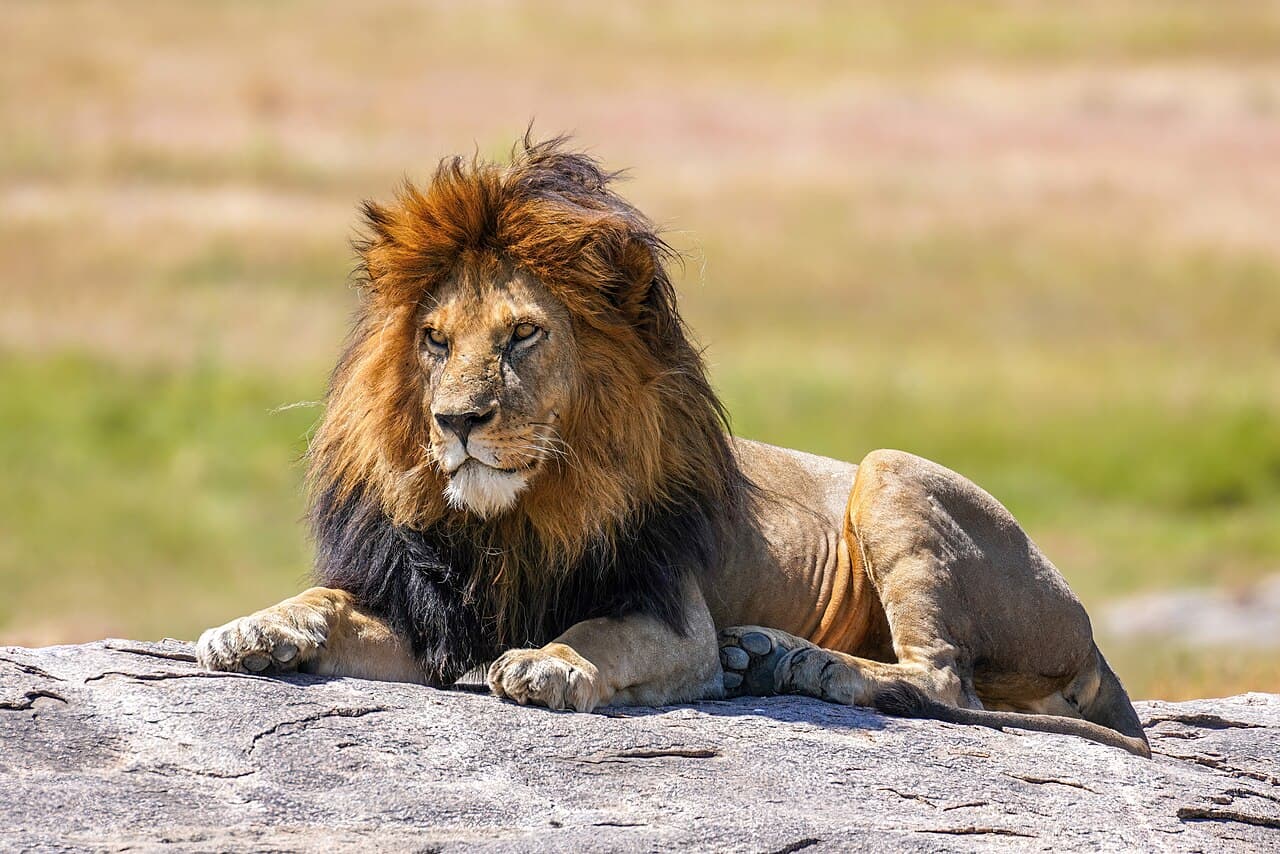
Lion
Panthera leo
A large wild cat of the African savanna that lives in family groups called prides.
Checking teacher reviews…
About the Lion
The lion lives mostly on the savannas and grasslands of Africa, and a small group also lives in the Gir Forest of India. Lions live in groups called prides that can have from 3 to 30 members. Lionesses do most of the hunting and go after large animals like zebras and wildebeest. A male lion's thick mane makes him look bigger to rivals and helps protect his neck in fights.[1][2]
Quick facts
- Scientific name
- Panthera leo[2]
- Size
- 3.5 to 4 feet (1 to 1.2 meters) tall at the shoulder. Males are larger than females.[2]
- Weight
- Males: 330 to 570 pounds (150 to 260 kg). Females: 270 to 400 pounds (122 to 180 kg).[1]
- Lifespan
- In the wild, lionesses can live up to 16 years and males rarely live past 12. In human care, lions can reach their late teens or early 20s.[2]
- Diet
- Carnivore. Hunts large animals such as zebras and wildebeest.[2]
- Habitat
- Savannas and grasslands.[2]
- Where it lives
- Africa, plus a small population in the Gir Forest of India.[2]
- Group life
- Lives in prides of 3 to 30 lions, depending on how much food and space the area has.[1]
- Babies
- A mother usually has 1 to 4 cubs at a time.[2]
- Conservation status
- Vulnerable (IUCN Red List).[1]
Fun facts
Vocabulary
- pride
- A family group of lions that live and hunt together.
- carnivore
- An animal that eats mostly meat.
- savanna
- A warm, grassy area with only a few scattered trees.
- mane
- The long, thick hair that grows around the head and neck of an adult male lion.
- vulnerable
- A conservation label meaning a species faces a high risk of dying out in the wild.
See it in person
- Montgomery ZooMontgomery, Alabama · AfricaSee this area on the zoo's website ↗
- Zoo AtlantaAtlanta, Georgia · All AnimalsSee this animal on the zoo's website ↗
- San Francisco Zoo & GardensSan Francisco, California · MammalsSee this animal on the zoo's website ↗
- Omaha's Henry Doorly Zoo and AquariumOmaha, Nebraska · Scott African GrasslandsSee this area on the zoo's website ↗
- Oakland ZooOakland, California · African SavannaSee this animal on the zoo's website ↗
These zoos had this animal when we gathered our information, but animals sometimes move. Check the zoo's website or contact the zoo before you visit.
Sources
- [1] San Diego Zoo Wildlife Alliance. “Lion.” https://animals.sandiegozoo.org/animals/lion (accessed 2026-10-01)
- [2] Smithsonian's National Zoo & Conservation Biology Institute. “Lion.” https://nationalzoo.si.edu/animals/lion (accessed 2026-10-01)
Facts last checked 2026-10-01.


