
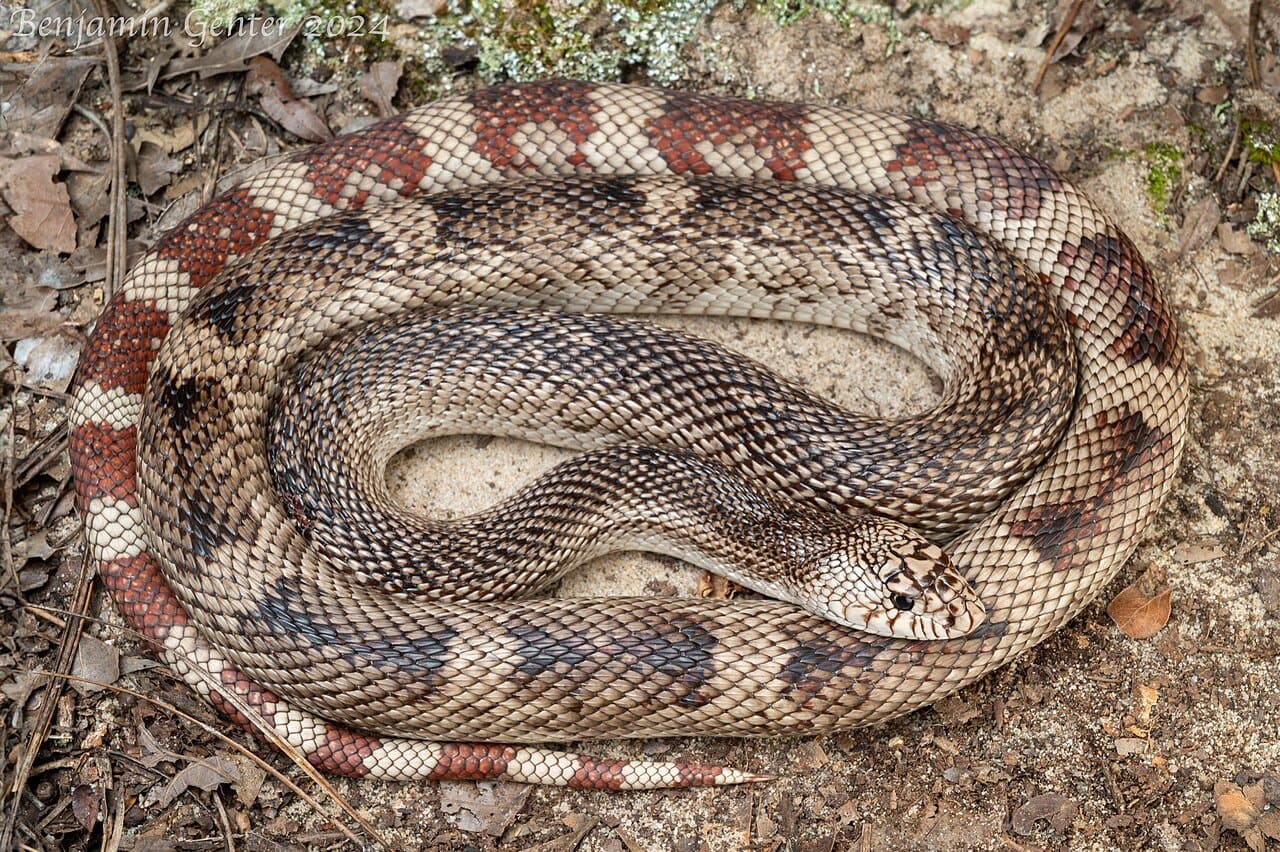
Northern Pine Snake
Pituophis melanoleucus melanoleucus
A powerful, nonvenomous constrictor of dry pine woods that digs burrows in sandy soil.
Checking teacher reviews…
About the Northern Pine Snake
Northern pine snakes can grow to about 6 feet long, making them among the largest snakes in North America. They have small, pointed heads. They live from New Jersey through the Appalachian region to South Carolina, Tennessee, Alabama and Georgia, almost always in dry upland forests, especially pine woods with sandy soil. They eat rodents, other small mammals, birds and bird eggs.[1]
Quick facts
- Scientific name
- Pituophis melanoleucus melanoleucus[1]
- Size
- Up to about 6 feet long.[1]
- Diet
- Carnivore. Rodents and other small mammals, birds and bird eggs.[1]
- Habitat
- Dry upland forests, especially pine woods with sandy soil.[1]
- Where it lives
- New Jersey and the southeastern U.S., from Virginia to Georgia and Alabama.[1]
- Babies
- Eggs laid in a chamber at the end of a burrow the female digs.[1]
- Conservation status
- Least Concern (IUCN Red List, assessed 2007, for the pine snake species as a whole).[2]
Fun facts
Vocabulary
- constrictor
- A snake that kills prey by wrapping around it and squeezing.
- burrow
- A hole or tunnel an animal digs to live in.
- nonvenomous
- Not able to inject venom.
- cold-blooded
- Having a body temperature that changes with the surroundings; also called ectothermic.
- least concern
- A conservation label meaning a species is widespread and not at risk of dying out soon.
See it in person
- Smithsonian's National ZooWashington, D.C. · Reptile Discovery CenterSee this animal on the zoo's website ↗
These zoos had this animal when we gathered our information, but animals sometimes move. Check the zoo's website or contact the zoo before you visit.
Sources
- [1] Smithsonian's National Zoo & Conservation Biology Institute. “Northern pine snake.” https://nationalzoo.si.edu/animals/northern-pine-snake (accessed 2026-10-08)
- [2] IUCN Red List of Threatened Species. “Pituophis melanoleucus.” https://www.iucnredlist.org/species/63873/12723588 (accessed 2026-10-08)
Facts last checked 2026-10-08.
More Snakes
 Amazon Tree BoaCorallus hortulana
 Ball PythonPython regius
 Black-headed PythonAspidites melanocephalus
 Boa ConstrictorBoa constrictor
 Brazilian Rainbow BoaEpicrates cenchria
 California KingsnakeLampropeltis californiae
 Cape CobraNaja nivea
 Corn SnakePantherophis guttatus
 Eastern Diamondback RattlesnakeCrotalus adamanteus
 Eastern Indigo SnakeDrymarchon couperi
 Emerald Tree BoaCorallus caninus
 False Water CobraHydrodynastes gigas
 Gray Rat SnakePantherophis spiloides
 Green Tree PythonMorelia viridis
 Inland TaipanOxyuranus microlepidotus
 Kenyan Sand BoaEryx colubrinus
 Mangrove SnakeBoiga dendrophila
 Northern CopperheadAgkistrodon contortrix mokasen
 Pacific Gopher SnakePituophis catenifer catenifer
 Puff AdderBitis arietans
 Rosy BoaLichanura trivirgata
 Rough Green SnakeOpheodrys aestivus
 SidewinderCrotalus cerastes
 Timber RattlesnakeCrotalus horridus
 Timor PythonMalayopython timoriensis (also called Python timoriensis)