
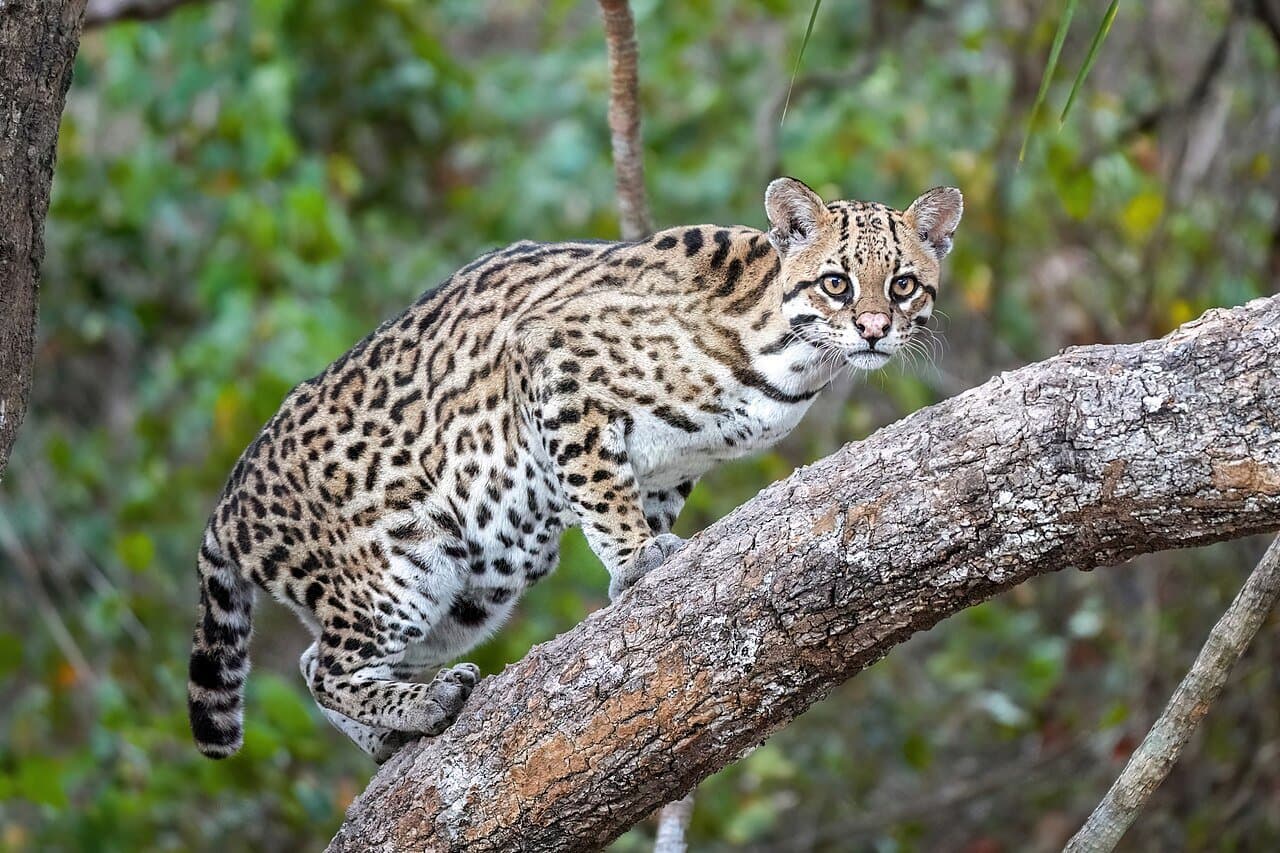
Ocelot
Leopardus pardalis
A small, secretive spotted cat of the Americas, from southern Texas to Argentina, that hunts mostly at night.
Checking teacher reviews…
About the Ocelot
Ocelots live from the southern tip of Texas to northern Argentina, in places with thick plants like chaparral and rainforest. They are 29 to 39 inches long, and males weigh 15 to 34 pounds. Their golden fur is covered with doughnut-shaped spots, stripes and blotches. They hunt mostly small rodents, plus birds, snakes, lizards, rabbits, fish and crabs.[1]
Quick facts
- Scientific name
- Leopardus pardalis[1]
- Size
- 29 to 39 inches long, plus a 10- to 16-inch tail.[1]
- Weight
- Females 14.5 to 25 pounds; males 15 to 34 pounds.[1]
- Diet
- Carnivore. Mostly small rodents, plus birds, reptiles, rabbits, fish and crabs.[1]
- Habitat
- Areas with thick plants, such as chaparral and tropical rainforest.[1]
- Where it lives
- Southern Texas to northern Argentina.[1]
- Group life
- Solitary. Active mostly at night.[1]
- Babies
- Usually one kitten, sometimes up to four.[1]
- Conservation status
- Least Concern (IUCN Red List, assessed 2014).[2]
Fun facts
Vocabulary
- chaparral
- Dry land covered with dense, shrubby plants.
- nocturnal
- Active mainly at night.
- rosette
- A ring-shaped spot on a cat's fur.
- den
- A sheltered place where an animal rests or raises young.
- least concern
- A conservation label meaning a species is widespread and not at risk of dying out soon.
See it in person
- Omaha's Henry Doorly Zoo and AquariumOmaha, Nebraska · Desert DomeSee this area on the zoo's website ↗
These zoos had this animal when we gathered our information, but animals sometimes move. Check the zoo's website or contact the zoo before you visit.
Sources
- [1] San Diego Zoo Wildlife Alliance. “Ocelot.” https://animals.sandiegozoo.org/animals/ocelot (accessed 2026-10-02)
- [2] IUCN Red List of Threatened Species. “Leopardus pardalis (Ocelot).” https://www.iucnredlist.org/species/11509/97212355 (accessed 2026-10-02)
Facts last checked 2026-10-02.

