
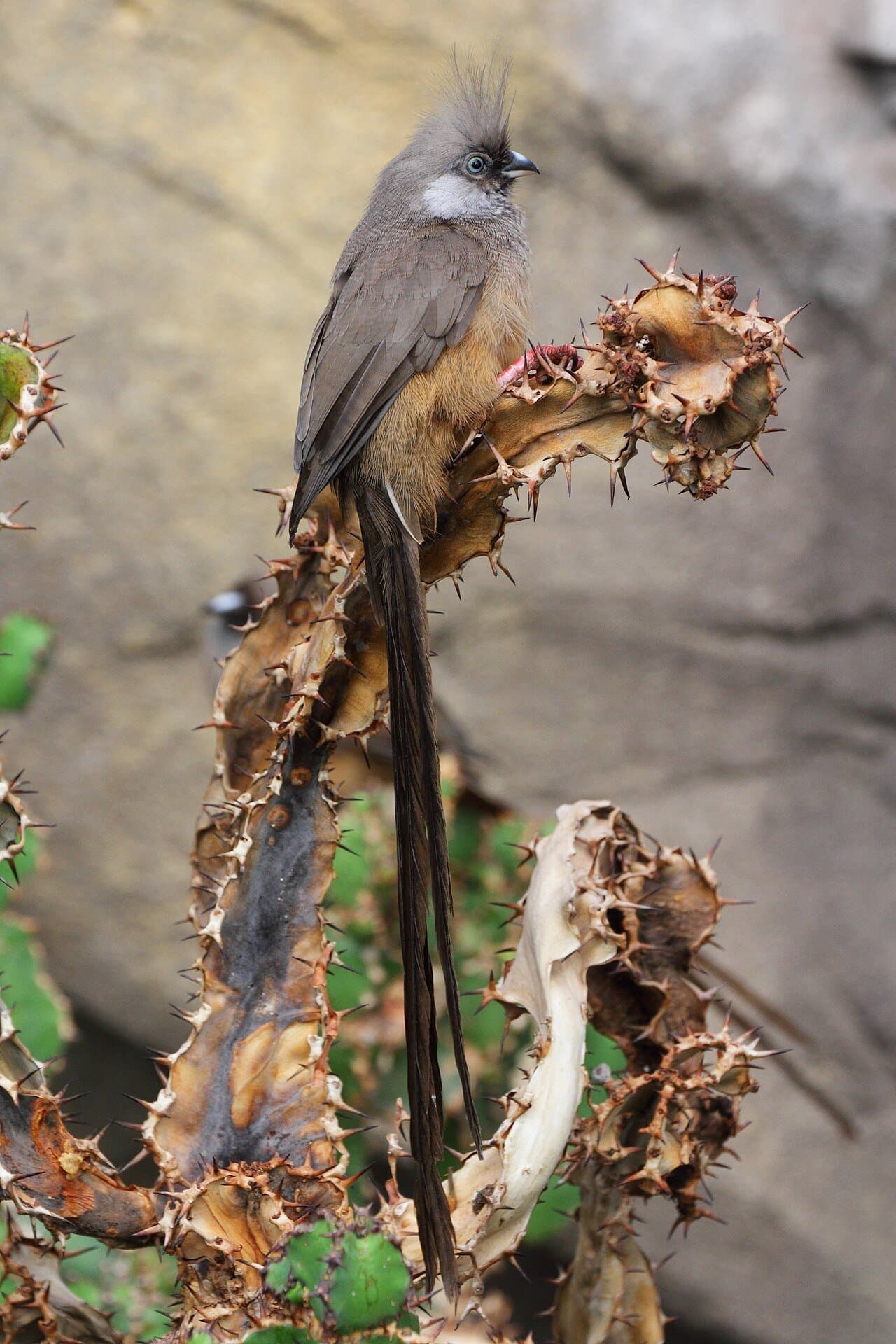
Speckled Mousebird
Colius striatus
A scruffy, long-tailed African bird that scampers through bushes like a mouse and can hang upside down to eat fruit.
Checking teacher reviews…
About the Speckled Mousebird
Speckled mousebirds are the largest mousebirds, about 14 inches long, but half of that is tail, and they weigh only about 2 ounces. They have dark faces, brownish-gray bodies and pale crests. They live in dry woodlands, brushlands, gardens and orchards across sub-Saharan Africa and eat ripe and unripe fruit, seeds, plants and aloe nectar.[1]
Quick facts
- Scientific name
- Colius striatus[1]
- Size
- About 14 inches long, half of it tail.[1]
- Weight
- Up to about 2 ounces.[1]
- Lifespan
- 8 to 10 years.[1]
- Diet
- Mostly fruit, seeds and plants, plus aloe nectar.[1]
- Habitat
- Savanna, open woodland, brushland and gardens.[1]
- Where it lives
- Sub-Saharan Africa.[1]
- Group life
- Flocks of 15 to 20.[1]
- Babies
- 2 or 3 eggs.[1]
- Conservation status
- Least Concern (IUCN Red List, assessed 2016).[2]
Fun facts
Vocabulary
- torpor
- A short, deep rest that saves energy, like a mini-hibernation.
- preen
- To clean and arrange feathers with the beak.
- crest
- A tuft of feathers on top of a bird's head.
- flock
- A group of birds that live and travel together.
- least concern
- A conservation label meaning a species is widespread and not at risk of dying out soon.
See it in person
- Oakland ZooOakland, California · African SavannaSee this animal on the zoo's website ↗
These zoos had this animal when we gathered our information, but animals sometimes move. Check the zoo's website or contact the zoo before you visit.
Sources
- [1] Oakland Zoo. “Speckled Mousebird.” https://www.oaklandzoo.org/animals/speckled-mousebird/ (accessed 2026-10-02)
- [2] IUCN Red List of Threatened Species. “Colius striatus (Speckled Mousebird).” https://www.iucnredlist.org/species/22683776/93000568 (accessed 2026-10-02)
Facts last checked 2026-10-02.
