
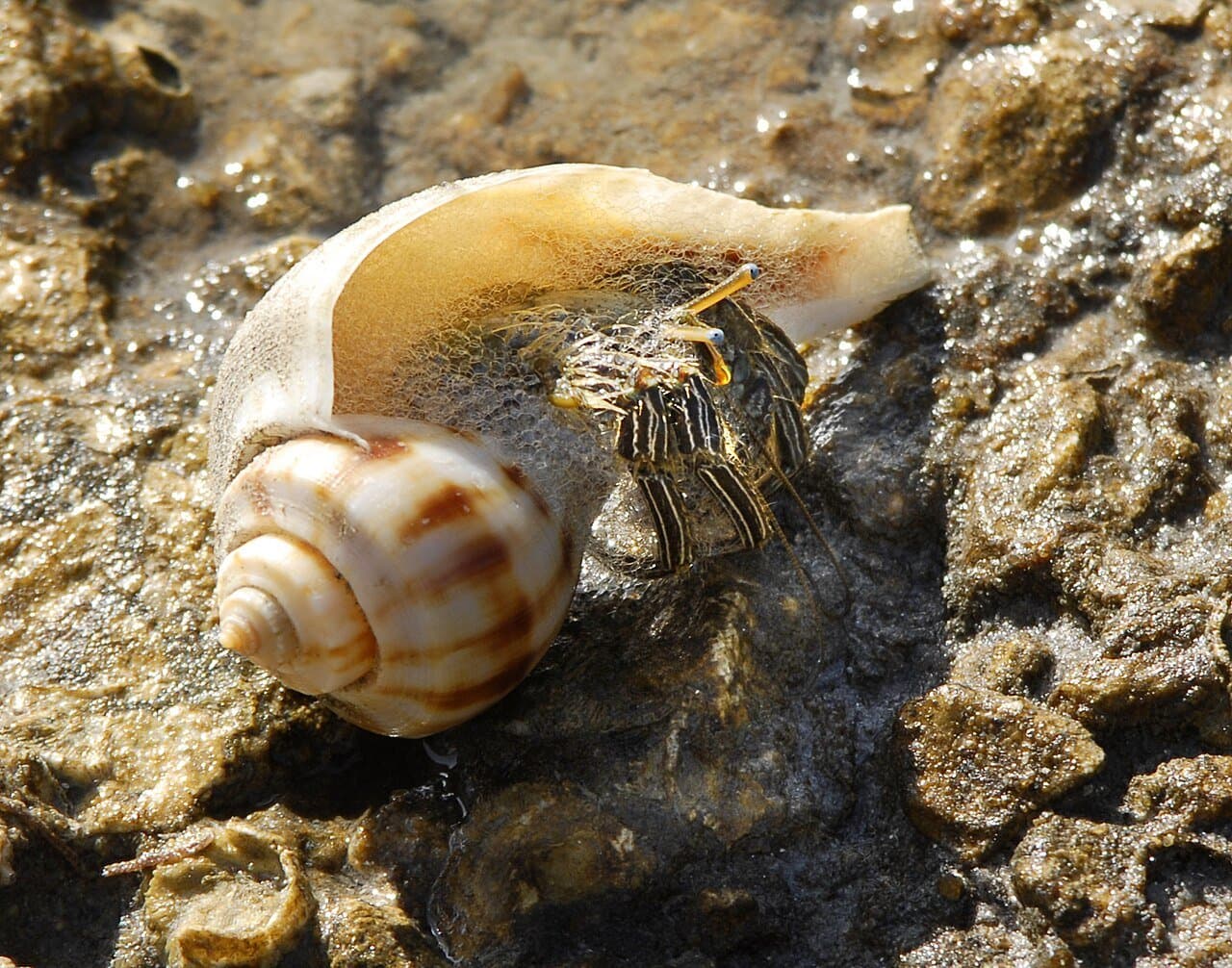
Striped Hermit Crab
Clibanarius vittatus
A small Atlantic hermit crab with striped legs that politely trades shells with other crabs instead of fighting.
Checking teacher reviews…
About the Striped Hermit Crab
Striped hermit crabs have bodies about 1.25 inches long, or about 3 inches including legs. They are greenish to dark brown with white and brown stripes on their walking legs. They live along warm Atlantic coasts in bays, mangroves, beaches and mudflats, in both salty and brackish water. They scavenge sea grasses, dead animals and other bits of food, mostly on the sea floor but also on land.[1]
Quick facts
- Scientific name
- Clibanarius vittatus[1]
- Size
- Body about 1.25 inches; about 3 inches with legs.[1]
- Diet
- Scavenger. Sea grasses, plants, dead animals and other bits of food.[1]
- Habitat
- Bays, mangroves, sandy beaches, mudflats and other shores.[1]
- Where it lives
- Warm Atlantic coasts.[1]
- Group life
- Social; shares space with other crabs.[1]
- Babies
- 1,000 to 30,000 eggs carried by the female; up to 180,000 a year.[1]
Fun facts
Vocabulary
- exoskeleton
- A hard outer covering that supports and protects an animal's body.
- crustacean
- An animal with a hard shell and jointed legs, such as a crab, shrimp or lobster.
- scavenger
- An animal that eats dead plants or animals it finds.
- plankton
- Tiny living things that drift in water.
- brackish
- Slightly salty.
See it in person
- Smithsonian's National ZooWashington, D.C. · Bird HouseSee this animal on the zoo's website ↗
These zoos had this animal when we gathered our information, but animals sometimes move. Check the zoo's website or contact the zoo before you visit.
Sources
- [1] Smithsonian's National Zoo & Conservation Biology Institute. “Striped hermit crab.” https://nationalzoo.si.edu/animals/striped-hermit-crab (accessed 2026-10-08)
Facts last checked 2026-10-08.

