
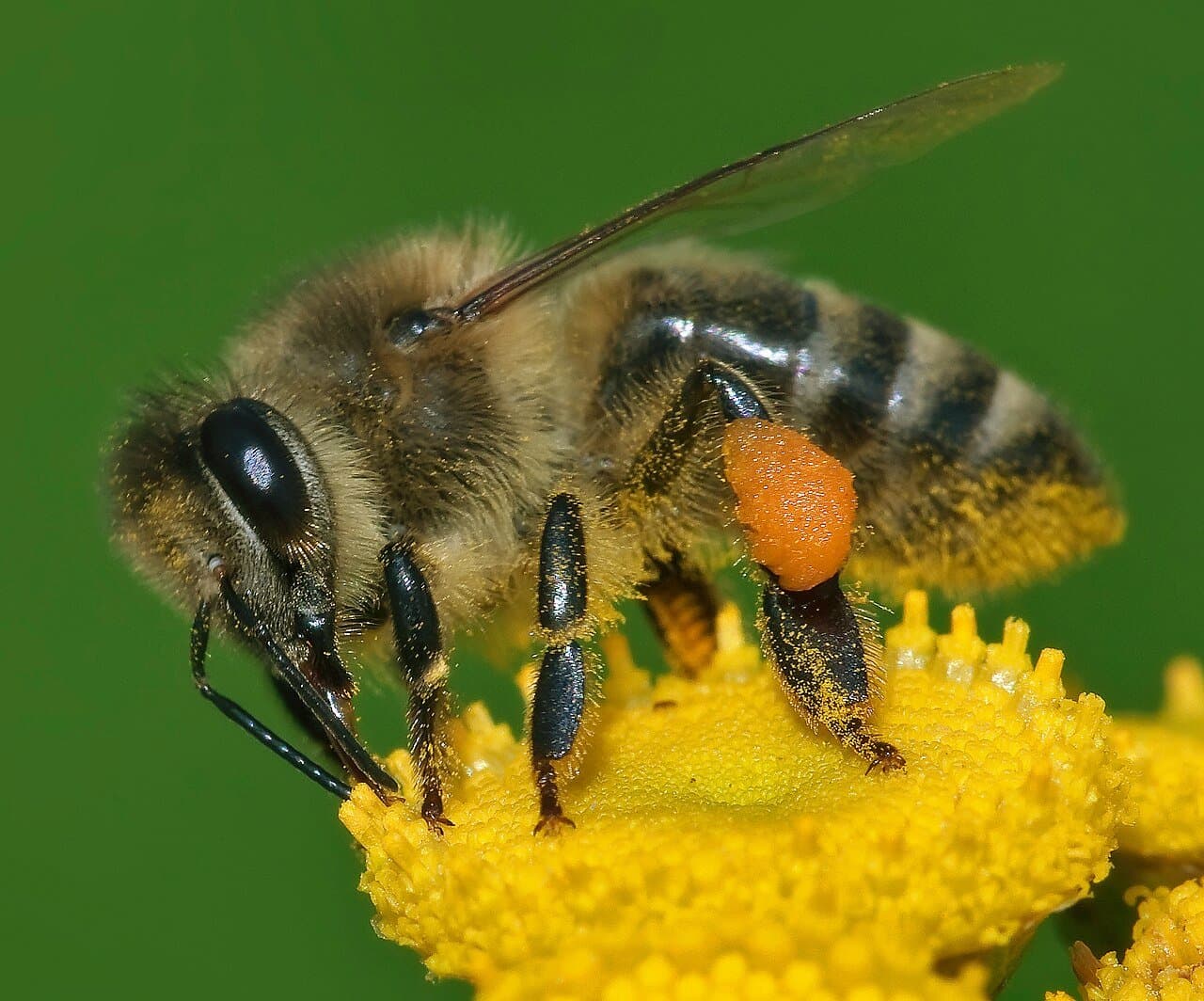
Western Honey Bee
Apis mellifera
The familiar honey-making bee, which lives in large, organized hives with a queen, drones and workers.
Checking teacher reviews…
About the Western Honey Bee
Western honey bees live in hives that can hold up to 20,000 bees in summer. Each bee belongs to one of three groups, called castes: the queen, the drones and the workers. Honey bees collect nectar from flowers, then refine and concentrate it into honey. They see the world through compound eyes.[1]
Quick facts
- Scientific name
- Apis mellifera[1]
- Diet
- Flower nectar and honey.[1]
- Habitat
- Hives.[1]
- Where it lives
- Native to Europe, Asia and Africa; introduced throughout the Americas.[1]
- Group life
- Hives of up to 20,000 in summer, with a queen, drones and workers.[1]
- Conservation status
- Common; not endangered. Not assessed by the IUCN.[1]
Fun facts
Vocabulary
- hive
- The home of a colony of bees.
- caste
- A group within an insect colony with its own job, such as workers.
- nectar
- A sweet liquid made by flowers.
- compound eye
- An eye made of many tiny lenses.
- pollinator
- An animal that carries pollen from flower to flower.
See it in person
- San Francisco Zoo & GardensSan Francisco, California · InvertebratesSee this animal on the zoo's website ↗
These zoos had this animal when we gathered our information, but animals sometimes move. Check the zoo's website or contact the zoo before you visit.
Sources
- [1] San Francisco Zoo & Gardens. “Honey Bees.” https://www.sfzoo.org/honey-bees/ (accessed 2026-10-02)
Facts last checked 2026-10-02.
More Insects
 Black Beauty Walking StickPeruphasma schultei
 Blue Death-Feigning BeetleCryptoglossa verrucosa
 Dubia RoachBlaptica dubia
 Garden Fruit ChaferPachnoda sinuata
 Giant CockroachBlaberus species
 Giant Prickly Stick InsectExtatosoma tiaratum
 Jungle NymphHeteropteryx dilatata
 Madagascar Hissing CockroachGromphadorhina portentosa
 New Guinea Walking StickEurycantha calcarata
 Orchid MantisHymenopus coronatus
 Pinacate BeetleEleodes species
 Red Harvester AntPogonomyrmex barbatus
 Velvet AntFamily Mutillidae
 White-Spotted Assassin BugPlatymeris biguttata