
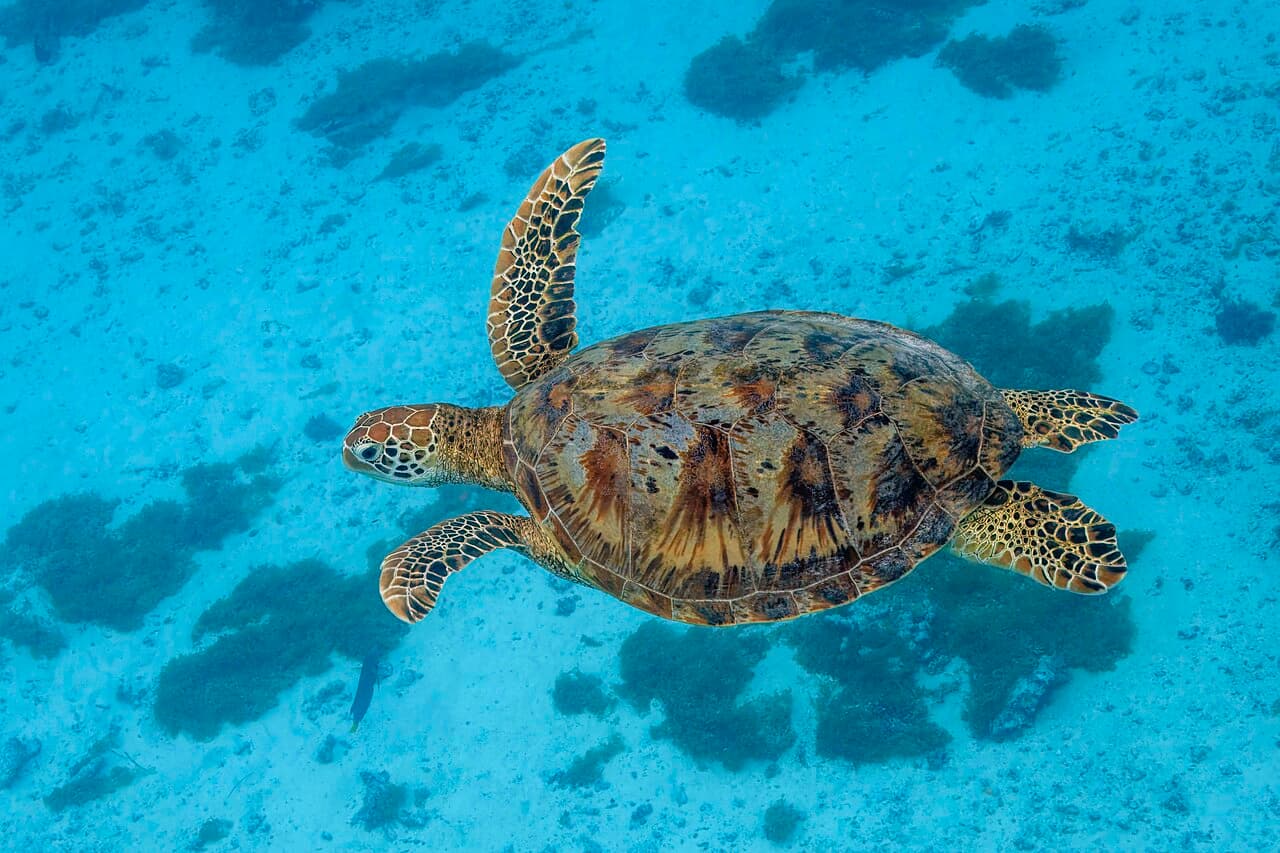
Green Sea Turtle
Chelonia mydas
A large sea turtle that grazes on seagrass and algae, named for the color of its fat rather than its shell.
Checking teacher reviews…
About the Green Sea Turtle
Green sea turtles swim in warm and mild ocean waters around the world, including the Atlantic, Pacific and Indian Oceans and the Mediterranean Sea. Adults can be 3 to 4 feet long and weigh 250 to 400 pounds. Young turtles eat both plants and small animals, but adults eat mostly seagrasses and algae. A female lays about 110 eggs in each nest she digs in the sand.[1]
Quick facts
- Scientific name
- Chelonia mydas[1]
- Size
- 3 to 4 feet long.[1]
- Weight
- 250 to 400 pounds.[1]
- Lifespan
- Estimated at 70 years or more. Females mature at 25 to 35 years old.[1]
- Diet
- Adults are herbivores that eat mostly seagrasses and algae. Juveniles eat both plants and animals.[1]
- Habitat
- Subtropical and temperate ocean waters. Females nest on sandy beaches.[1]
- Where it lives
- Atlantic, Pacific and Indian Oceans and the Mediterranean Sea. Nests in more than 80 countries.[1]
- Babies
- About 110 eggs per nest. Eggs incubate in the sand for about two months.[1]
- Conservation status
- Protected under the U.S. Endangered Species Act: some populations are Endangered and others are Threatened.[1]
Fun facts
- Green sea turtles are named for the color of their fat, not their shells.[1]
- The temperature of the sand decides whether baby turtles hatch as males or females.[1]
- A female green sea turtle may be 25 to 35 years old before she lays her first eggs.[1]
- Green turtles nest on beaches in more than 80 countries.[1]
Vocabulary
- algae
- Simple plant-like living things that grow in water.
- seagrass
- Flowering plants that grow underwater in shallow parts of the ocean.
- hatchling
- A baby animal that has just come out of its egg.
- incubation
- Keeping eggs warm so the babies inside can grow and hatch.
- bycatch
- Animals that get caught by accident in fishing gear meant for other fish.
Sources
- [1] NOAA Fisheries. “Green Turtle.” https://www.fisheries.noaa.gov/species/green-turtle (accessed 2026-10-01)
Facts last checked 2026-10-01.