
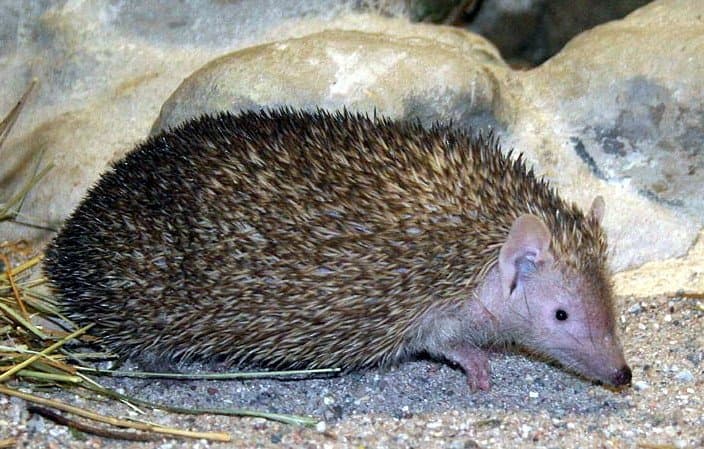
Lesser Hedgehog Tenrec
Echinops telfairi
A small, spiny, insect-eating mammal of Madagascar that looks like a hedgehog but is more closely related to moles and shrews.
Checking teacher reviews…
About the Lesser Hedgehog Tenrec
Lesser hedgehog tenrecs live in southern and southwestern Madagascar, in scrublands, dry forests, savannas and grasslands. They are up to 7 inches long and weigh less than half a pound. Their spines are special hairs. They hunt at night using their whiskers and strong senses of smell and hearing, eating insects, eggs, spiders and fruit.[1]
Quick facts
- Scientific name
- Echinops telfairi[1]
- Size
- Up to 7 inches long.[1]
- Weight
- Less than half a pound.[1]
- Diet
- Insectivore. Insects, eggs, spiders and fruit.[1]
- Habitat
- Scrublands, semi-deserts, dry forests, coasts, savannas and grasslands.[1]
- Where it lives
- Southern and southwestern Madagascar.[1]
- Group life
- Usually solitary and active at night.[1]
- Babies
- Pregnancy lasts 40 to 60 days. Usually five to seven babies.[1]
- Conservation status
- Least Concern (IUCN Red List, assessed 2015).[2]
Fun facts
Vocabulary
- torpor
- A deep, sleep-like state that saves energy when food is scarce.
- insectivore
- An animal that eats mostly insects.
- nocturnal
- Active at night and resting during the day.
- endemic
- Found naturally in only one place.
- spine
- A sharp, stiff point on an animal's body.
See it in person
- Zoo AtlantaAtlanta, Georgia · All AnimalsSee this animal on the zoo's website ↗
Sources
- [1] Zoo Atlanta. “Lesser hedgehog tenrec.” https://zooatlanta.org/animal/lesser-hedgehog-tenrec/ (accessed 2026-10-02)
- [2] IUCN Red List of Threatened Species. “Echinops telfairi (Lesser Hedgehog Tenrec).” https://www.iucnredlist.org/species/40592/97188634 (accessed 2026-10-02)
Facts last checked 2026-10-02.