
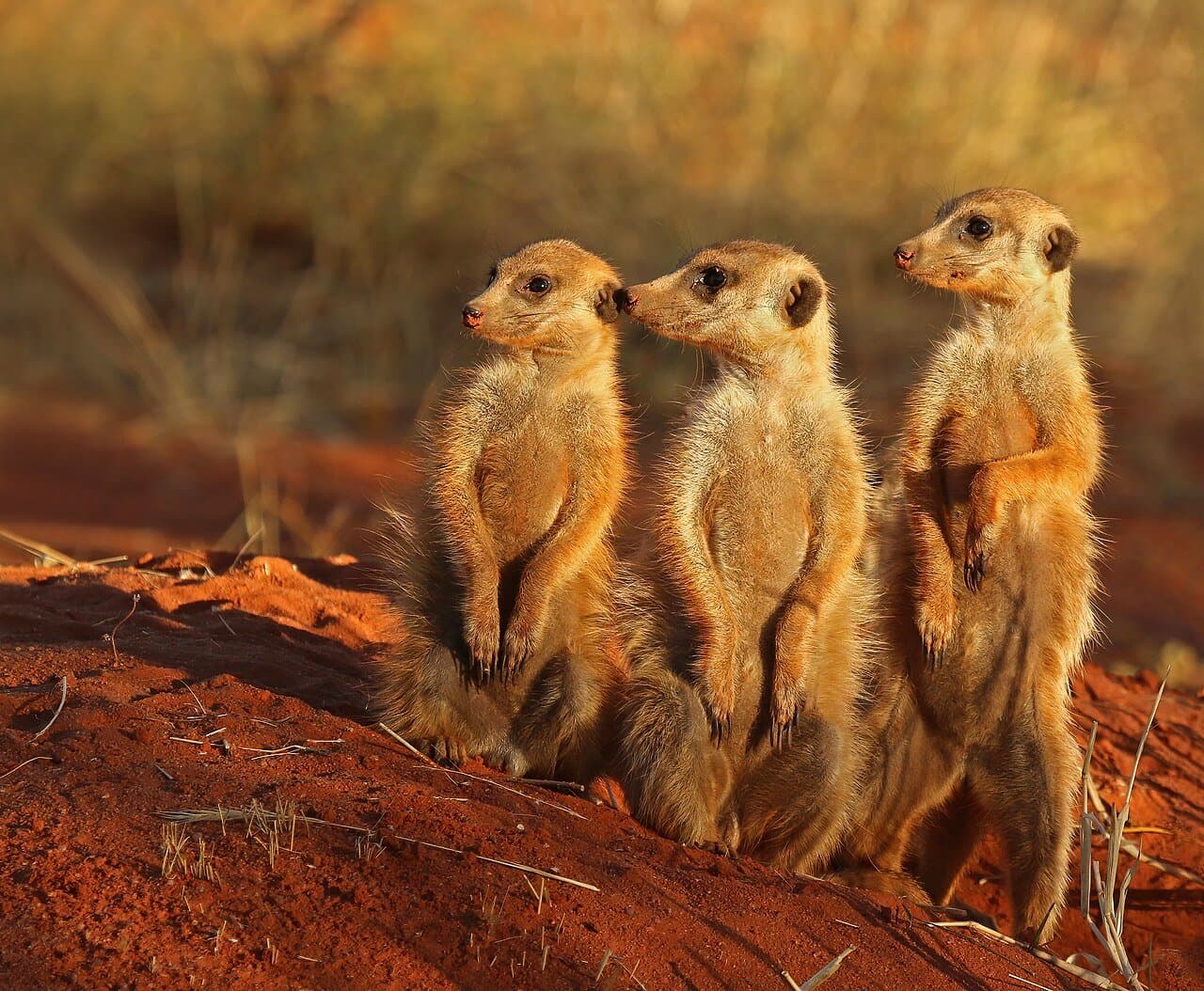
Meerkat
Suricata suricatta
A small, social desert mammal of southern Africa, also called the slender-tailed meerkat, that takes turns standing guard.
Checking teacher reviews…
About the Meerkat
Slender-tailed meerkats live in grasslands, dry savannas and deserts across southern Africa, including the Kalahari Desert. They live in groups called mobs of 10 to 30. While the mob looks for food, one meerkat acts as a lookout and barks an alarm if it sees a predator such as an eagle, hawk or snake. Meerkats eat insects, spiders, scorpions, small animals, eggs, leaves and fruit.[1]
Quick facts
- Scientific name
- Suricata suricatta[1]
- Size
- 17 to 24 inches long including the tail, about 20 inches on average.[1]
- Weight
- About 1.5 pounds.[1]
- Diet
- Omnivore. Insects, spiders, scorpions, small vertebrates, eggs, leaves and fruit.[1]
- Habitat
- Grasslands, dry savannas and deserts.[1]
- Where it lives
- Southern Africa, including the Kalahari Desert.[1]
- Group life
- Mobs of 10 to 30, made of up to three family groups.[1]
- Babies
- Pregnancy lasts about three months. Litters average three pups.[1]
- Conservation status
- Least Concern (IUCN Red List, assessed 2015).[2]
Fun facts
Vocabulary
- mob
- A group of meerkats that live together.
- lookout
- An animal that watches for danger while others eat or rest.
- burrow
- A hole or tunnel dug in the ground by an animal.
- diurnal
- Active during the day and resting at night.
- Kalahari
- A large, dry sandy region in southern Africa.
See it in person
- Zoo AtlantaAtlanta, Georgia · All AnimalsSee this animal on the zoo's website ↗
Sources
- [1] Zoo Atlanta. “Slender-tailed Meerkat.” https://zooatlanta.org/animal/slender-tailed-meerkat/ (accessed 2026-10-02)
- [2] IUCN Red List of Threatened Species. “Suricata suricatta (Meerkat).” https://www.iucnredlist.org/species/41624/45209377 (accessed 2026-10-02)
Facts last checked 2026-10-02.