Panamanian Golden Frog
Atelopus zeteki
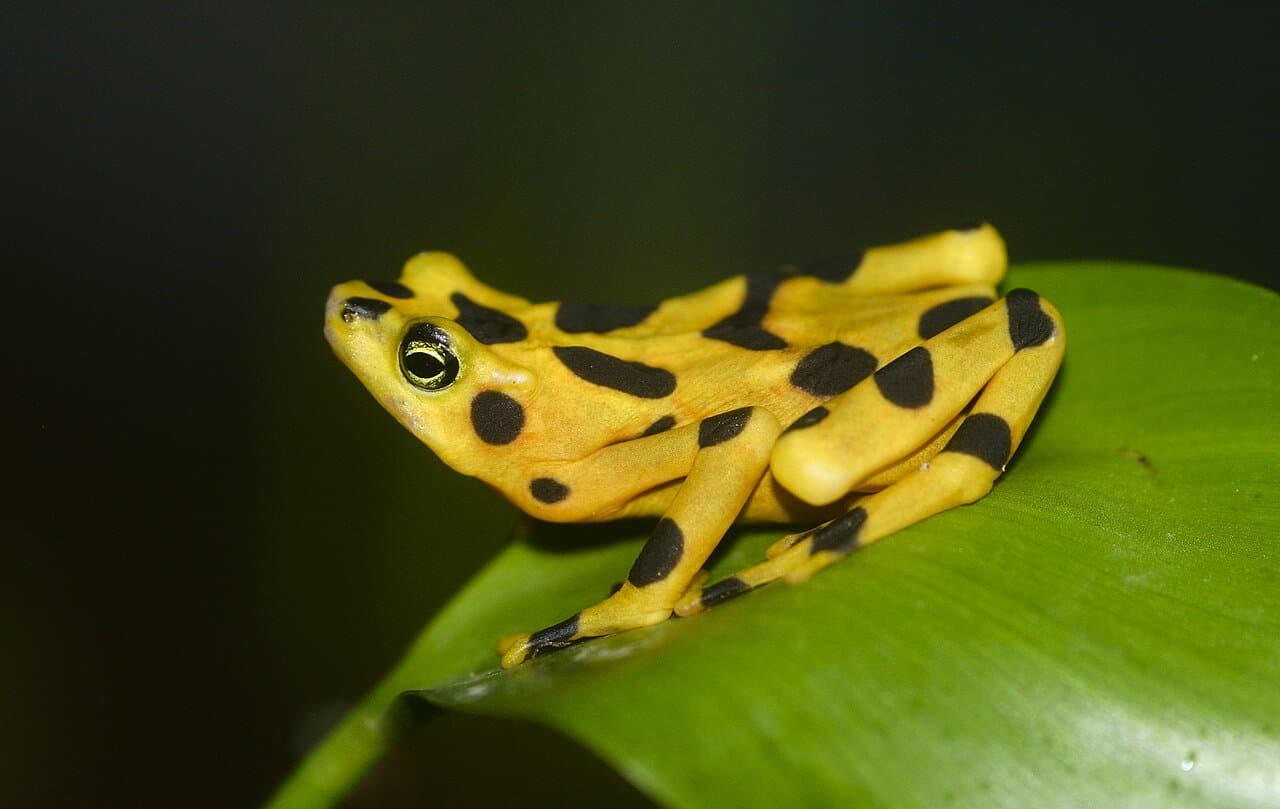
A bright golden, poisonous frog that is Panama's symbol of good luck. It has not been seen in the wild since 2009 and survives in zoo breeding programs.
Checking teacher reviews…
About the Panamanian Golden Frog
Panamanian golden frogs come from a small area on the lower mountain slopes of central Panama, in forests between rainforest and cloud forest. They eat tiny insects and other invertebrates from the leaf litter. Their bright colors warn predators that they are poisonous, though they aren't harmful to people unless put in a mouth. No two frogs have exactly the same pattern.[1]
Quick facts
- Scientific name
- Atelopus zeteki[1]
- Diet
- Insectivore. Tiny insects and invertebrates such as springtails and worms.[1]
- Habitat
- Forests between lowland rainforest and cloud forest, with clear streams.[1]
- Where it lives
- A small area of central Panama.[1]
- Babies
- Eggs laid in fast-flowing streams. Tadpoles cling to rocks.[1]
Fun facts
Vocabulary
- chytrid
- A fungus that infects the skin of amphibians and can kill them.
- semaphore
- Sending signals by waving, like flags.
- tadpole
- A young frog that lives in water and breathes with gills.
- cloud forest
- A wet mountain forest that is often covered in low clouds or fog.
- critically endangered
- A conservation label meaning a species faces an extremely high risk of dying out in the wild.
See it in person
- Zoo AtlantaAtlanta, Georgia · All AnimalsSee this animal on the zoo's website ↗
Sources
- [1] Zoo Atlanta. “Panamanian Golden Frog.” https://zooatlanta.org/animal/panamanian-golden-frog/ (accessed 2026-10-02)
- [2] IUCN Red List of Threatened Species. “Atelopus zeteki (Cerro Campana Stubfoot Toad).” https://www.iucnredlist.org/species/54563/54341110 (accessed 2026-10-02)
Facts last checked 2026-10-02.