
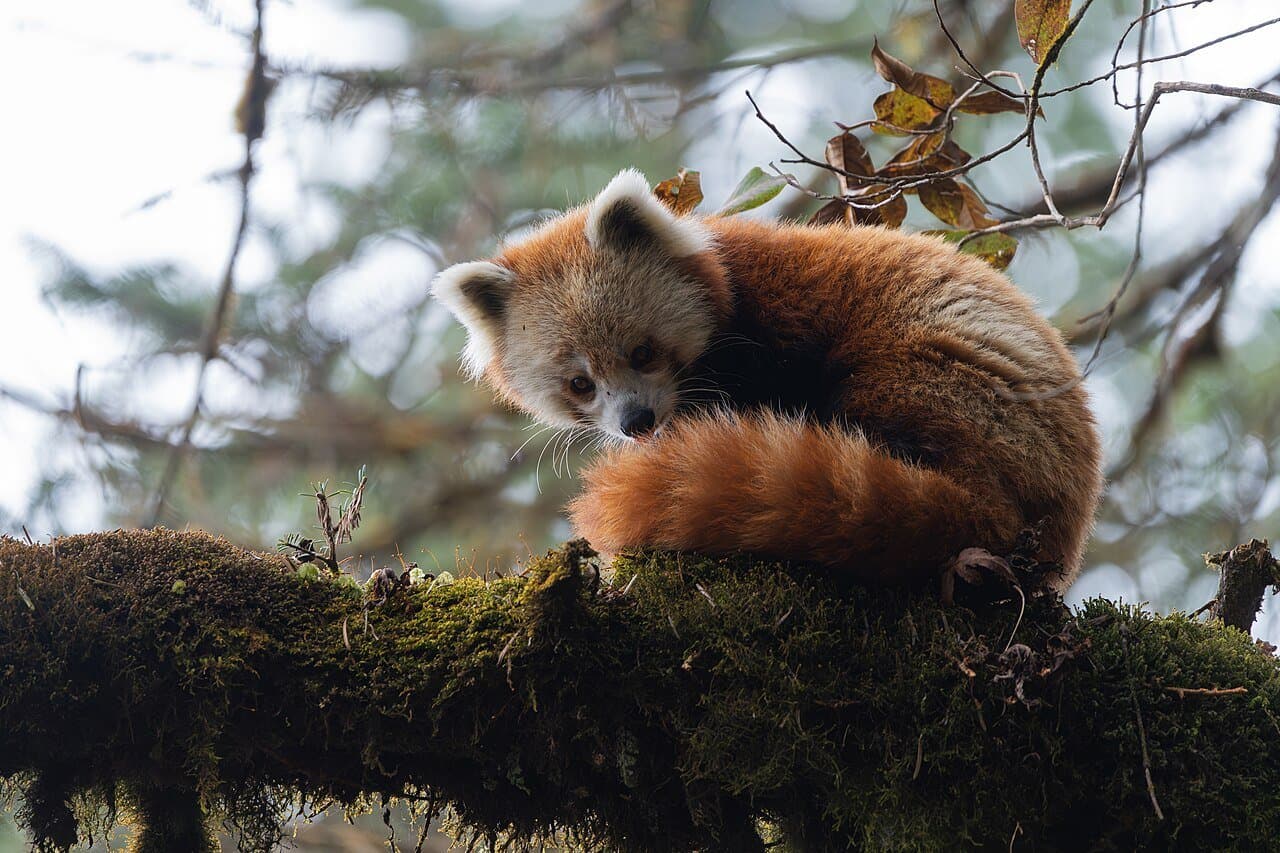
Red Panda
Ailurus fulgens
A red, bushy-tailed tree climber of Himalayan and Chinese mountain forests that eats bamboo but is not related to the giant panda.
Checking teacher reviews…
About the Red Panda
Red pandas live in cool mountain forests with bamboo growing underneath, in Nepal, Bhutan, India and China. They are about 22 to 25 inches long, plus a furry 15 to 19 inch tail. A thick, woolly undercoat keeps them warm. Like giant pandas, they have a "false thumb," an enlarged wrist bone that helps them hold bamboo.[1]
Quick facts
- Scientific name
- Ailurus fulgens[1]
- Size
- About 22 to 25 inches long, plus a 15 to 19 inch tail.[1]
- Lifespan
- About 8 to 10 years in the wild. Into their late teens in zoos.[1]
- Diet
- Omnivore. Mostly bamboo and fruit.[1]
- Habitat
- Temperate mountain forests with a bamboo understory.[1]
- Where it lives
- Nepal, Bhutan and parts of India (Himalayan red panda) and China.[1]
- Babies
- Pregnancy averages 134 days. Young open their eyes at about 18 days.[1]
- Conservation status
- Endangered (IUCN Red List, assessed 2015).[2]
Fun facts
Vocabulary
- understory
- The layer of plants growing beneath the tall trees of a forest.
- undercoat
- Short, soft fur under the longer outer hairs that keeps an animal warm.
- temperate
- Having mild weather with warm summers and cool winters.
- family
- In science, a group of closely related genera of living things.
- endangered
- A conservation label meaning a species faces a very high risk of dying out in the wild.
See it in person
- Zoo AtlantaAtlanta, Georgia · All AnimalsSee this animal on the zoo's website ↗
Sources
- [1] Zoo Atlanta. “Red Panda.” https://zooatlanta.org/animal/red-panda/ (accessed 2026-10-02)
- [2] IUCN Red List of Threatened Species. “Ailurus fulgens (Red Panda).” https://www.iucnredlist.org/species/714/110023718 (accessed 2026-10-02)
Facts last checked 2026-10-02.