
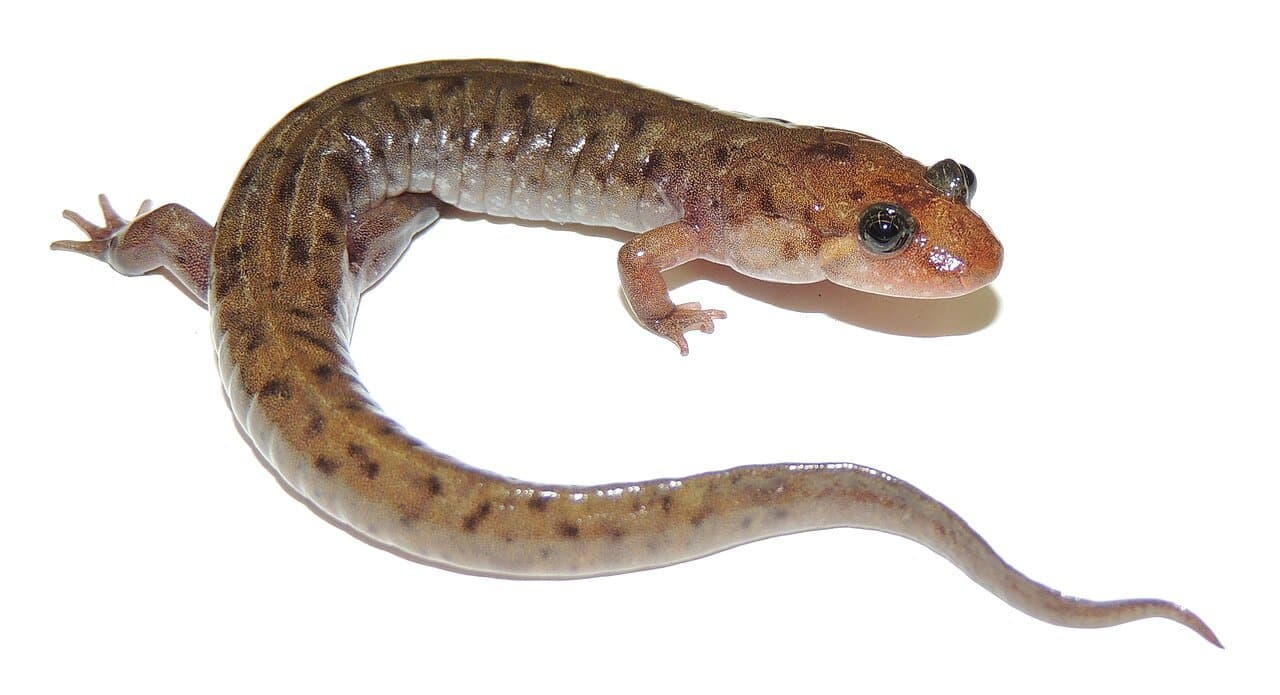
Seal Salamander
Desmognathus monticola
A lungless stream salamander of the Appalachian Mountains that breathes through its skin and hides under rocks in shallow water.
Checking teacher reviews…
About the Seal Salamander
Seal salamanders live in clear springs, seeps and small streams in forests of the Appalachian Mountains, from Pennsylvania to Georgia and Alabama. Adults have no lungs and take in oxygen through their skin. Strong feet help them move among pebbles on the bottoms of fast streams. They eat tiny water insects and other invertebrates such as caddisflies and worms.[1]
Quick facts
- Scientific name
- Desmognathus monticola[1]
- Diet
- Insectivore. Tiny water insects such as caddisflies, plus worms.[1]
- Habitat
- Clear seeps, springs and small streams in upland forests.[1]
- Where it lives
- The Appalachian Mountains, from Pennsylvania to Georgia and Alabama.[1]
- Group life
- Males defend small territories. Often active at night.[1]
- Babies
- Eggs stuck under a rock in a stream, guarded by the female. Larvae have bushy gills.[1]
- Conservation status
- Least Concern (IUCN Red List, assessed 2021).[2]
Fun facts
Vocabulary
- salamander
- An amphibian with a long tail and four legs that looks like a lizard but has smooth, moist skin.
- amphibian
- A cold-blooded animal, like a frog or salamander, that usually starts life in water.
- larva
- The young stage of an animal that looks different from the adult (plural: larvae).
- gills
- Body parts that let an animal breathe underwater.
- metamorphosis
- A big change in body form as an animal grows up, like a tadpole becoming a frog.
See it in person
- Zoo AtlantaAtlanta, Georgia · All AnimalsSee this animal on the zoo's website ↗
Sources
- [1] Zoo Atlanta. “Seal Salamander.” https://zooatlanta.org/animal/seal-salamander/ (accessed 2026-10-02)
- [2] IUCN Red List of Threatened Species. “Desmognathus monticola (Seal Salamander).” https://www.iucnredlist.org/species/59252/58075291 (accessed 2026-10-02)
Facts last checked 2026-10-02.