
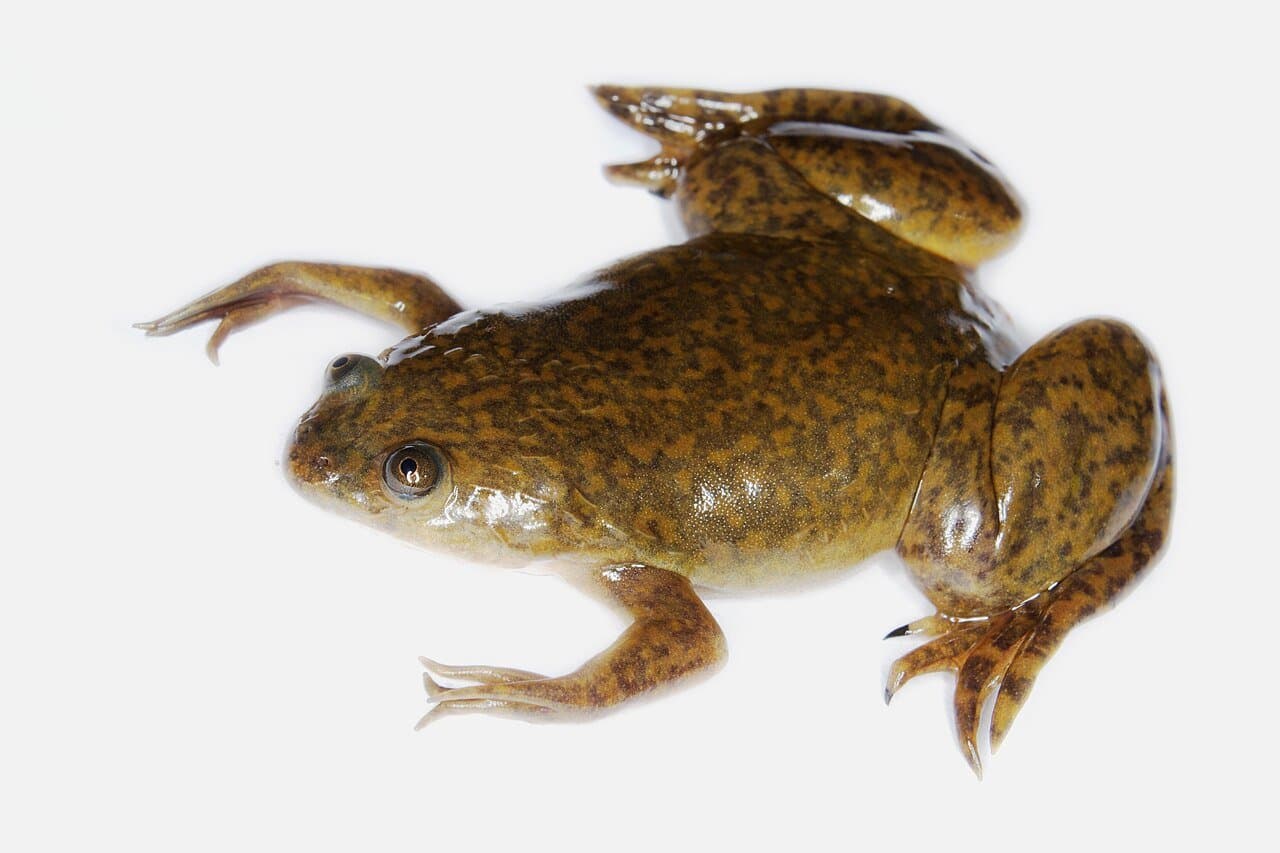
African Clawed Frog
Xenopus laevis
A flat, fully aquatic African frog with clawed toes, used widely in research and now invasive on four continents.
Checking teacher reviews…
About the African Clawed Frog
African clawed frogs have flat bodies with eyes and nostrils on top of the head. Females are about 4 to 4.5 inches long and much bigger than males. They live in eastern and southern Africa, but after escaping from labs they now live wild on four continents. Tadpoles filter food from the water, and adults scavenge insects, crustaceans, small fish, worms and snails.[1]
Quick facts
- Scientific name
- Xenopus laevis[1]
- Size
- Females 4 to 4.5 inches; males 2 to 2.5 inches.[1]
- Weight
- Females about 7 ounces; males about 2 ounces.[1]
- Lifespan
- Up to 15 years.[1]
- Diet
- Scavenger. Water insects, larvae, crustaceans, small fish, tadpoles, worms and snails.[1]
- Habitat
- Still, stagnant fresh water.[1]
- Where it lives
- Eastern and southern Africa; invasive on four other continents.[1]
- Babies
- 500 to 2,000 eggs.[1]
- Conservation status
- Least Concern (IUCN Red List, assessed 2024).[2]
Fun facts
Vocabulary
- amphibian
- A cold-blooded animal, such as a frog or salamander, that usually starts life in water and has moist skin.
- invasive species
- A plant or animal living where it doesn't belong that causes harm.
- scavenger
- An animal that eats dead plants or animals it finds.
- tadpole
- A young frog that lives in water and breathes with gills.
- least concern
- A conservation label meaning a species is widespread and not at risk of dying out soon.
See it in person
- Smithsonian's National ZooWashington, D.C. · AmazoniaSee this animal on the zoo's website ↗
These zoos had this animal when we gathered our information, but animals sometimes move. Check the zoo's website or contact the zoo before you visit.
Sources
- [1] Smithsonian's National Zoo & Conservation Biology Institute. “African clawed frog.” https://nationalzoo.si.edu/animals/african-clawed-frog (accessed 2026-10-08)
- [2] IUCN Red List of Threatened Species. “Xenopus laevis (African Clawed Frog).” https://www.iucnredlist.org/species/110466172/248905894 (accessed 2026-10-08)
Facts last checked 2026-10-08.
More Frogs
 Amazon Milk FrogTrachycephalus resinifictrix
 Cranwell's Horned FrogCeratophrys cranwelli
 Fowler's ToadAnaxyrus fowleri
 Gray Tree FrogHyla versicolor (also called Dryophytes versicolor)
 Green MantellaMantella viridis
 Lemur Leaf FrogAgalychnis lemur
 Madagascar Reed FrogHeterixalus madagascariensis
 Oriental Fire-bellied ToadBombina orientalis
 Panamanian Golden FrogAtelopus zeteki
 Poison Dart FrogsFamily Dendrobatidae (about 220 species)
 Red-Eyed Tree FrogAgalychnis callidryas
 Smoky Jungle FrogLeptodactylus pentadactylus
 Smooth-sided ToadRhaebo guttatus (also called Bufo guttatus)
 Starry Night Reed FrogHeterixalus alboguttatus
 Vietnamese Mossy FrogTheloderma corticale
 Yosemite ToadAnaxyrus canorus