
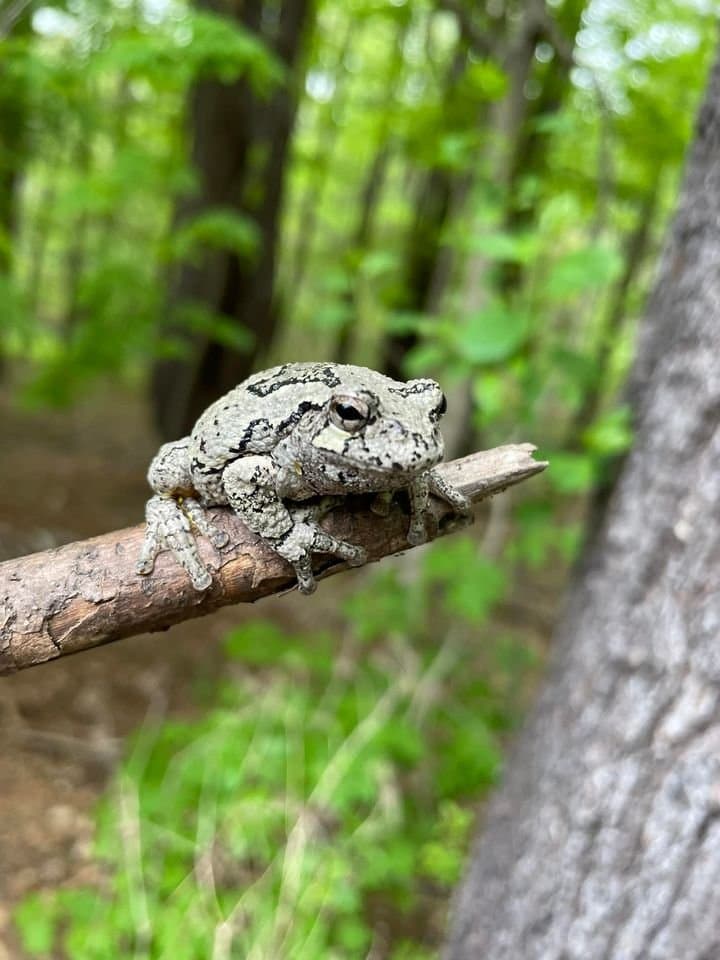
Gray Tree Frog
Hyla versicolor (also called Dryophytes versicolor)
A color-changing eastern tree frog that survives winter by partly freezing.
Checking teacher reviews…
About the Gray Tree Frog
Gray tree frogs are 1.25 to 2.25 inches long; females are a bit larger. Their lichen-like pattern can turn green, gray or brown. They live from northern Florida to central Texas and north into southeastern Canada, in forests, swamps, farms and backyards. At night they climb with special toe pads to hunt insects, mites, spiders, snails and slugs.[1]
Quick facts
- Size
- Males 1.25 to 2 inches; females 1.5 to 2.25 inches.[1]
- Lifespan
- Usually 7 to 9 years.[1]
- Diet
- Insects, mites, spiders, plant lice, snails and slugs.[1]
- Habitat
- Forests, swamps, farmland and backyards.[1]
- Where it lives
- Eastern U.S. from northern Florida to central Texas, and southeastern Canada.[1]
- Group life
- Nocturnal; males defend territories.[1]
- Conservation status
- Least Concern (IUCN Red List, assessed 2020).[2]
Fun facts
Vocabulary
- arboreal
- Living mostly in trees.
- toe pad
- A sticky pad on the toes that helps a frog climb.
- hibernate
- To spend the winter in a deep, sleep-like state.
- nocturnal
- Active mainly at night.
- least concern
- A conservation label meaning a species is widespread and not at risk of dying out soon.
See it in person
- Smithsonian's National ZooWashington, D.C. · AmazoniaSee this animal on the zoo's website ↗
These zoos had this animal when we gathered our information, but animals sometimes move. Check the zoo's website or contact the zoo before you visit.
Sources
- [1] Smithsonian's National Zoo & Conservation Biology Institute. “Gray tree frog.” https://nationalzoo.si.edu/animals/gray-tree-frog (accessed 2026-10-08)
- [2] IUCN Red List of Threatened Species. “Dryophytes versicolor (Gray Treefrog).” https://www.iucnredlist.org/species/55687/193371642 (accessed 2026-10-08)
Facts last checked 2026-10-08.
More Frogs
 African Clawed FrogXenopus laevis
 Amazon Milk FrogTrachycephalus resinifictrix
 Cranwell's Horned FrogCeratophrys cranwelli
 Fowler's ToadAnaxyrus fowleri
 Green MantellaMantella viridis
 Lemur Leaf FrogAgalychnis lemur
 Madagascar Reed FrogHeterixalus madagascariensis
 Oriental Fire-bellied ToadBombina orientalis
 Panamanian Golden FrogAtelopus zeteki
 Poison Dart FrogsFamily Dendrobatidae (about 220 species)
 Red-Eyed Tree FrogAgalychnis callidryas
 Smoky Jungle FrogLeptodactylus pentadactylus
 Smooth-sided ToadRhaebo guttatus (also called Bufo guttatus)
 Starry Night Reed FrogHeterixalus alboguttatus
 Vietnamese Mossy FrogTheloderma corticale
 Yosemite ToadAnaxyrus canorus