
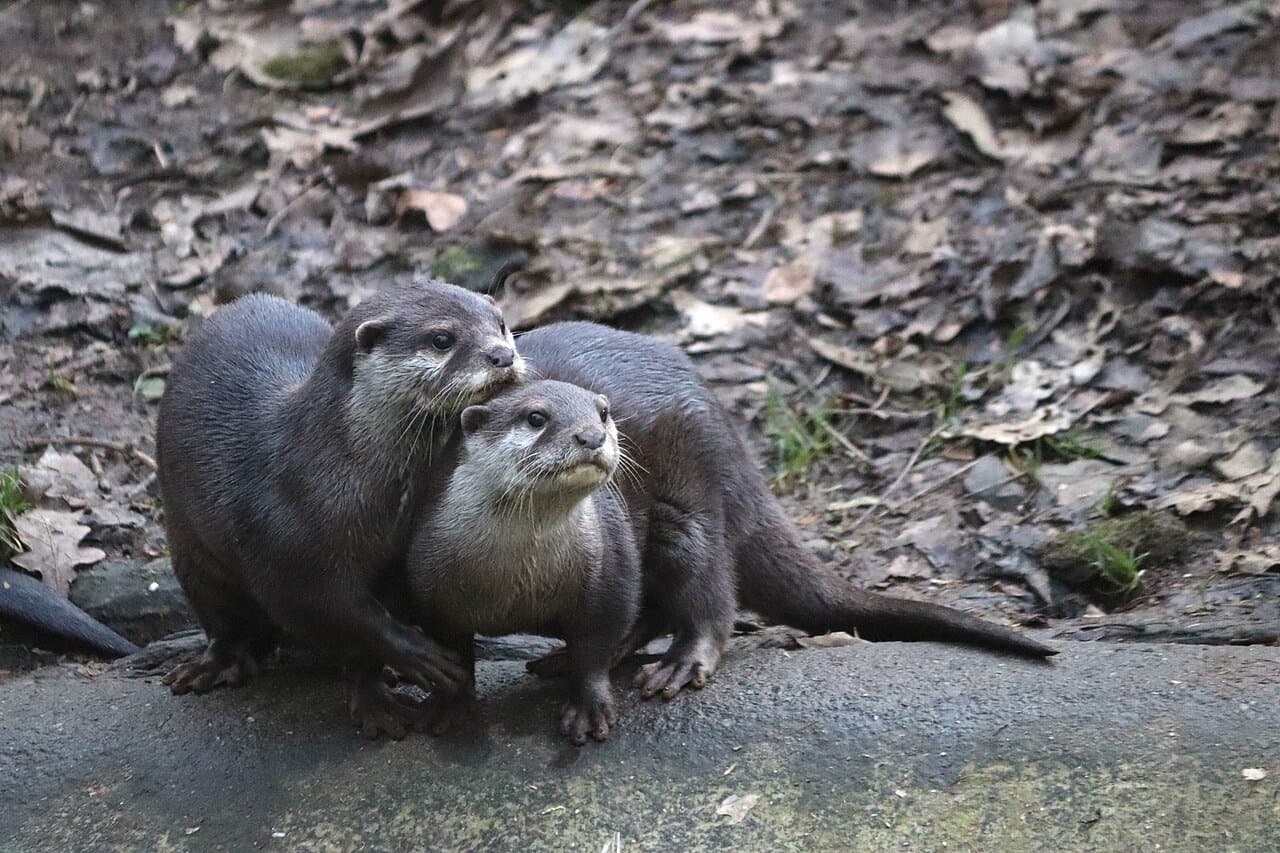
Asian Small-clawed Otter
Aonyx cinereus
The world's smallest otter, a chatty, social otter from Asia that feels for crabs and clams with its nimble front paws.
Checking teacher reviews…
About the Asian Small-clawed Otter
Asian small-clawed otters weigh less than 10 pounds and are up to 2 feet long, including the tail. Their tiny claws don't stick out past their toe pads. They live in southern India, southern China, Southeast Asia, Indonesia and the Philippines. They feel for food with sensitive paws and eat mostly crabs and shellfish, plus fish, insects and frogs. They crush shells with their hands or teeth.[1]
Quick facts
- Scientific name
- Aonyx cinereus[1]
- Size
- Up to 2 feet long, including a 10- to 14-inch tail.[1]
- Weight
- Less than 10 pounds.[1]
- Lifespan
- Up to 12 years in human care, sometimes over 20.[1]
- Diet
- Carnivore. Mostly crabs, clams and mussels, plus fish, insects, frogs and reptiles.[1]
- Habitat
- Small streams, rivers, marshes, rice paddies, seacoasts and mangroves.[1]
- Where it lives
- Southern India, southern China, Southeast Asia, Indonesia and the Philippines.[1]
- Group life
- Family groups of up to 15 to 20.[1]
- Babies
- 1 to 6 pups, usually two litters a year.[1]
- Conservation status
- Vulnerable (IUCN Red List, assessed 2020).[2]
Fun facts
Vocabulary
- holt
- An otter's den, often dug into a riverbank.
- indicator species
- An animal whose health tells scientists how healthy its environment is.
- mangrove
- A tree or shrub that grows in salty water along tropical coasts.
- carnivore
- An animal that eats mostly meat.
- vulnerable
- A conservation label meaning a species faces a high risk of dying out in the wild.
See it in person
- Smithsonian's National ZooWashington, D.C. · Asia TrailSee this animal on the zoo's website ↗
These zoos had this animal when we gathered our information, but animals sometimes move. Check the zoo's website or contact the zoo before you visit.
Sources
- [1] Smithsonian's National Zoo & Conservation Biology Institute. “Asian small-clawed otter.” https://nationalzoo.si.edu/animals/asian-small-clawed-otter (accessed 2026-10-08)
- [2] IUCN Red List of Threatened Species. “Aonyx cinereus (Asian Small-clawed Otter).” https://www.iucnredlist.org/species/44166/164580923 (accessed 2026-10-08)
Facts last checked 2026-10-08.


