
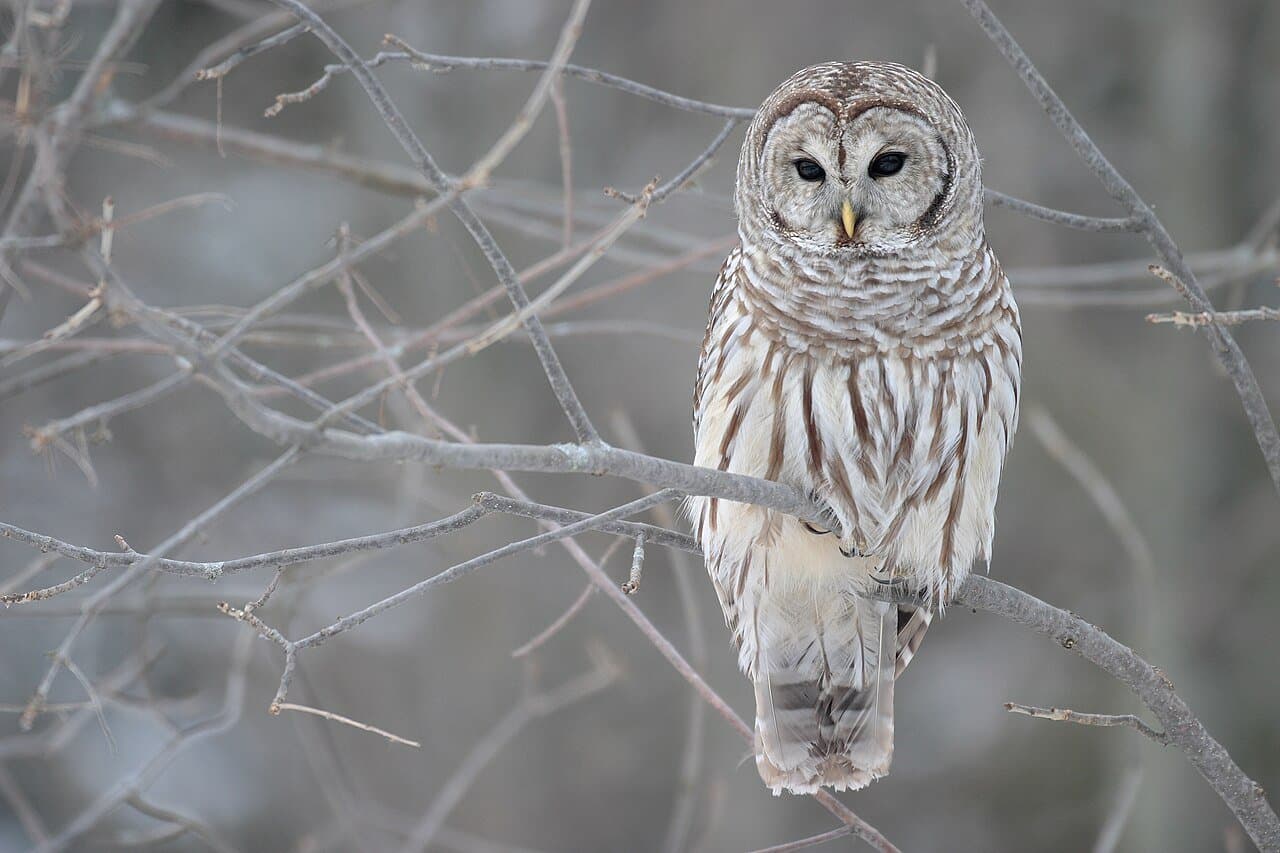
Barred Owl
Strix varia
A big, brown-eyed forest owl whose call sounds like 'Who cooks for you? Who cooks for you all?'
Checking teacher reviews…
About the Barred Owl
Barred owls stand up to 22 inches tall, and females are much bigger than males. They are brownish-gray with round heads, no ear tufts and dark brown eyes, unlike most owls, which have yellow eyes. They live in large forests across Canada and the United States, with another population in Mexico. They eat almost anything they can catch, from small mammals and birds to reptiles, frogs and insects.[1]
Quick facts
- Scientific name
- Strix varia[1]
- Size
- Up to 22 inches tall.[1]
- Diet
- Carnivore. Small mammals up to the size of rabbits, birds, reptiles, amphibians and invertebrates.[1]
- Habitat
- Large, old forests.[1]
- Where it lives
- Canada and the United States, plus a separate population in Mexico.[1]
- Group life
- Mostly nocturnal.[1]
- Babies
- 2 to 5 eggs, incubated for 28 to 32 days.[1]
- Conservation status
- Least Concern (IUCN Red List, assessed 2024).[2]
Fun facts
Vocabulary
- raptor
- A bird of prey, such as a hawk, eagle, vulture or owl.
- ear tuft
- A clump of feathers that sticks up from an owl's head.
- cavity
- A hole or hollow space, such as in a tree.
- nocturnal
- Active mainly at night.
- least concern
- A conservation label meaning a species is widespread and not at risk of dying out soon.
See it in person
- Smithsonian's National ZooWashington, D.C. · Bird HouseSee this animal on the zoo's website ↗
These zoos had this animal when we gathered our information, but animals sometimes move. Check the zoo's website or contact the zoo before you visit.
Sources
- [1] Smithsonian's National Zoo & Conservation Biology Institute. “Barred owl.” https://nationalzoo.si.edu/animals/barred-owl (accessed 2026-10-08)
- [2] IUCN Red List of Threatened Species. “Strix varia (Barred Owl).” https://www.iucnredlist.org/species/22689094/264599155 (accessed 2026-10-08)
Facts last checked 2026-10-08.


