
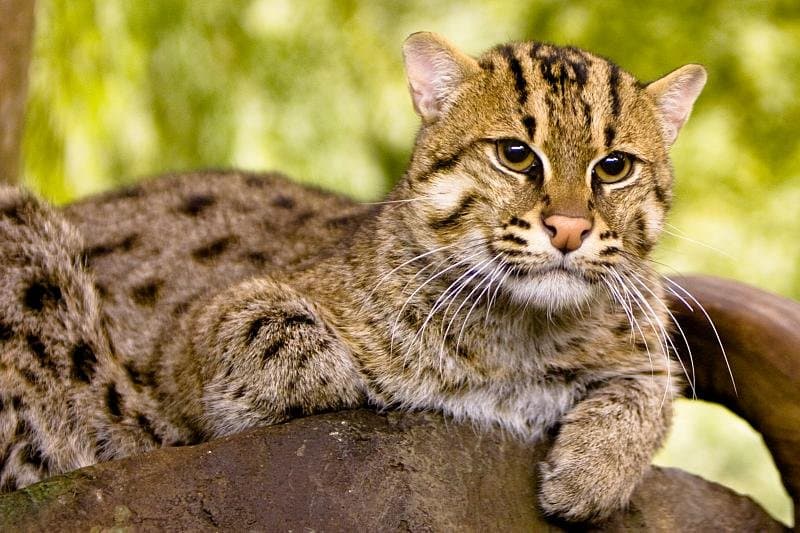
Fishing Cat
Prionailurus viverrinus
A sturdy, spotted wild cat of South and Southeast Asia that swims and scoops fish from the water.
Checking teacher reviews…
About the Fishing Cat
Fishing cats are among the largest small cats, with bodies 33 to 45 inches long. Males weigh 18 to 31 pounds and females 11 to 20 pounds. They live in South and Southeast Asia, from Pakistan to Cambodia and south to Sri Lanka and Thailand. They hunt along the edges of water and eat mostly fish and small mammals, plus birds, shellfish, lizards and frogs.[1]
Quick facts
- Scientific name
- Prionailurus viverrinus[1]
- Size
- Body 33 to 45 inches long; over 16 inches tall at the shoulder.[1]
- Weight
- Males 18 to 31 pounds; females 11 to 20 pounds.[1]
- Lifespan
- Into the late teens in human care.[1]
- Diet
- Carnivore. Mostly fish and small mammals, plus birds, shellfish, lizards and amphibians.[1]
- Where it lives
- South and Southeast Asia, from Pakistan east to Cambodia and south to Sri Lanka and Thailand.[1]
- Group life
- Thought to be solitary. Nocturnal.[1]
- Babies
- 1 to 4 kittens after about a 65-day pregnancy.[1]
- Conservation status
- Vulnerable (IUCN Red List, assessed 2024).[2]
Fun facts
Vocabulary
- wetland
- Land that is soaked with water, like a marsh or swamp.
- webbed
- Having skin between the toes, which helps with swimming.
- nocturnal
- Active mainly at night.
- carnivore
- An animal that eats mostly meat.
- vulnerable
- A conservation label meaning a species faces a high risk of dying out in the wild.
See it in person
- Smithsonian's National ZooWashington, D.C. · Asia TrailSee this animal on the zoo's website ↗
These zoos had this animal when we gathered our information, but animals sometimes move. Check the zoo's website or contact the zoo before you visit.
Sources
- [1] Smithsonian's National Zoo & Conservation Biology Institute. “Fishing cat.” https://nationalzoo.si.edu/animals/fishing-cat (accessed 2026-10-08)
- [2] IUCN Red List of Threatened Species. “Prionailurus viverrinus (Fishing Cat).” https://www.iucnredlist.org/species/18150/268618387 (accessed 2026-10-08)
Facts last checked 2026-10-08.


