
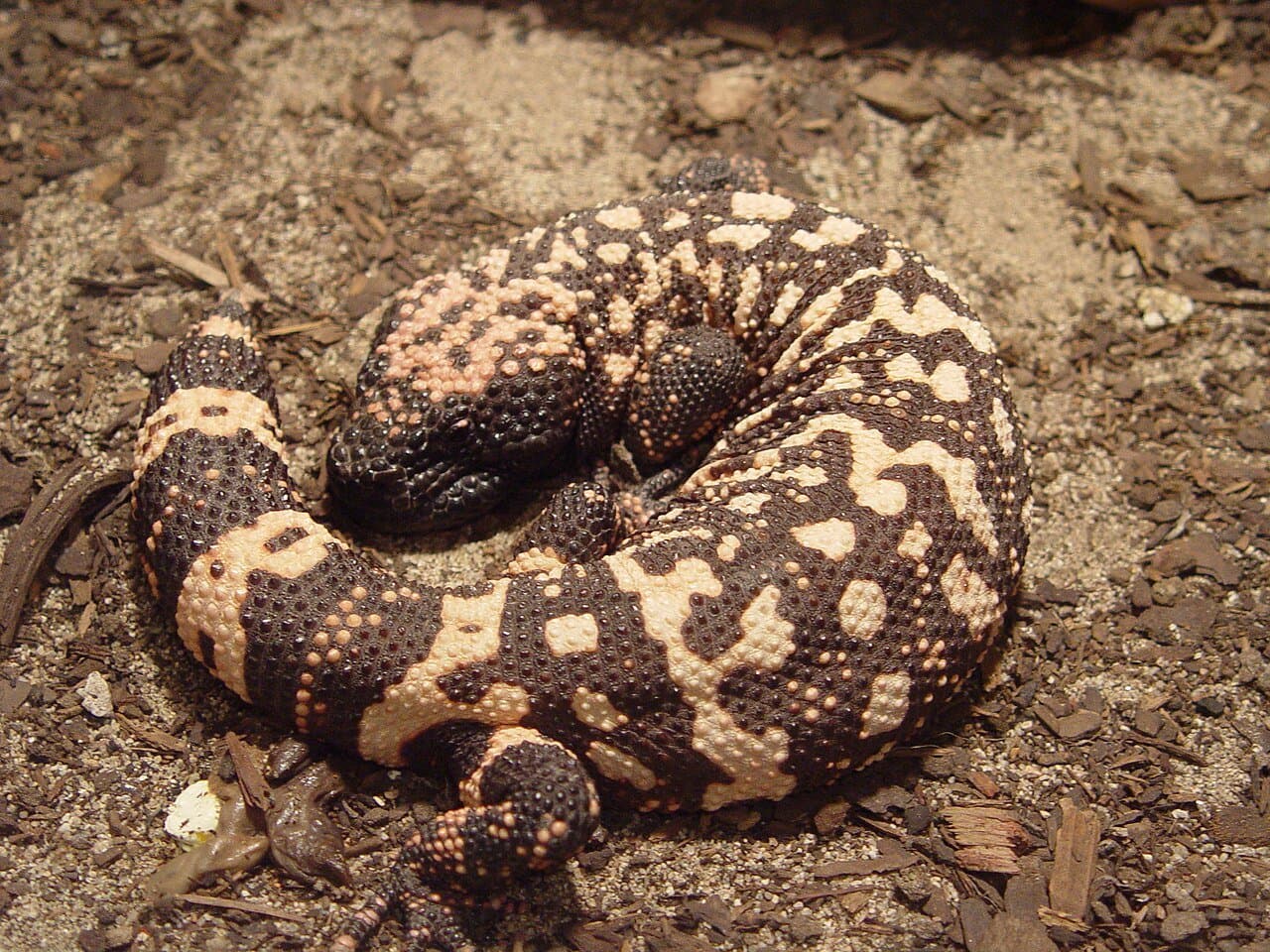
Gila Monster
Heloderma suspectum
The largest lizard native to the United States, a black-and-pink venomous desert lizard whose venom led to diabetes medicines.
Checking teacher reviews…
About the Gila Monster
Gila monsters are the largest lizards native to the U.S., up to about 22 inches long. They are black with pink or orange patterns. They live in the Sonoran, Mojave and Chihuahuan deserts of the southwestern U.S. and northwestern Mexico, near washes and rocky foothills. They raid nests for eggs and baby birds and also eat small mammals, lizards, frogs and insects.[1][2]
Quick facts
- Scientific name
- Heloderma suspectum[2]
- Size
- Up to about 22 inches long.[2]
- Lifespan
- 20+ years in human care; the record is 36.[2]
- Diet
- Carnivore. Eggs, baby birds, small mammals, lizards, frogs, insects and carrion.[2]
- Habitat
- Desert scrub, rocky foothills and washes.[2]
- Where it lives
- Southwestern U.S. and northwestern Mexico.[2]
- Group life
- Spends much of its time underground.[2]
- Conservation status
- Near Threatened (IUCN Red List, assessed 2007).[3]
Fun facts
Vocabulary
- venomous
- Able to inject poison by biting or stinging.
- groove
- A long, narrow channel, like the ones on a Gila monster's teeth.
- wash
- A dry streambed in the desert.
- metabolism
- How fast an animal's body uses energy.
- near threatened
- A conservation label meaning a species may soon be at risk of dying out if things don't improve.
See it in person
- Oakland ZooOakland, California · Reptile and Amphibian Discovery RoomSee this animal on the zoo's website ↗
These zoos had this animal when we gathered our information, but animals sometimes move. Check the zoo's website or contact the zoo before you visit.
Sources
- [1] Oakland Zoo. “Gila Monster.” https://www.oaklandzoo.org/animals/gila-monster/ (accessed 2026-10-02)
- [2] Smithsonian's National Zoo & Conservation Biology Institute. “Gila monster.” https://nationalzoo.si.edu/animals/gila-monster (accessed 2026-10-02)
- [3] IUCN Red List of Threatened Species. “Heloderma suspectum (Gila Monster).” https://www.iucnredlist.org/species/9865/13022716 (accessed 2026-10-02)
Facts last checked 2026-10-02.
More Lizards
 Black Tree MonitorVaranus beccarii
 Blue Spiny LizardSceloporus cyanogenys
 Caiman LizardDracaena guianensis
 Common Blue-Tongued SkinkTiliqua scincoides
 Common ChuckwallaSauromalus ater
 Green AnoleAnolis carolinensis
 Green Spiny LizardSceloporus malachiticus
 Guatemalan Beaded LizardHeloderma charlesbogerti
 Henkel's Leaf-Tailed GeckoUroplatus henkeli
 Komodo DragonVaranus komodoensis
 Motagua Spiny-Tailed IguanaCtenosaura palearis
 Ornate UromastyxUromastyx ornata
 Rhinoceros IguanaCyclura cornuta
 Solomon Islands SkinkCorucia zebrata
 Sudan Plated LizardGerrhosaurus major (also called Broadleysaurus major)
 White-Throated MonitorVaranus albigularis