
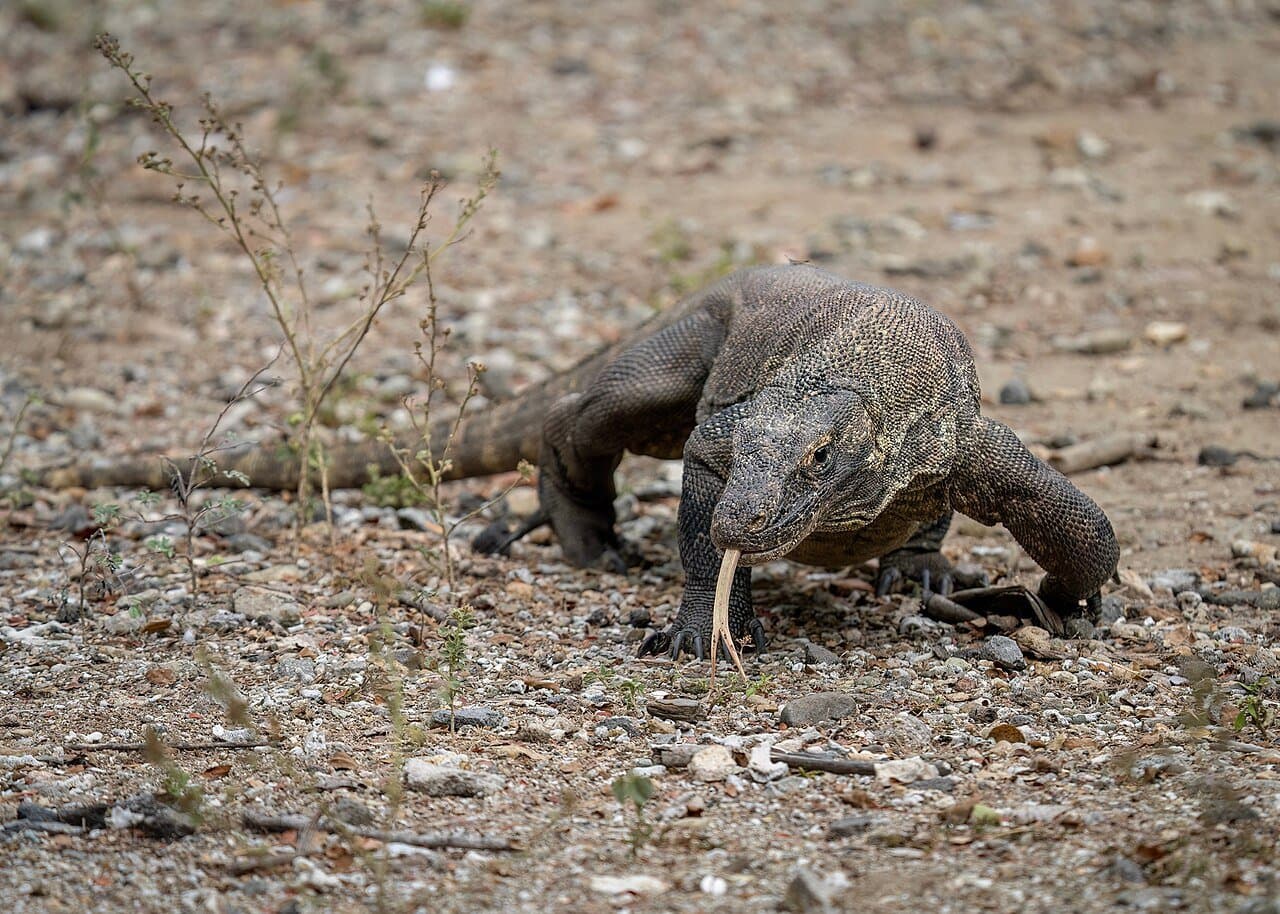
Komodo Dragon
Varanus komodoensis
The largest living lizard, a venomous predator found only on a few Indonesian islands that can smell food miles away.
Checking teacher reviews…
About the Komodo Dragon
Komodo dragons live in tropical savanna forests on a few Indonesian islands, including Komodo, Flores, Rinca and Padar. They flick their forked tongues to sample the air and can smell a dead animal up to 2.5 miles away. Komodo dragons can briefly run 10 to 13 miles per hour. Young dragons eat small lizards, insects, snakes and birds.[1]
Quick facts
- Scientific name
- Varanus komodoensis[1]
- Size
- The largest verified one was 10.3 feet (3.13 m) long.[1]
- Weight
- Wild adults typically about 154 pounds (70 kg). The largest verified weighed 366 pounds.[1]
- Lifespan
- About 30 years in the wild.[1]
- Diet
- Carnivore. Eats carrion and live prey; young eat small lizards, insects, snakes and birds.[1]
- Habitat
- Tropical savanna forests.[1]
- Where it lives
- A few Indonesian islands in the Lesser Sundas: Komodo, Flores, Rinca and Padar.[1]
- Babies
- About 30 eggs, which hatch after about nine months. Hatchlings are about 16 inches long.[1]
- Conservation status
- Endangered (IUCN Red List, assessed 2019).[2]
Fun facts
Vocabulary
- venom
- A poison an animal puts into another animal by biting or stinging.
- forked tongue
- A tongue split into two tips, used by lizards and snakes to smell.
- carrion
- The meat of an animal that is already dead.
- hatchling
- A baby animal that has just come out of its egg.
- endangered
- A conservation label meaning a species faces a very high risk of dying out in the wild.
See it in person
- Montgomery ZooMontgomery, Alabama · Komodo DragonSee this area on the zoo's website ↗
- Zoo AtlantaAtlanta, Georgia · All AnimalsSee this animal on the zoo's website ↗
- San Francisco Zoo & GardensSan Francisco, California · ReptilesSee this animal on the zoo's website ↗
These zoos had this animal when we gathered our information, but animals sometimes move. Check the zoo's website or contact the zoo before you visit.
Sources
- [1] Smithsonian's National Zoo & Conservation Biology Institute. “Komodo dragon.” https://nationalzoo.si.edu/animals/komodo-dragon (accessed 2026-10-02)
- [2] IUCN Red List of Threatened Species. “Varanus komodoensis (Komodo Dragon).” https://www.iucnredlist.org/species/22884/123633058 (accessed 2026-10-02)
Facts last checked 2026-10-02.
More Lizards
 Black Tree MonitorVaranus beccarii
 Blue Spiny LizardSceloporus cyanogenys
 Caiman LizardDracaena guianensis
 Common Blue-Tongued SkinkTiliqua scincoides
 Common ChuckwallaSauromalus ater
 Gila MonsterHeloderma suspectum
 Green AnoleAnolis carolinensis
 Green Spiny LizardSceloporus malachiticus
 Guatemalan Beaded LizardHeloderma charlesbogerti
 Henkel's Leaf-Tailed GeckoUroplatus henkeli
 Motagua Spiny-Tailed IguanaCtenosaura palearis
 Ornate UromastyxUromastyx ornata
 Rhinoceros IguanaCyclura cornuta
 Solomon Islands SkinkCorucia zebrata
 Sudan Plated LizardGerrhosaurus major (also called Broadleysaurus major)
 White-Throated MonitorVaranus albigularis