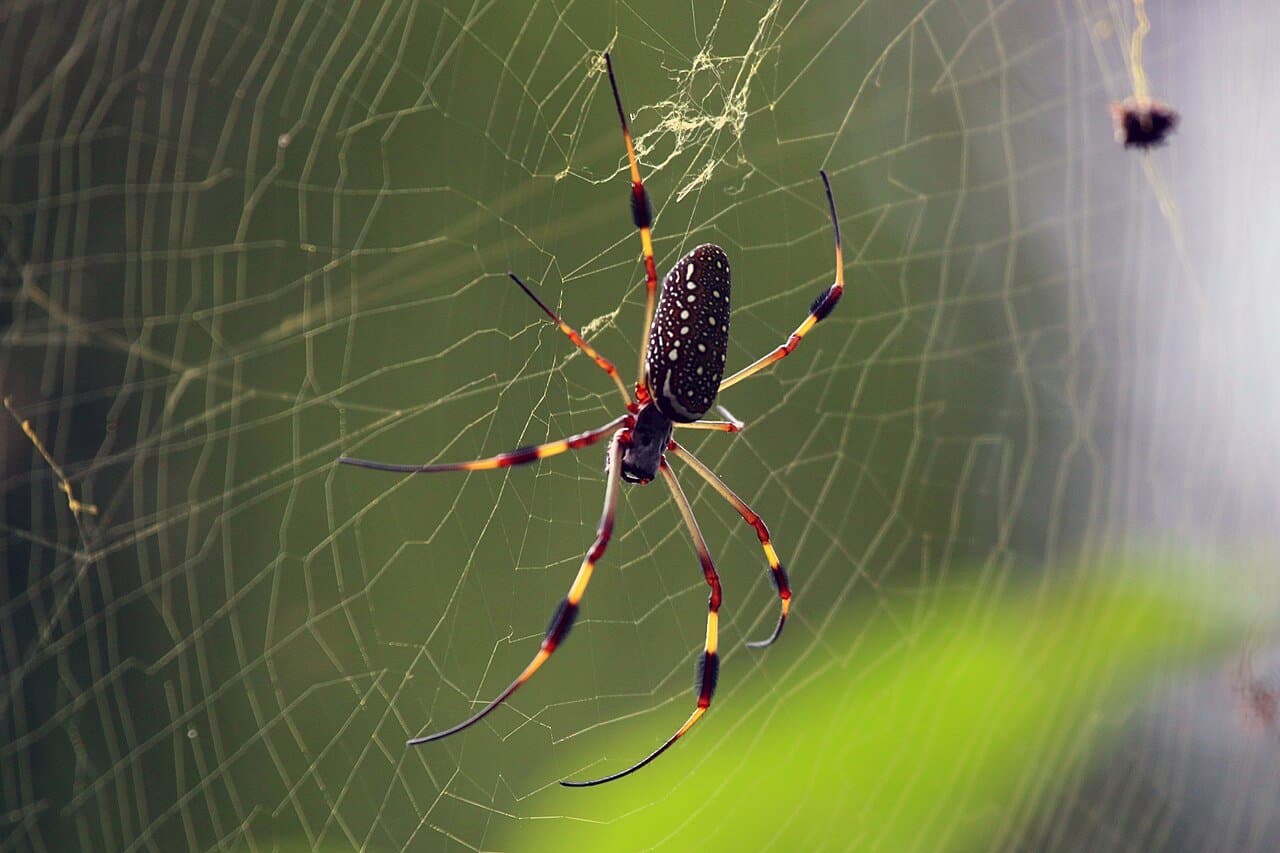
Golden Silk Orbweaver
Trichonephila clavipes (also called Nephila clavipes)
A large American spider whose golden silk is stronger than steel for its weight.
Checking teacher reviews…
About the Golden Silk Orbweaver
Golden silk orbweavers live from the southeastern United States to Argentina and Peru, in humid open spaces along clearings and forest trails. Females are about 3 inches long, five or six times bigger than males, with yellow, long abdomens and hairy legs. Their strong webs catch flies, grasshoppers and other small insects, which they wrap in silk.[1][2]
Quick facts
- Size
- Females about 3 inches long; males much smaller.[2]
- Diet
- Carnivore. Flies, grasshoppers and other small insects.[2]
- Habitat
- Humid open spaces along clearings and forest trails.[1]
- Where it lives
- Southeastern United States to Argentina and Peru.[2]
- Group life
- Active during the day.[1]
- Conservation status
- Least Concern (IUCN Red List, assessed 2016).[3]
Fun facts
Vocabulary
- arachnid
- An animal with eight legs and two body parts, such as a spider or scorpion.
- orb web
- A round, wheel-shaped spider web.
- biodegradable
- Able to break down naturally.
- sexually dimorphic
- Having males and females that look different.
- least concern
- A conservation label meaning a species is widespread and not at risk of dying out soon.
See it in person
- Oakland ZooOakland, California · House of BugsSee this animal on the zoo's website ↗
These zoos had this animal when we gathered our information, but animals sometimes move. Check the zoo's website or contact the zoo before you visit.
Sources
- [1] Oakland Zoo. “Golden Silk Orb Weaver.” https://www.oaklandzoo.org/animals/golden-silk-orbweaver/ (accessed 2026-10-02)
- [2] Animal Diversity Web, University of Michigan. “Golden silk spider (Nephila clavipes).” https://animaldiversity.org/accounts/Nephila_clavipes/ (accessed 2026-10-02)
- [3] IUCN Red List of Threatened Species. “Nephila clavipes (American Golden Orb Weaver).” https://www.iucnredlist.org/species/89292313/89292873 (accessed 2026-10-02)
Facts last checked 2026-10-02.


