
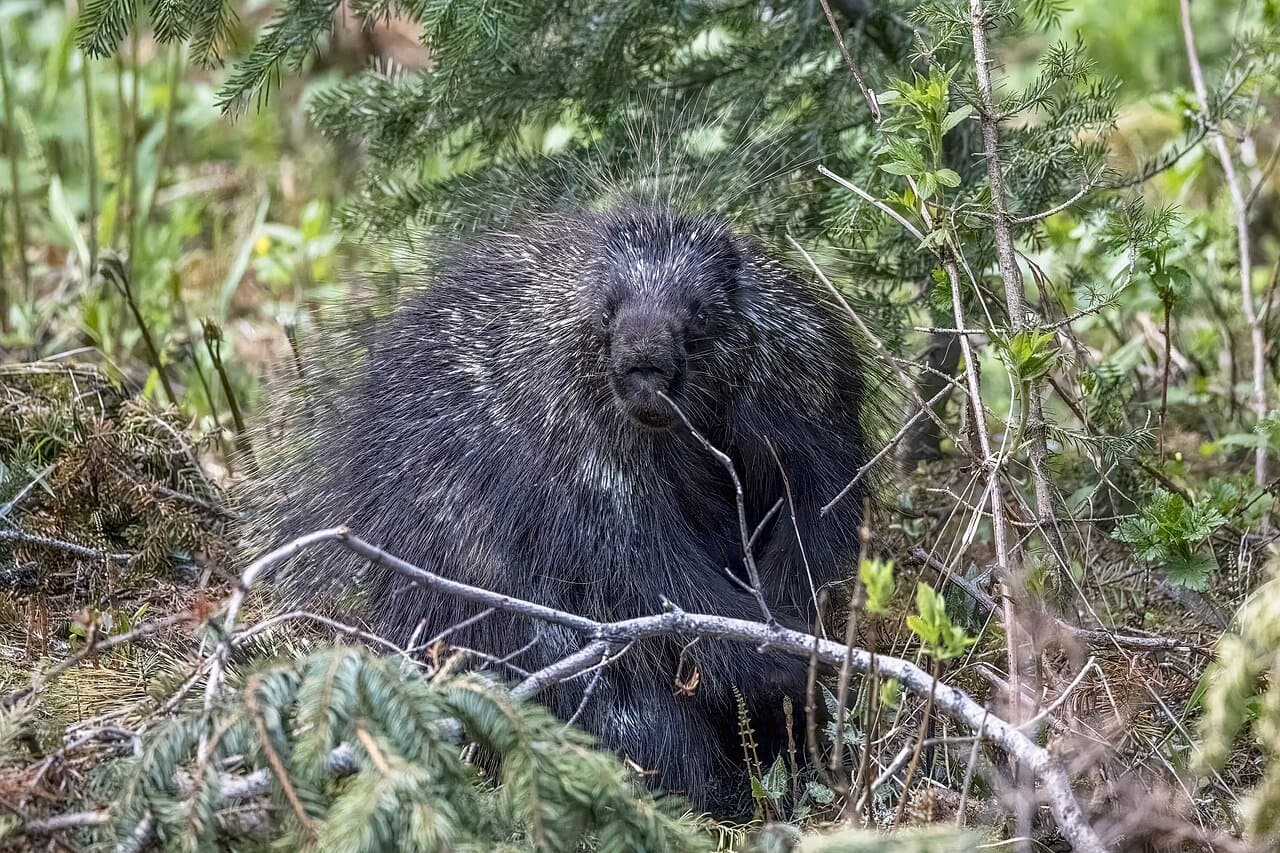
North American Porcupine
Erethizon dorsatum
A big, slow-moving forest rodent covered in about 30,000 loose quills that stick in a predator's skin.
Checking teacher reviews…
About the North American Porcupine
North American porcupines weigh about 20 pounds and are 2 to 3 feet long. Only the beaver is a bigger rodent in North America. Porcupines live in forests, grasslands, desert shrublands and even tundra in Canada, the United States and northern Mexico. In winter they eat evergreen needles and inner tree bark, and in spring and summer they eat berries, seeds, grasses and leaves.[1]
Quick facts
- Scientific name
- Erethizon dorsatum[1]
- Size
- 2 to 3 feet long.[1]
- Weight
- About 20 pounds.[1]
- Lifespan
- Up to 18 years in the wild.[1]
- Diet
- Herbivore. Evergreen needles and inner bark in winter; berries, seeds, grasses, leaves, roots and stems in spring and summer.[1]
- Habitat
- Forests, grasslands, desert shrublands and tundra.[1]
- Where it lives
- Canada, the northeastern and western United States and northern Mexico.[1]
- Babies
- Usually one porcupette after a 205- to 217-day pregnancy.[1]
- Conservation status
- Least Concern (IUCN Red List, assessed 2016).[2]
Fun facts
Vocabulary
- quill
- A stiff, sharp, hollow spine.
- porcupette
- A baby porcupine.
- predator
- An animal that hunts and eats other animals.
- herbivore
- An animal that eats only plants.
- least concern
- A conservation label meaning a species is widespread and not at risk of dying out soon.
See it in person
- Smithsonian's National ZooWashington, D.C. · Claws & Paws PathwaySee this animal on the zoo's website ↗
These zoos had this animal when we gathered our information, but animals sometimes move. Check the zoo's website or contact the zoo before you visit.
Sources
- [1] Smithsonian's National Zoo & Conservation Biology Institute. “North American porcupine.” https://nationalzoo.si.edu/animals/north-american-porcupine (accessed 2026-10-08)
- [2] IUCN Red List of Threatened Species. “Erethizon dorsatum (North American Porcupine).” https://www.iucnredlist.org/species/8004/22213161 (accessed 2026-10-08)
Facts last checked 2026-10-08.
More Rodents
 Black-Tailed Prairie DogCynomys ludovicianus
 CapybaraHydrochoerus hydrochaeris
 Guinea PigCavia porcellus
 Long-tailed ChinchillaChinchilla lanigera
 Naked Mole RatHeterocephalus glaber
 North American BeaverCastor canadensis
 Patagonian MaraDolichotis patagonum
 Prehensile-tailed PorcupineCoendou prehensilis
 Prevost's SquirrelCallosciurus prevostii
 Red-Rumped AgoutiDasyprocta leporina
 SpringharePedetes capensis