
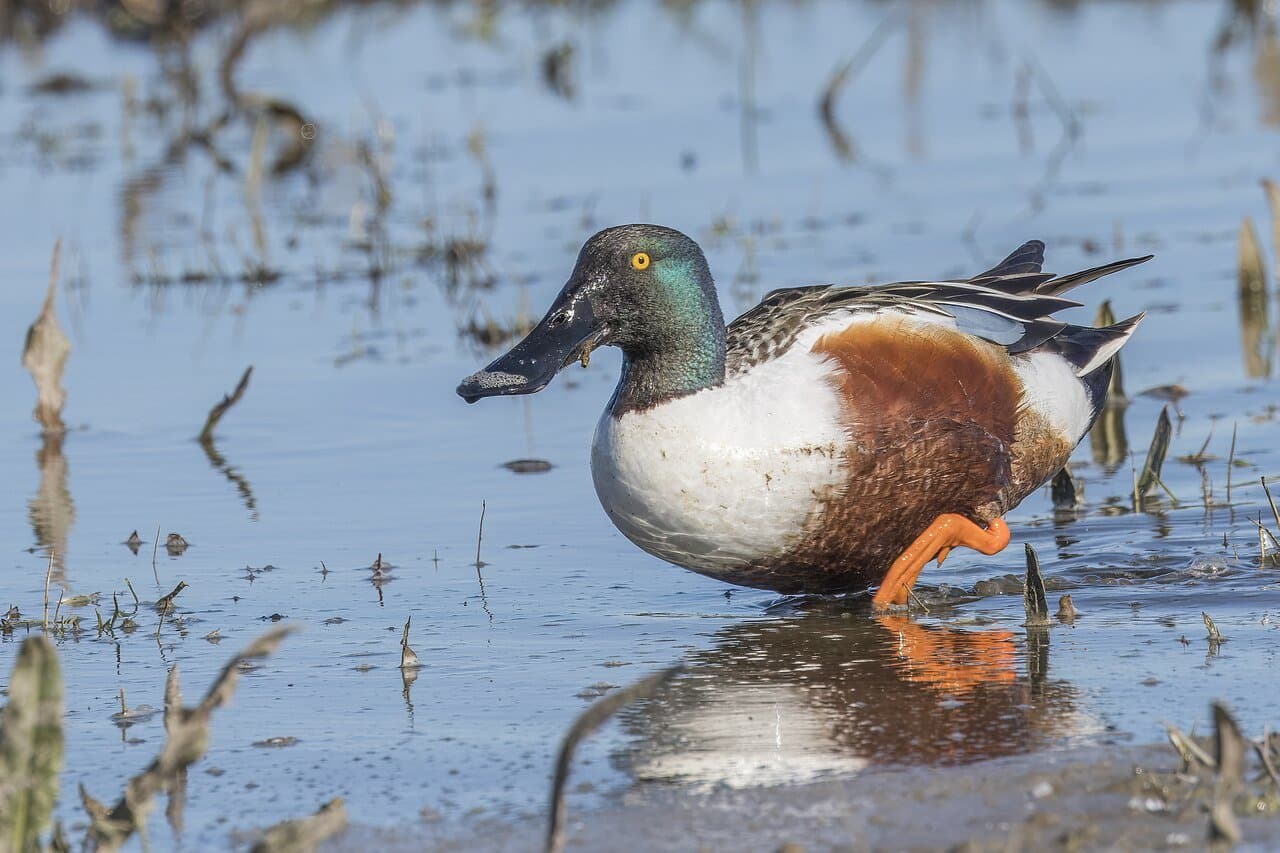
Northern Shoveler
Spatula clypeata
A duck with a huge, shovel-shaped bill that it uses to strain tiny animals and seeds from the water.
Checking teacher reviews…
About the Northern Shoveler
Northern shovelers are about 19 inches long, and their bill alone is about 2.5 inches. They weigh about 1.5 pounds. They breed on shallow freshwater lakes, ponds and marshes and spend winters in fresh and salty coastal waters. They live in the Americas and Europe all year, and some winter in Africa and Asia. They eat duckweed, seeds and tiny water animals like insects, snails and crustaceans.[1]
Quick facts
- Scientific name
- Spatula clypeata[1]
- Size
- About 19 inches long; 31-inch wingspan.[1]
- Weight
- About 1.5 pounds.[1]
- Lifespan
- Up to 13 years in the wild.[1]
- Diet
- Duckweed, seeds and small water animals such as insects, snails and crustaceans.[1]
- Habitat
- Shallow lakes, ponds and marshes; coasts and lagoons in winter.[1]
- Where it lives
- The Americas and Europe; some winter in Africa, India and Southeast Asia.[1]
- Group life
- Pairs for the breeding season; flocks at other times.[1]
- Babies
- 9 to 11 eggs, incubated for about 24 days.[1]
- Conservation status
- Least Concern (IUCN Red List, assessed 2019).[2]
Fun facts
Vocabulary
- dabbling duck
- A duck that feeds at the water's surface, often tipping its head down and tail up.
- lamellae
- Thin, comb-like ridges on a duck's bill that strain food from water.
- clutch
- A group of eggs laid at one time.
- incubate
- To keep eggs warm so they can hatch.
- least concern
- A conservation label meaning a species is widespread and not at risk of dying out soon.
See it in person
- Smithsonian's National ZooWashington, D.C. · Bird HouseSee this animal on the zoo's website ↗
These zoos had this animal when we gathered our information, but animals sometimes move. Check the zoo's website or contact the zoo before you visit.
Sources
- [1] Smithsonian's National Zoo & Conservation Biology Institute. “Northern shoveler.” https://nationalzoo.si.edu/animals/northern-shoveler (accessed 2026-10-08)
- [2] IUCN Red List of Threatened Species. “Spatula clypeata (Northern Shoveler).” https://www.iucnredlist.org/species/22680247/153875944 (accessed 2026-10-08)
Facts last checked 2026-10-08.
More Waterfowl
 Abyssinian Blue-Winged GooseCyanochen cyanoptera
 American WigeonMareca americana
 Black-bellied Whistling DuckDendrocygna autumnalis
 Blue-Winged TealSpatula discors
 BuffleheadBucephala albeola
 CanvasbackAythya valisineria
 Cape TealAnas capensis
 Egyptian GooseAlopochen aegyptiaca
 GadwallMareca strepera
 Northern PintailAnas acuta
 RedheadAythya americana
 Ringed TealCallonetta leucophrys
 Ross's GooseAnser rossii
 Ruddy DuckOxyura jamaicensis
 Snow GooseAnser caerulescens
 Southern ScreamerChauna torquata
 Spur-Winged GoosePlectropterus gambensis
 Swan GooseAnser cygnoides
 White-cheeked PintailAnas bahamensis
 White-Faced Whistling DuckDendrocygna viduata
 Wood DuckAix sponsa