
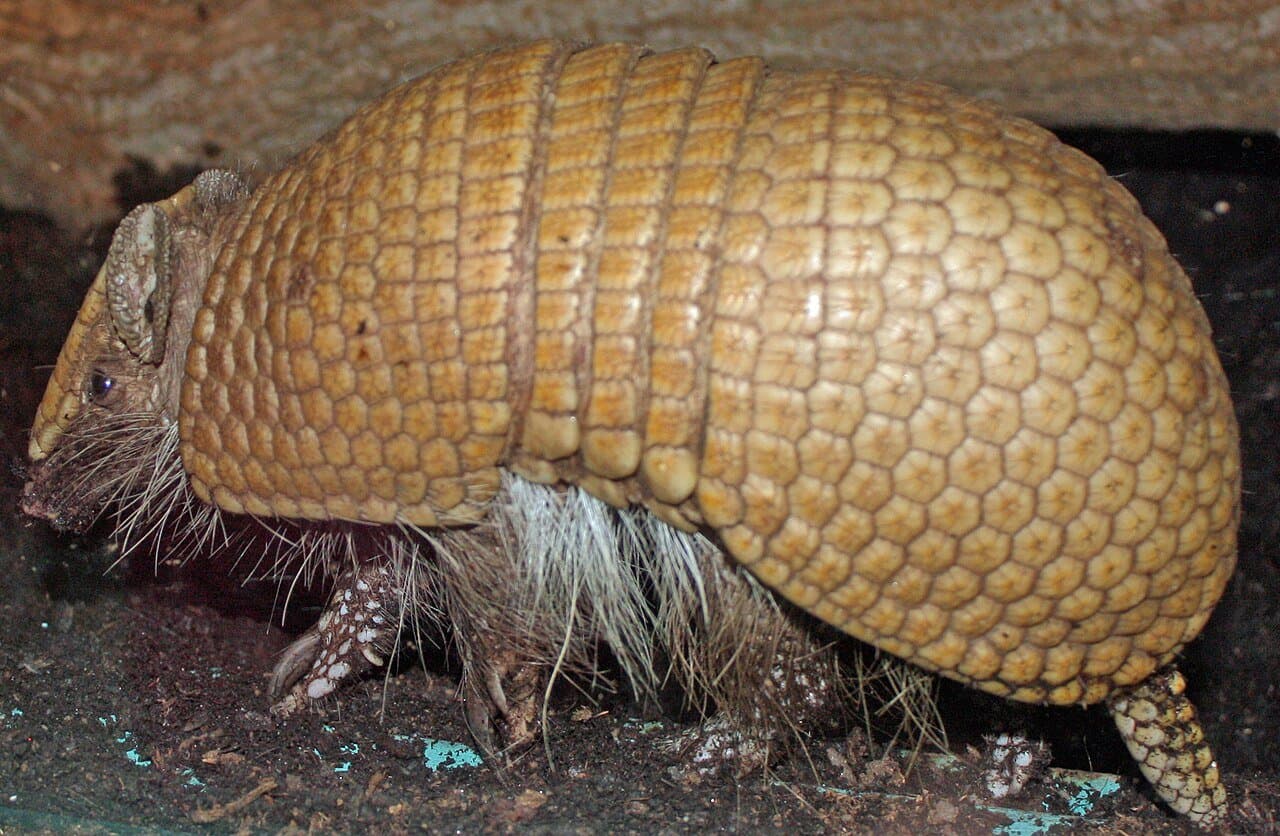
Southern Three-Banded Armadillo
Tolypeutes matacus
A small South American armadillo, the only kind that can roll up into a complete armored ball.
Checking teacher reviews…
About the Southern Three-Banded Armadillo
Southern three-banded armadillos live in grasslands, marshy areas and open woods in Bolivia, Brazil, Paraguay and Argentina. They are named for the three bands across the middle of their armor. They have poor eyesight but a keen sense of smell, and long, sharp front claws help them dig for ants, termites and beetle larvae. "Armadillo" is Spanish for "little armored one."[1]
Quick facts
- Scientific name
- Tolypeutes matacus[1]
- Diet
- Insectivore. Ants, termites and beetle larvae, sometimes ripe fruit.[1]
- Habitat
- Dry grasslands, marshy areas and open woods.[1]
- Where it lives
- Bolivia, central Brazil, Paraguay and northern and central Argentina.[1]
- Group life
- Mostly solitary, but may gather in groups of up to 12 in cold weather.[1]
- Babies
- One baby after about four months. Babies are born blind but soon walk and roll up.[1]
- Conservation status
- Near Threatened (IUCN Red List, assessed 2013).[2]
Fun facts
Vocabulary
- armor
- A hard covering that protects the body.
- keratin
- A tough protein that makes up hair, nails, hooves and horns.
- larva
- The young, worm-like stage of an insect (plural: larvae).
- insectivore
- An animal that eats mostly insects.
- near threatened
- A conservation label meaning a species may become threatened soon.
See it in person
- Zoo AtlantaAtlanta, Georgia · All AnimalsSee this animal on the zoo's website ↗
These zoos had this animal when we gathered our information, but animals sometimes move. Check the zoo's website or contact the zoo before you visit.
Sources
- [1] Zoo Atlanta. “Southern three-banded armadillo.” https://zooatlanta.org/animal/southern-three-banded-armadillo/ (accessed 2026-10-02)
- [2] IUCN Red List of Threatened Species. “Tolypeutes matacus (Southern Three-banded Armadillo).” https://www.iucnredlist.org/species/21974/47443233 (accessed 2026-10-02)
Facts last checked 2026-10-02.


