
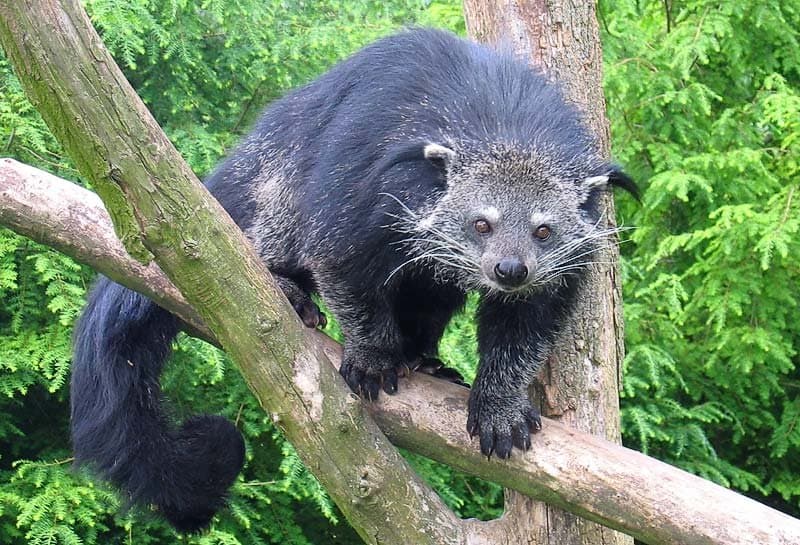
Binturong
Arctictis binturong
A shaggy, tree-climbing "bearcat" of Southeast Asia that smells like popcorn and grips branches with its tail.
Checking teacher reviews…
About the Binturong
Binturongs live high in the canopy of tropical forests in South and Southeast Asia, from India and Nepal to China, Vietnam, Malaysia and the Philippines. They are mostly active at night and move slowly through the trees. A binturong's thick, muscular tail can grab branches like an extra hand. Binturongs mostly eat fruit, especially figs, but also eat insects, birds, fish and rodents.[1][2]
Quick facts
- Scientific name
- Arctictis binturong[1]
- Size
- Body 61 to 96 cm (2 to 3 feet) long, plus a 56 to 89 cm tail. Females are larger than males.[2]
- Weight
- 9 to 20 kg (about 20 to 44 pounds).[2]
- Lifespan
- Up to 18 years in the wild. Over 25 years in captivity.[2]
- Diet
- Mostly fruit, such as strangler figs, plus insects, birds, fish and rodents.[2]
- Habitat
- The canopies of tall, dense tropical forests.[2]
- Where it lives
- South and Southeast Asia, including India, Nepal, Bangladesh, China, Thailand, Vietnam, Malaysia and the Philippines.[2]
- Group life
- Usually alone or in small family groups. Mostly active at night.[1]
- Conservation status
- Vulnerable (IUCN Red List, assessed 2016).[3]
Fun facts
Vocabulary
- prehensile
- Able to grab or wrap around things, like a binturong's tail.
- canopy
- The top layer of a forest, made of treetops.
- arboreal
- Living mostly in trees.
- seed dispersal
- How seeds get carried to new places, like when an animal eats fruit and drops the seeds.
- vulnerable
- A conservation label meaning a species faces a high risk of dying out in the wild.
See it in person
- Montgomery ZooMontgomery, Alabama · AustraliaSee this area on the zoo's website ↗
- Zoo AtlantaAtlanta, Georgia · All AnimalsSee this animal on the zoo's website ↗
Sources
- [1] San Diego Zoo Wildlife Alliance. “Binturong.” https://animals.sandiegozoo.org/animals/binturong (accessed 2026-10-02)
- [2] Animal Diversity Web, University of Michigan Museum of Zoology. “Arctictis binturong (binturong).” https://animaldiversity.org/accounts/Arctictis_binturong/ (accessed 2026-10-02)
- [3] IUCN Red List of Threatened Species. “Arctictis binturong (Binturong).” https://www.iucnredlist.org/species/41690/45217088 (accessed 2026-10-02)
Facts last checked 2026-10-02.