
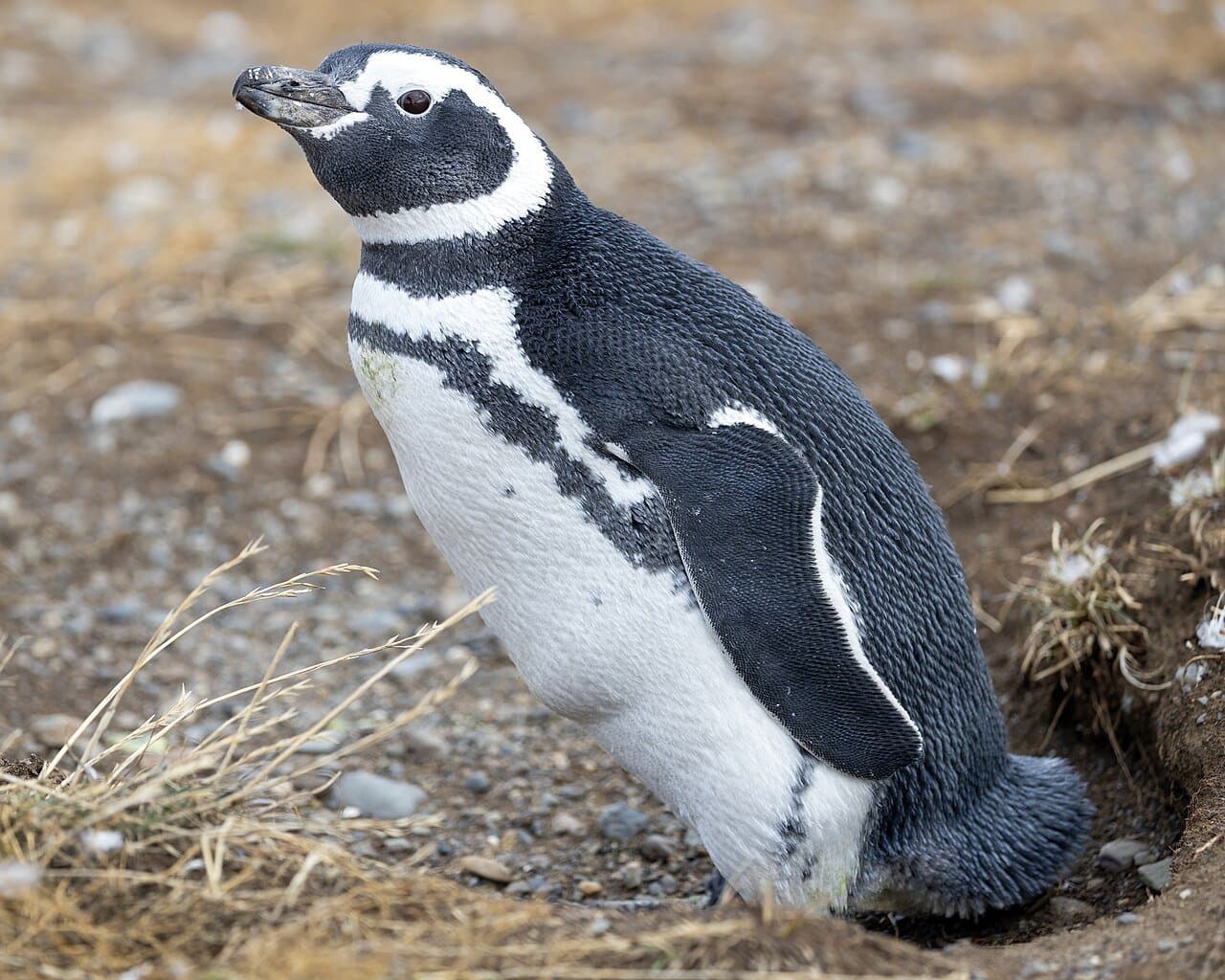
Magellanic Penguin
Spheniscus magellanicus
A burrow-nesting penguin of the coasts of Chile, Argentina and the Falkland Islands, named for the Strait of Magellan.
Checking teacher reviews…
About the Magellanic Penguin
Magellanic penguins live along the coasts of southern Chile, Argentina and the Falkland Islands. A white stripe curves from each eye around the head, and adults have a black band across the chest. Their wings work like flippers, pushing them through the water at up to 15 miles per hour. They eat squid, cuttlefish and sardines. Not all penguins live in icy places; this one's home is not much colder than northern California.[1]
Quick facts
- Scientific name
- Spheniscus magellanicus[1]
- Lifespan
- About 25 years in the wild. Up to 30 in human care.[1]
- Diet
- Carnivore. Squid, cuttlefish and sardines.[1]
- Habitat
- Rocky shores and the open ocean.[1]
- Where it lives
- Southern Chile, the Patagonian coast of Argentina and the Falkland Islands.[1]
- Group life
- Large groups at sea; crowded nesting colonies.[1]
- Babies
- Two eggs in a burrow, incubated 40 to 42 days by both parents.[1]
- Conservation status
- Least Concern (IUCN Red List, assessed 2020).[2]
Fun facts
Vocabulary
- countershading
- Coloring that is dark on top and light underneath, which helps hide an animal.
- flipper
- A flat limb used for swimming.
- burrow
- A hole or tunnel dug in the ground by an animal.
- colony
- A large group of animals of one kind that live or nest together.
- molt
- To shed old feathers, fur or skin and grow new ones.
See it in person
- San Francisco Zoo & GardensSan Francisco, California · BirdsSee this animal on the zoo's website ↗
Sources
- [1] San Francisco Zoo & Gardens. “Magellanic Penguin.” https://www.sfzoo.org/magellanic-penguin/ (accessed 2026-10-02)
- [2] IUCN Red List of Threatened Species. “Spheniscus magellanicus (Magellanic Penguin).” https://www.iucnredlist.org/species/22697822/157428850 (accessed 2026-10-02)
Facts last checked 2026-10-02.