Malayan Sun Bear
Helarctos malayanus
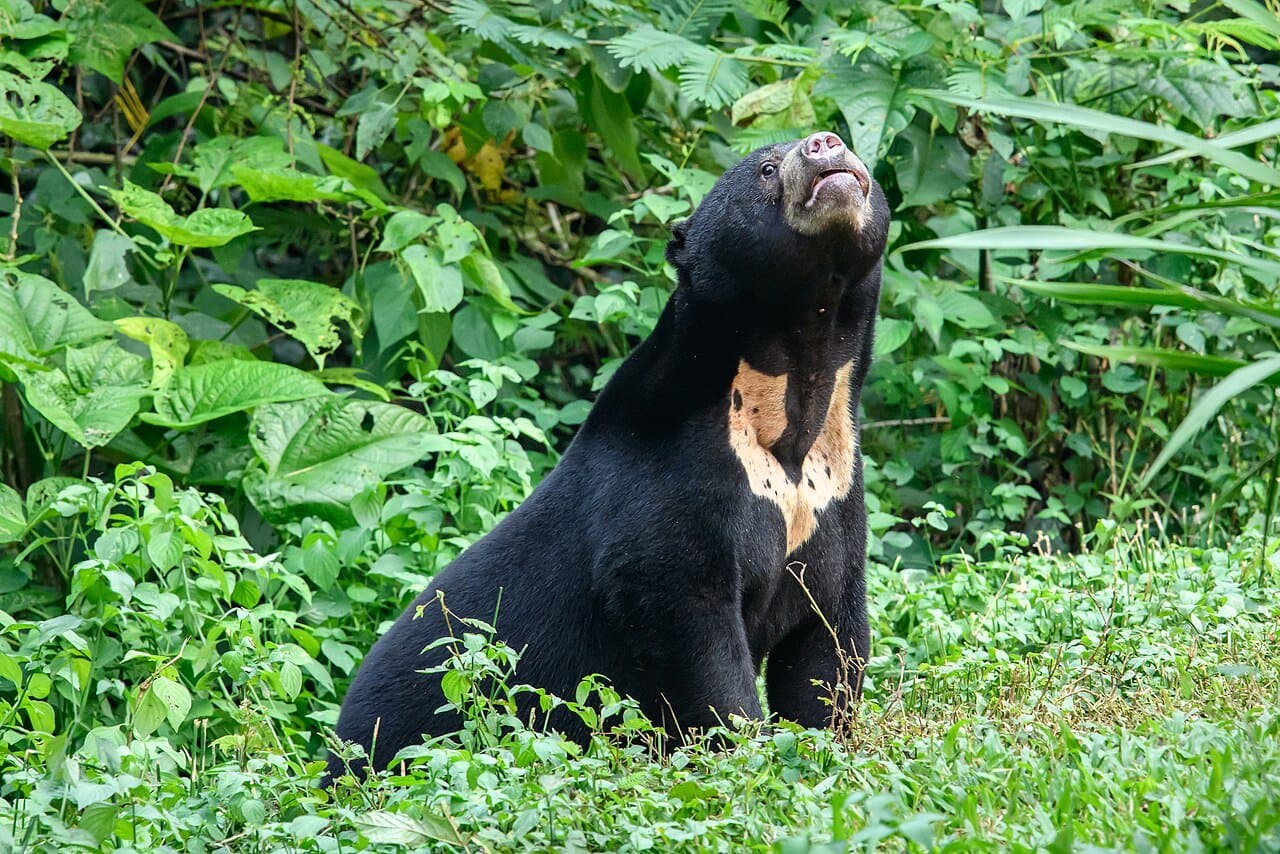
The smallest bear, a tree-climbing honey lover of Southeast Asian forests with a golden patch on its chest and the longest tongue of any bear.
Checking teacher reviews…
About the Malayan Sun Bear
Sun bears live in dense forests from southern China and eastern India south to Indonesia. They are 3.5 to 4.5 feet long and weigh 60 to 180 pounds. Their tongues are 8 to 10 inches long, the longest of any bear, and their curved claws can be more than 4 inches long, perfect for tearing into logs and termite mounds. Sun bears are good climbers and often rest or sunbathe in trees.[1]
Quick facts
- Scientific name
- Helarctos malayanus[1]
- Size
- 3.5 to 4.5 feet long. Females are 10 to 20 percent smaller than males.[1]
- Weight
- 60 to 180 pounds.[1]
- Lifespan
- Unknown in the wild. Can exceed 30 years in zoos.[1]
- Diet
- Omnivore. Fruit, berries, insects, termites, honey, eggs, small animals, roots and tree sap.[1]
- Habitat
- Dense lowland forests, including tropical rainforests and seasonally dry forests.[1]
- Where it lives
- Southeast Asia, from southern China and eastern India south to Indonesia.[1]
- Group life
- Solitary, except mothers raising cubs. Mostly active at night.[1]
- Babies
- Usually two cubs after 95 to 100 days. Newborns weigh 7 to 12 ounces.[1]
- Conservation status
- Vulnerable (IUCN Red List, assessed 2016).[2]
Fun facts
Vocabulary
- hibernate
- To spend the winter in a deep, inactive sleep.
- arboreal
- Living mostly in trees.
- omnivore
- An animal that eats both plants and other animals.
- poaching
- Hunting or capturing animals illegally.
- palm oil
- An oil made from palm fruit; clearing forest for palm farms destroys animal habitat.
See it in person
- Zoo AtlantaAtlanta, Georgia · All AnimalsSee this animal on the zoo's website ↗
Sources
- [1] Zoo Atlanta. “Malayan Sun Bear.” https://zooatlanta.org/animal/malayan-sun-bear/ (accessed 2026-10-02)
- [2] IUCN Red List of Threatened Species. “Helarctos malayanus (Sun Bear).” https://www.iucnredlist.org/species/9760/123798233 (accessed 2026-10-02)
Facts last checked 2026-10-02.