
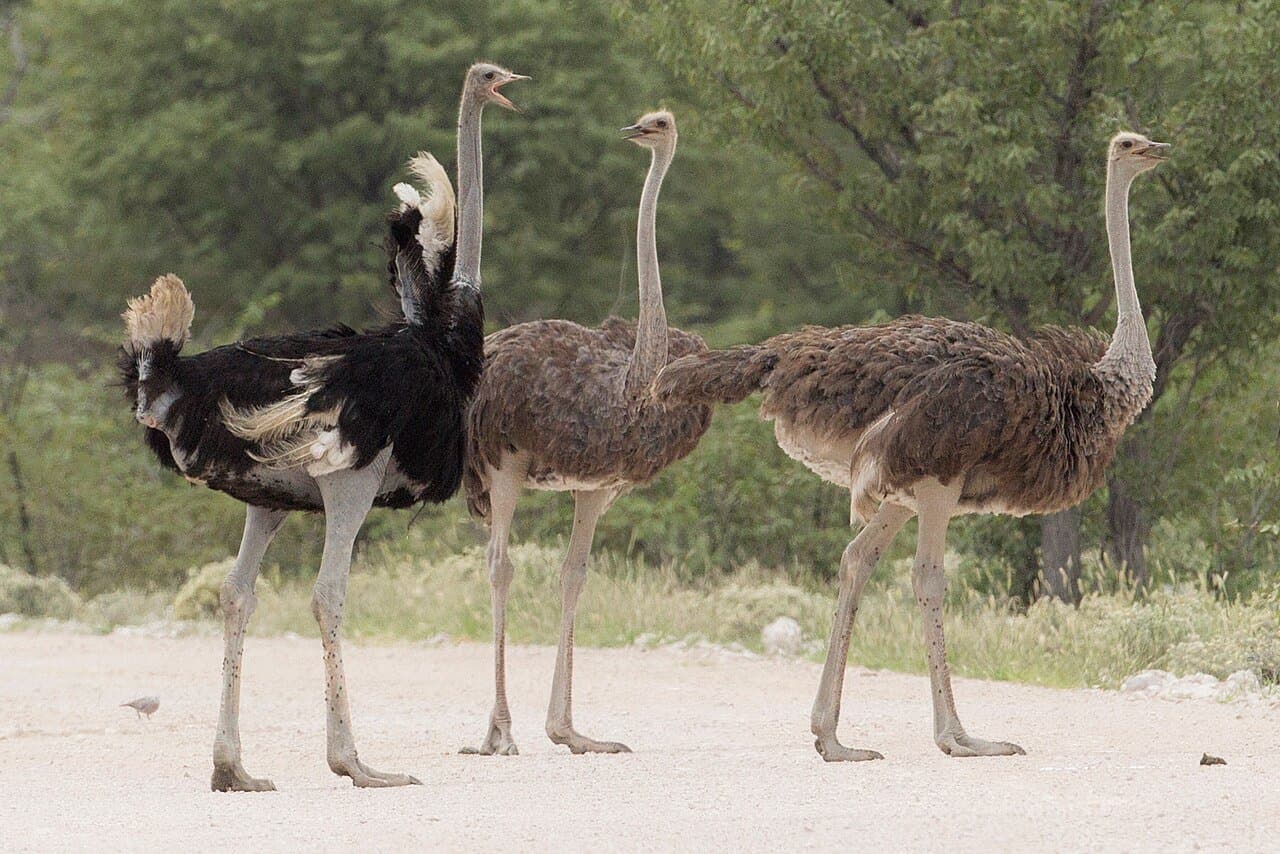
Ostrich
Struthio camelus
The world's largest bird, a fast-running flightless bird of African savannas that lays the largest egg on Earth.
Checking teacher reviews…
About the Ostrich
Ostriches live in the savannas and deserts of Africa. A male can stand up to 9 feet tall. Ostriches cannot fly, but they can sprint up to 43 miles per hour and cover 10 to 16 feet in a single stride. They eat mostly roots, leaves and seeds, plus insects, snakes, lizards and rodents. And no, ostriches do not bury their heads in the sand![1]
Quick facts
- Scientific name
- Struthio camelus[1]
- Size
- Females stand 5.7 to 6.2 feet (1.7 to 1.9 m) tall. Males stand 6.9 to 9 feet.[1]
- Weight
- Females 198 to 242 pounds (90 to 110 kg). Males 220 to 287 pounds.[1]
- Lifespan
- Median life expectancy is about 10 years.[1]
- Diet
- Omnivore. Mostly roots, leaves and seeds, plus insects, snakes, lizards and rodents.[1]
- Habitat
- Savannas and deserts.[1]
- Group life
- Usually groups of about 10 birds, or just a pair. Up to 700 may gather at water during the dry season.[1][2]
- Babies
- Eggs are about 6 inches (15 cm) long and weigh about 3 pounds (1.5 kg). They take about 40 days to hatch.[1][2]
- Conservation status
- Least Concern (IUCN Red List, common ostrich, assessed 2018).[3]
Fun facts
- An ostrich egg is the largest egg, and the largest single cell, found on Earth today.[1]
- An ostrich's eye is almost 2 inches (5 cm) across, the largest eye of any land animal.[1]
- Ostriches are the only birds with just two toes on each foot.[1]
- Ostriches can sprint up to 43 miles per hour (70 km/h) and keep up a steady 31 miles per hour.[1]
- Ostriches do not bury their heads in the sand. That is a myth.[1]
Vocabulary
- flightless
- Not able to fly.
- omnivore
- An animal that eats both plants and other animals.
- cell
- The smallest living unit that makes up a plant or animal.
- myth
- A widely believed idea that is not true.
- stride
- The distance covered in one full step while running.
See it in person
- Montgomery ZooMontgomery, Alabama · AfricaSee this area on the zoo's website ↗
- Zoo AtlantaAtlanta, Georgia · All AnimalsSee this animal on the zoo's website ↗
Sources
- [1] San Diego Zoo Wildlife Alliance. “Ostrich.” https://animals.sandiegozoo.org/animals/ostrich (accessed 2026-10-02)
- [2] African Wildlife Foundation. “Ostrich.” https://www.awf.org/wildlife-conservation/ostrich (accessed 2026-10-02)
- [3] IUCN Red List of Threatened Species. “Struthio camelus (Common Ostrich).” https://www.iucnredlist.org/species/45020636/132189458 (accessed 2026-10-02)
Facts last checked 2026-10-02.