
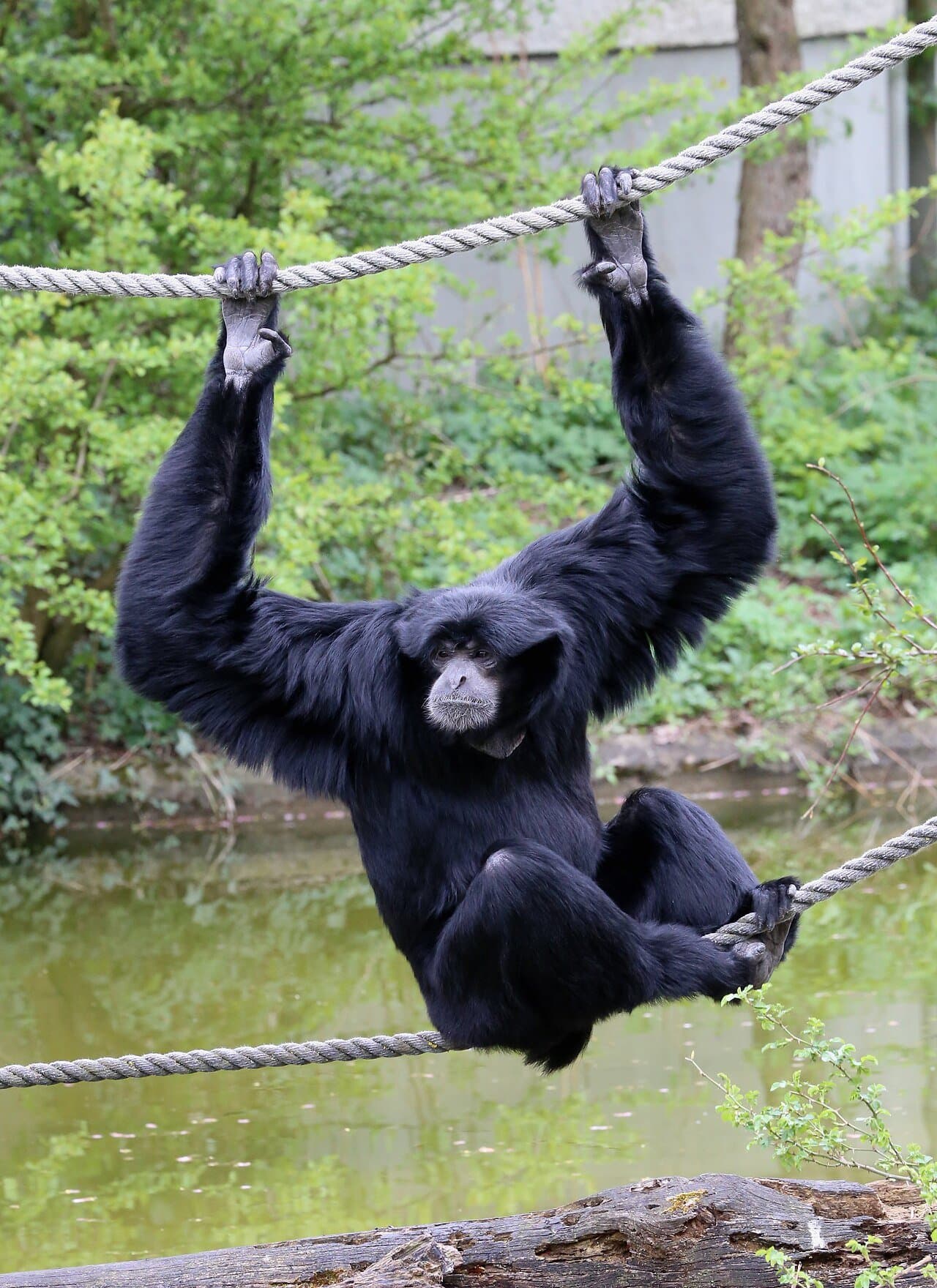
Siamang
Symphalangus syndactylus
A long-armed gibbon of Southeast Asian rainforests that calls with a deep boom, using a throat sac that swells as big as a grapefruit.
Checking teacher reviews…
About the Siamang
Siamangs live in the rainforests of the Malay Peninsula and the island of Sumatra in Southeast Asia. They eat mostly fruit and new leaves. A siamang's arms can be two and a half times as long as its body, and it swings from branch to branch, sometimes flying 25 to 32 feet in one swing. When a siamang calls, its throat sac can swell as big as a grapefruit.[1]
Quick facts
- Scientific name
- Symphalangus syndactylus[1]
- Size
- 29 to 35 inches (74 to 89 cm) tall. Arms can be two and a half times the length of the body.[1]
- Weight
- About 23 pounds (10 kg).[1]
- Diet
- Mostly fruit and new leaves.[1]
- Habitat
- Rainforests and monsoon forests.[1]
- Where it lives
- The Malay Peninsula and Sumatra, in Southeast Asia.[1]
- Group life
- Family groups, usually an adult pair with their young, that defend a territory of about 60 acres.[1]
- Babies
- Pregnancy lasts about seven and a half months. One baby is born every two or three years.[1]
- Conservation status
- Endangered (IUCN Red List, assessed 2015).[2]
Fun facts
- A siamang's throat sac can swell up as big as a grapefruit when it calls.[1]
- Siamangs have been seen swinging 25 to 32 feet (8 to 10 m) through the trees in one move.[1]
- Siamangs spend about 44 percent of their feeding time eating fruit and 45 percent eating leaves.[1]
- The siamang's deep boom carries farther through the forest than its high-pitched "wow" call.[1]
Vocabulary
- gibbon
- A small ape with very long arms that swings through trees. Gibbons are sometimes called lesser apes.
- brachiation
- Moving through trees by swinging from branch to branch using the arms.
- throat sac
- A stretchy pouch of skin on the throat that fills with air to make calls louder.
- monsoon forest
- A forest with a long rainy season and a long dry season each year.
- territory
- An area an animal lives in and defends from others.
See it in person
- Montgomery ZooMontgomery, Alabama · AfricaSee this area on the zoo's website ↗
Sources
- [1] Smithsonian's National Zoo & Conservation Biology Institute. “Siamang.” https://nationalzoo.si.edu/animals/siamang (accessed 2026-10-02)
- [2] IUCN Red List of Threatened Species. “Symphalangus syndactylus (Siamang).” https://www.iucnredlist.org/species/39779/17967873 (accessed 2026-10-02)
Facts last checked 2026-10-02.