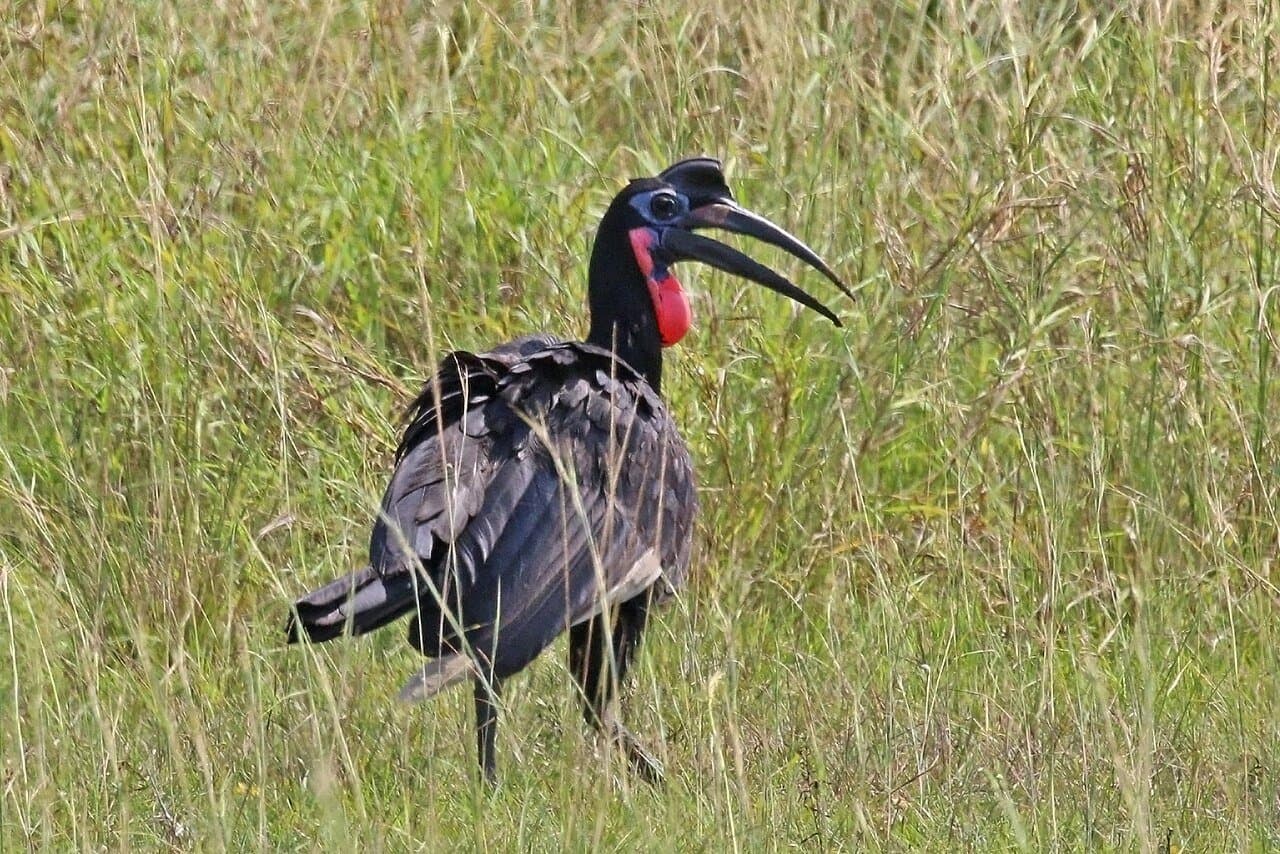
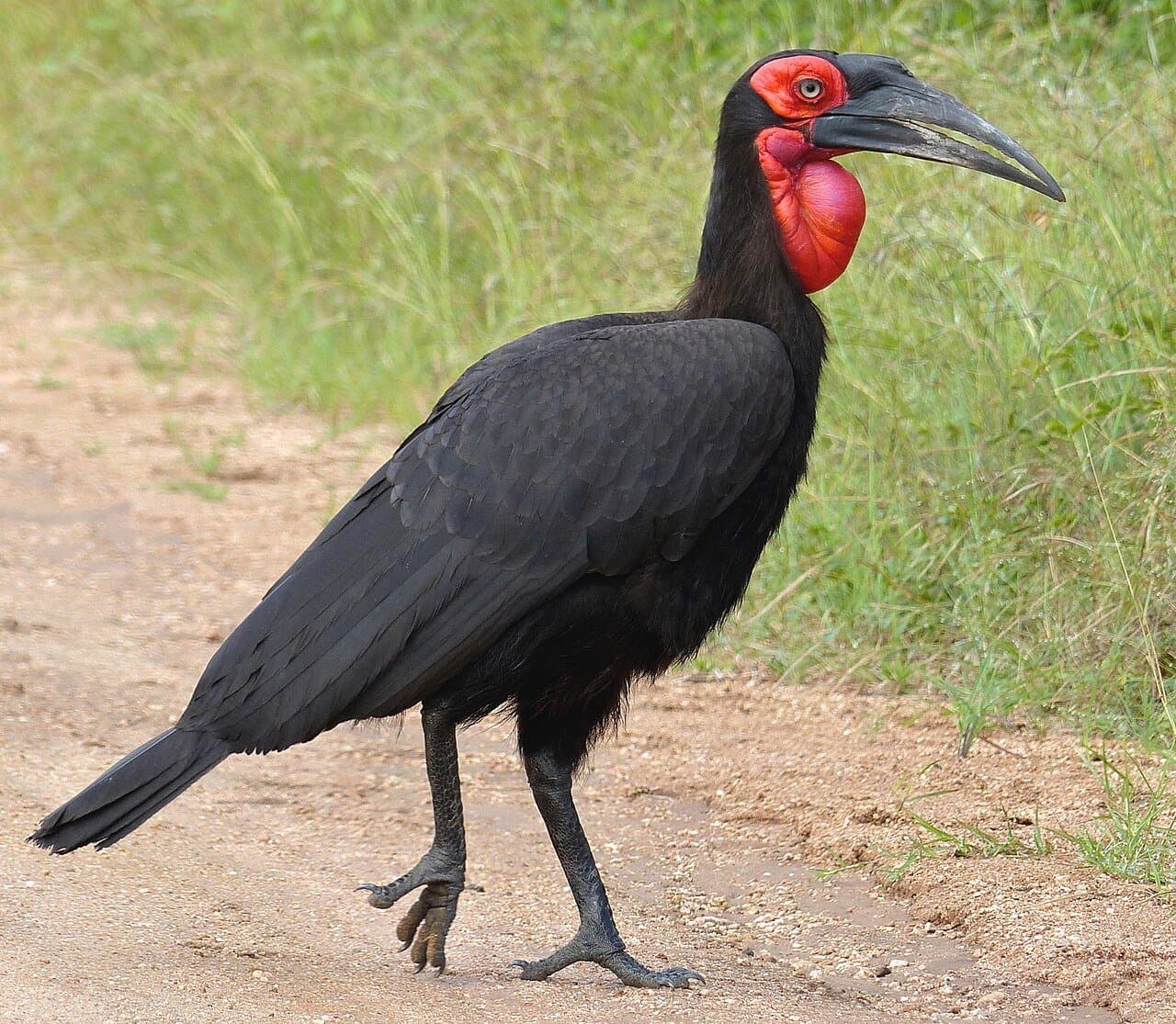
Southern Ground Hornbill
Bucorvus leadbeateri
A big black African hornbill that walks the grasslands hunting small animals and booms to announce its territory.
Checking teacher reviews…
About the Southern Ground Hornbill
Southern ground hornbills live in drier areas from Kenya and the Democratic Republic of Congo south to Botswana and South Africa. They walk or run through thin grass and thorny scrub looking for prey: rodents, snakes, lizards, frogs, eggs, baby birds and insects. A few strikes of their heavy bill can kill even venomous snakes. Females have a bright blue patch on the throat.[1]
Quick facts
- Scientific name
- Bucorvus leadbeateri[1]
- Diet
- Carnivore. Rodents, snakes, lizards, frogs, eggs, nestlings and insects.[1]
- Habitat
- Grasslands and thorny scrub.[1]
- Where it lives
- Drier parts of central and southern Africa, from Kenya and the DR Congo to Botswana and South Africa.[1]
- Group life
- Small groups that raise young together.[1]
- Babies
- One or two eggs in a tree nest, incubated about 40 days.[1]
- Conservation status
- Vulnerable (IUCN Red List, assessed 2025).[2]
Fun facts
Vocabulary
- hornbill
- A bird with a large, curved bill.
- territory
- An area an animal lives in and defends from others.
- venomous
- Able to inject poison by biting or stinging.
- nestling
- A baby bird that hasn't left the nest yet.
- vulnerable
- A conservation label meaning a species faces a high risk of dying out in the wild.
See it in person
- Zoo AtlantaAtlanta, Georgia · All AnimalsSee this animal on the zoo's website ↗
Sources
- [1] Zoo Atlanta. “Southern Ground Hornbill.” https://zooatlanta.org/animal/southern-ground-hornbill/ (accessed 2026-10-02)
- [2] IUCN Red List of Threatened Species. “Bucorvus leadbeateri (Southern Ground-hornbill).” https://www.iucnredlist.org/species/22682638/266675349 (accessed 2026-10-02)
Facts last checked 2026-10-02.