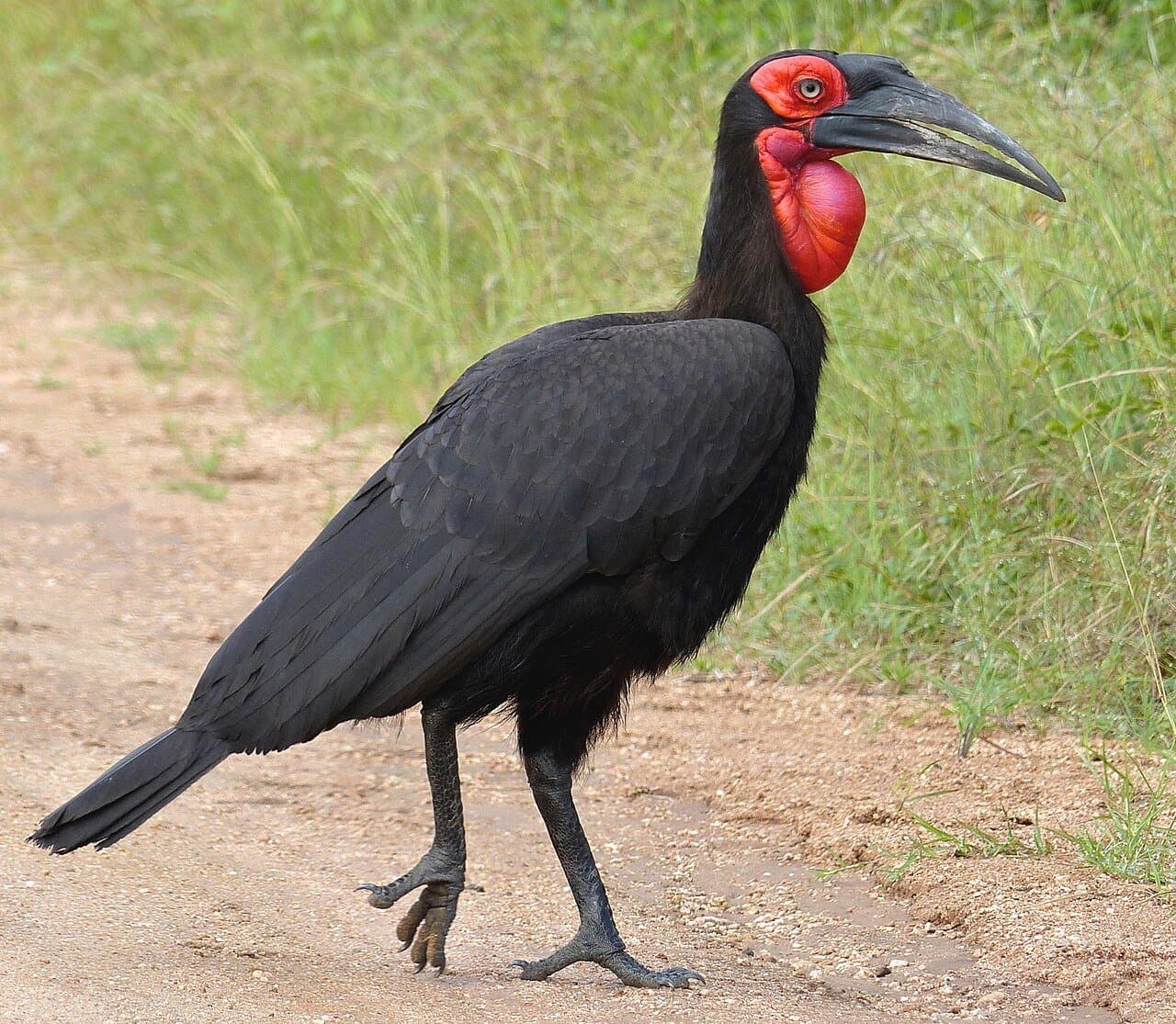
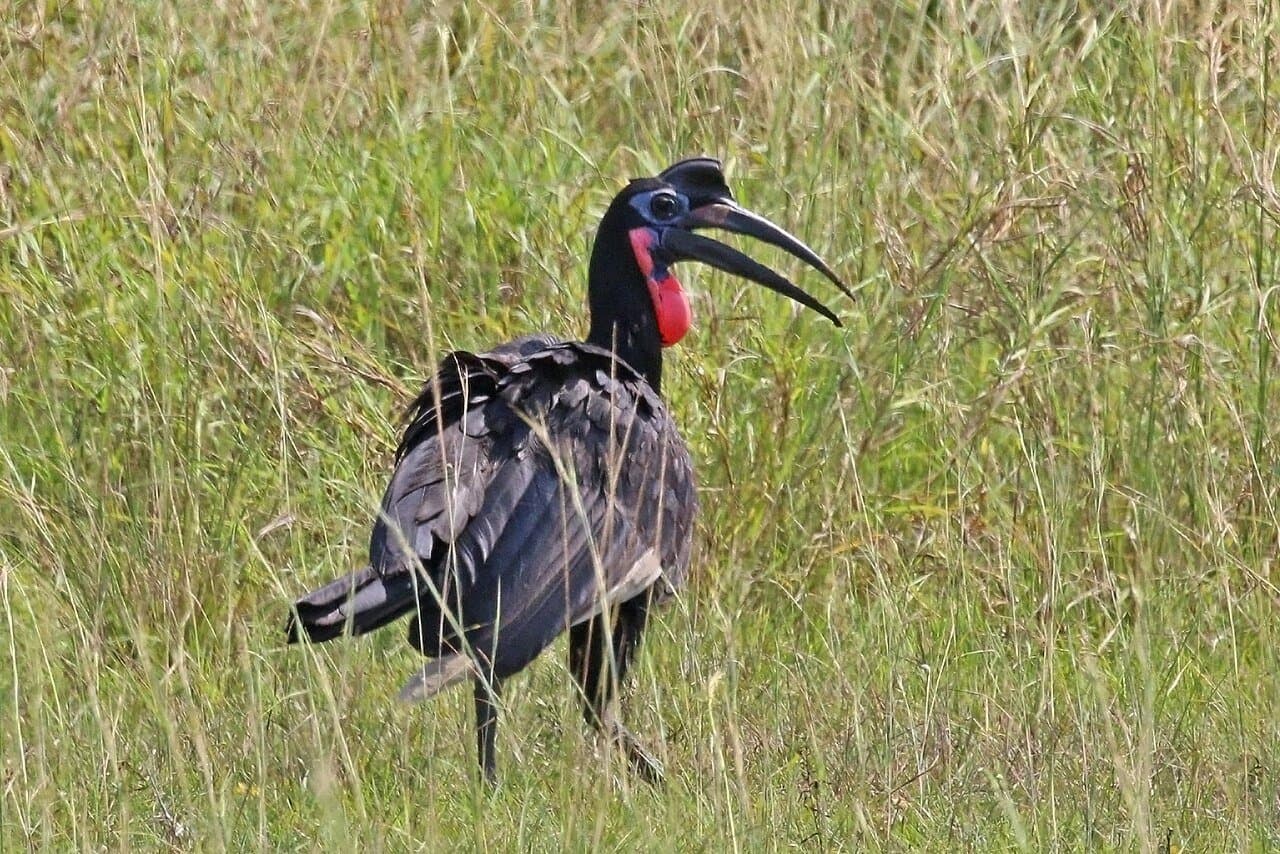
Abyssinian Ground Hornbill
Bucorvus abyssinicus
A big black hornbill of African savannas that walks the ground hunting snakes, lizards and small mammals. Also called the northern ground hornbill.
Checking teacher reviews…
About the Abyssinian Ground Hornbill
Abyssinian ground hornbills live in savannas, grasslands and scrub across north-central Africa, from Senegal and Guinea in the west to Ethiopia in the east. They are mostly meat-eaters that hunt reptiles such as cobras, tortoises and lizards, mammals like hares and mongooses, and insects and spiders. A hornbill may walk up to 7 miles in one day looking for food. They are usually seen in pairs.[1]
Quick facts
- Size
- About 40 inches (102 cm) long.[1]
- Weight
- About 8 to 11 pounds (4 to 5 kg).[1]
- Lifespan
- Up to 40 years in human care. Unknown in the wild.[1]
- Diet
- Mostly carnivore. Reptiles such as cobras, tortoises and lizards, mammals such as hares and mongooses, and insects and arachnids.[1]
- Habitat
- Savannas, grasslands and scrub with trees for nesting.[1]
- Where it lives
- North-central Africa, from Senegal and Guinea to Ethiopia.[1]
- Group life
- Usually seen in pairs, sometimes in groups.[1]
- Babies
- One or two eggs, incubated for 37 to 41 days.[1]
- Conservation status
- Vulnerable (IUCN Red List, assessed 2018).[2]
Fun facts
Vocabulary
- hornbill
- A bird with a large, curved bill, often with a bony ridge on top called a casque.
- carnivore
- An animal that eats mostly meat.
- arachnid
- An animal with eight legs, such as a spider or scorpion.
- duet
- A song performed by two singers together.
- scrub
- Land covered with low bushes and small trees.
See it in person
- Montgomery ZooMontgomery, Alabama · AfricaSee this area on the zoo's website ↗
Sources
- [1] Smithsonian's National Zoo & Conservation Biology Institute. “Abyssinian ground hornbill.” https://nationalzoo.si.edu/animals/abyssinian-ground-hornbill (accessed 2026-10-02)
- [2] IUCN Red List of Threatened Species. “Bucorvus abyssinicus (Northern Ground-hornbill).” https://www.iucnredlist.org/species/22682632/132204438 (accessed 2026-10-02)
Facts last checked 2026-10-02.