
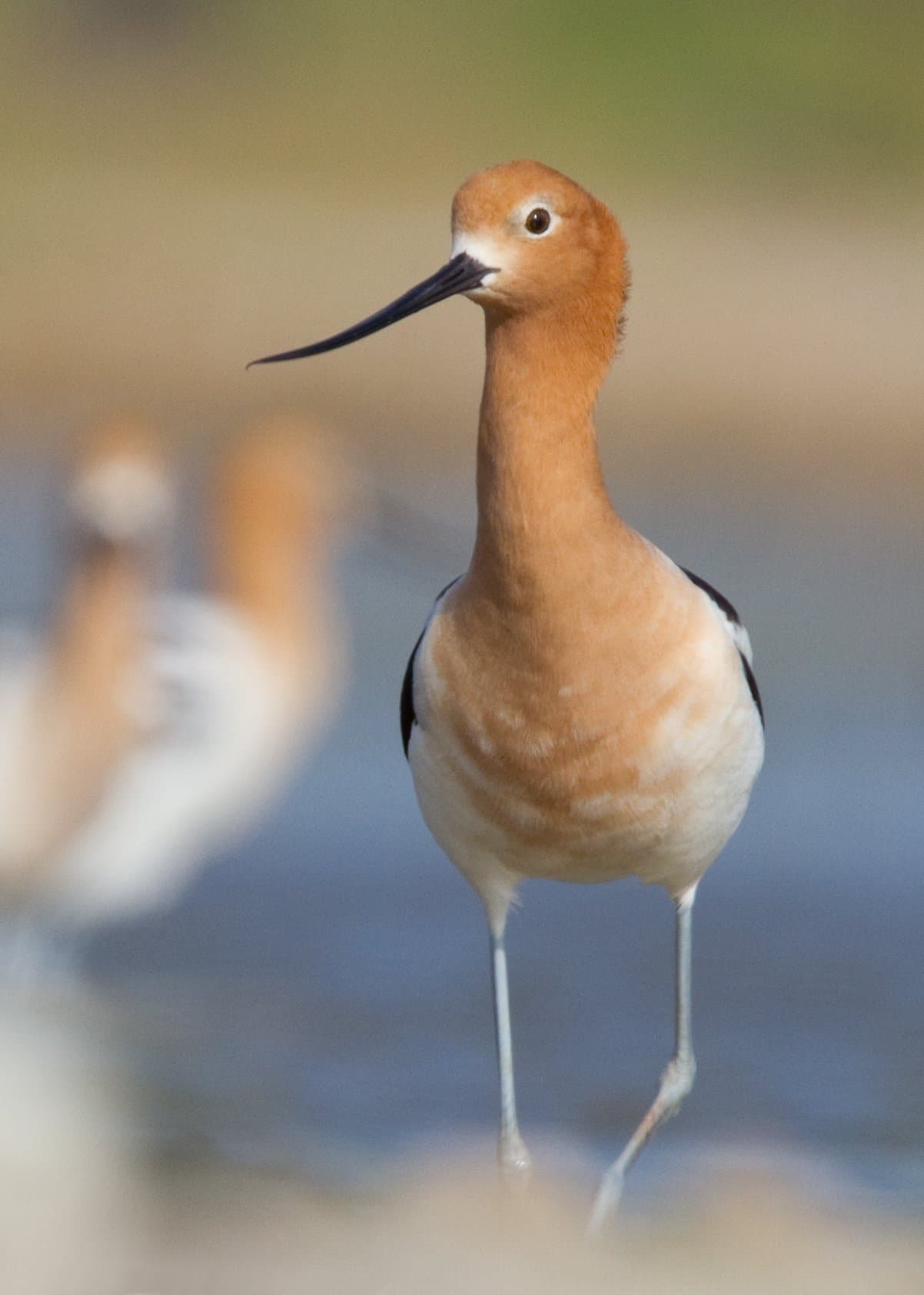
American Avocet
Recurvirostra americana
An elegant shorebird with blue legs and a long, upturned bill that it sweeps through shallow water to catch food.
Checking teacher reviews…
About the American Avocet
American avocets are 17 to 18.5 inches long and weigh 10 to 12 ounces. They have white bodies, black-and-white wings, long bluish legs and a thin, upturned bill about 3.5 inches long. Their head and neck turn rusty orange in the breeding season and grayish white in winter. They live in shallow wetlands, mudflats, lagoons, rice fields and ponds.[1]
Quick facts
- Scientific name
- Recurvirostra americana[1]
- Size
- 17 to 18.5 inches long; about 28-inch wingspan.[1]
- Weight
- 10 to 12 ounces.[1]
- Lifespan
- About 9 to 15 years in the wild.[1]
- Diet
- Water invertebrates such as beetles, midges, brine flies and fairy shrimp, plus small fish and seeds.[1]
- Habitat
- Open shallow wetlands, mudflats, lagoons, rice fields and ponds.[1]
- Group life
- Large flocks outside the breeding season; nests in loose colonies.[1]
- Babies
- 3 or 4 eggs that hatch after 18 to 29 days.[1]
- Conservation status
- Least Concern (IUCN Red List, assessed 2024).[2]
Fun facts
Vocabulary
- shorebird
- A bird that lives and feeds along beaches, mudflats and other shorelines.
- invertebrate
- An animal without a backbone, such as an insect, worm, crab or snail.
- incubate
- To keep eggs warm so they can hatch.
- crepuscular
- Most active at dawn and dusk.
- least concern
- A conservation label meaning a species is widespread and not at risk of dying out soon.
See it in person
- Smithsonian's National ZooWashington, D.C. · Bird HouseSee this animal on the zoo's website ↗
These zoos had this animal when we gathered our information, but animals sometimes move. Check the zoo's website or contact the zoo before you visit.
Sources
- [1] Smithsonian's National Zoo & Conservation Biology Institute. “American avocet.” https://nationalzoo.si.edu/animals/american-avocet (accessed 2026-10-08)
- [2] IUCN Red List of Threatened Species. “Recurvirostra americana (American Avocet).” https://www.iucnredlist.org/species/22693717/262144636 (accessed 2026-10-08)
Facts last checked 2026-10-08.
More Shorebirds
 American Golden PloverPluvialis dominica
 American OystercatcherHaematopus palliatus
 Black-necked StiltHimantopus mexicanus
 DunlinCalidris alpina
 Red KnotCalidris canutus
 Ruddy TurnstoneArenaria interpres
 SanderlingCalidris alba
 Semipalmated PloverCharadrius semipalmatus
 Semipalmated SandpiperCalidris pusilla
 Short-billed DowitcherLimnodromus griseus
 Wattled JacanaJacana jacana