
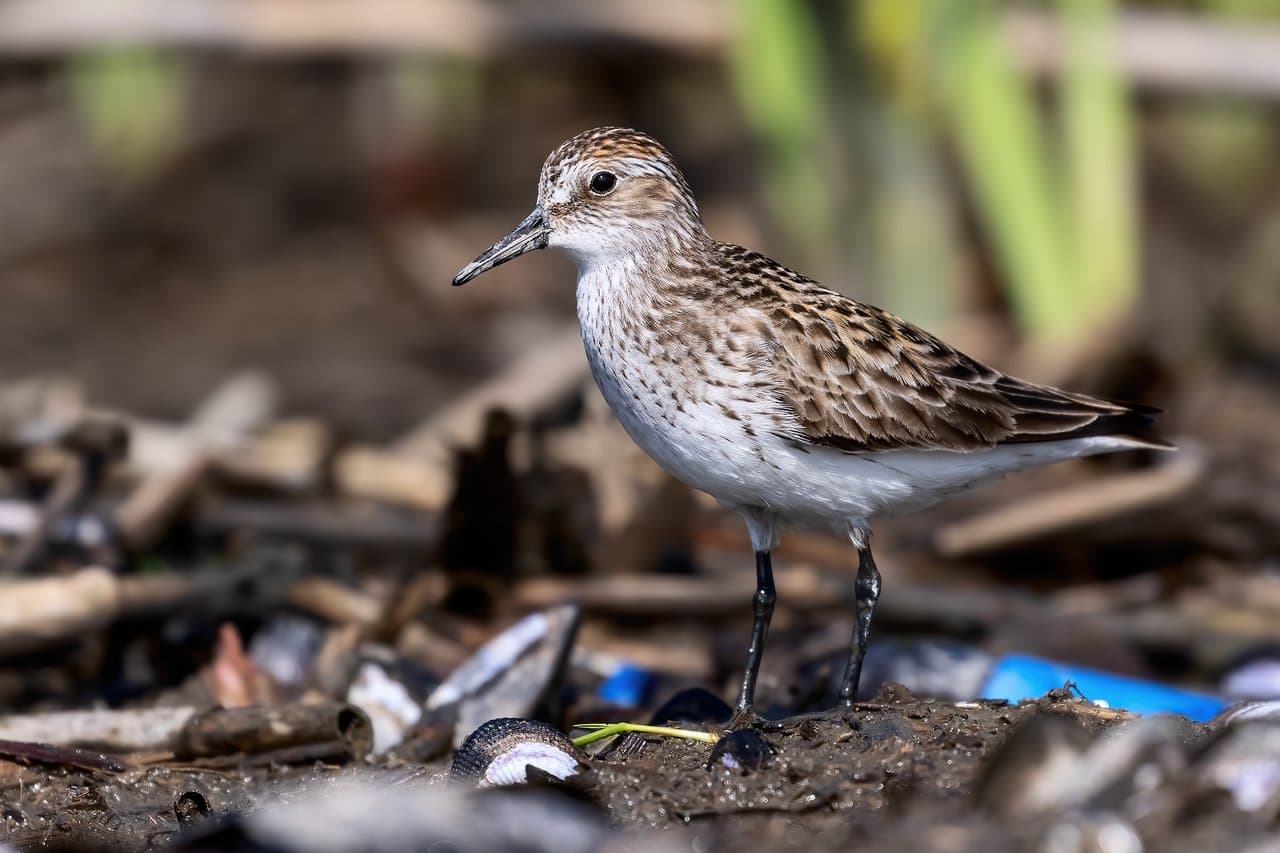
Semipalmated Sandpiper
Calidris pusilla
A sparrow-sized sandpiper that can double its weight before flying nonstop up to 2,000 miles over the ocean.
Checking teacher reviews…
About the Semipalmated Sandpiper
Semipalmated sandpipers are about the size of a sparrow and weigh 17 to 51 grams, depending on how much fat they've stored. They have black legs and bills, gray backs and white chests. They nest near fresh water in the Arctic and stop at oceans, lakes and wetlands during migration. They eat worms, fly larvae, tiny crustaceans and mollusks, and even a slimy layer of algae on mudflats called biofilm.[1]
Quick facts
- Scientific name
- Calidris pusilla[1]
- Weight
- 17 to 51 grams, depending on stored fat.[1]
- Lifespan
- The oldest known was 16 years old.[1]
- Diet
- Worms, fly larvae, tiny crustaceans, mollusks and biofilm.[1]
- Habitat
- Arctic tundra near fresh water; beaches, lakes and wetlands in migration.[1]
- Where it lives
- Breeds in the subarctic and Arctic; migrates to South America.[1]
- Group life
- Territorial when nesting; mixed flocks in migration. Active by day.[1]
- Babies
- 4 eggs, incubated by both parents.[1]
- Conservation status
- Near Threatened (IUCN Red List, assessed 2024).[2]
Fun facts
Vocabulary
- biofilm
- A slimy layer of tiny algae and living things on mud or rocks.
- semipalmated
- Having toes that are partly webbed.
- migrate
- To travel from one region to another with the seasons.
- scrape
- A shallow hollow in the ground that a bird uses as a nest.
- near threatened
- A conservation label meaning a species may soon be at risk of dying out if things don't improve.
See it in person
- Smithsonian's National ZooWashington, D.C. · Bird HouseSee this animal on the zoo's website ↗
These zoos had this animal when we gathered our information, but animals sometimes move. Check the zoo's website or contact the zoo before you visit.
Sources
- [1] Smithsonian's National Zoo & Conservation Biology Institute. “Semipalmated sandpiper.” https://nationalzoo.si.edu/animals/semipalmated-sandpiper (accessed 2026-10-08)
- [2] IUCN Red List of Threatened Species. “Calidris pusilla (Semipalmated Sandpiper).” https://www.iucnredlist.org/species/22693373/255806237 (accessed 2026-10-08)
Facts last checked 2026-10-08.
More Shorebirds
 American AvocetRecurvirostra americana
 American Golden PloverPluvialis dominica
 American OystercatcherHaematopus palliatus
 Black-necked StiltHimantopus mexicanus
 DunlinCalidris alpina
 Red KnotCalidris canutus
 Ruddy TurnstoneArenaria interpres
 SanderlingCalidris alba
 Semipalmated PloverCharadrius semipalmatus
 Short-billed DowitcherLimnodromus griseus
 Wattled JacanaJacana jacana