
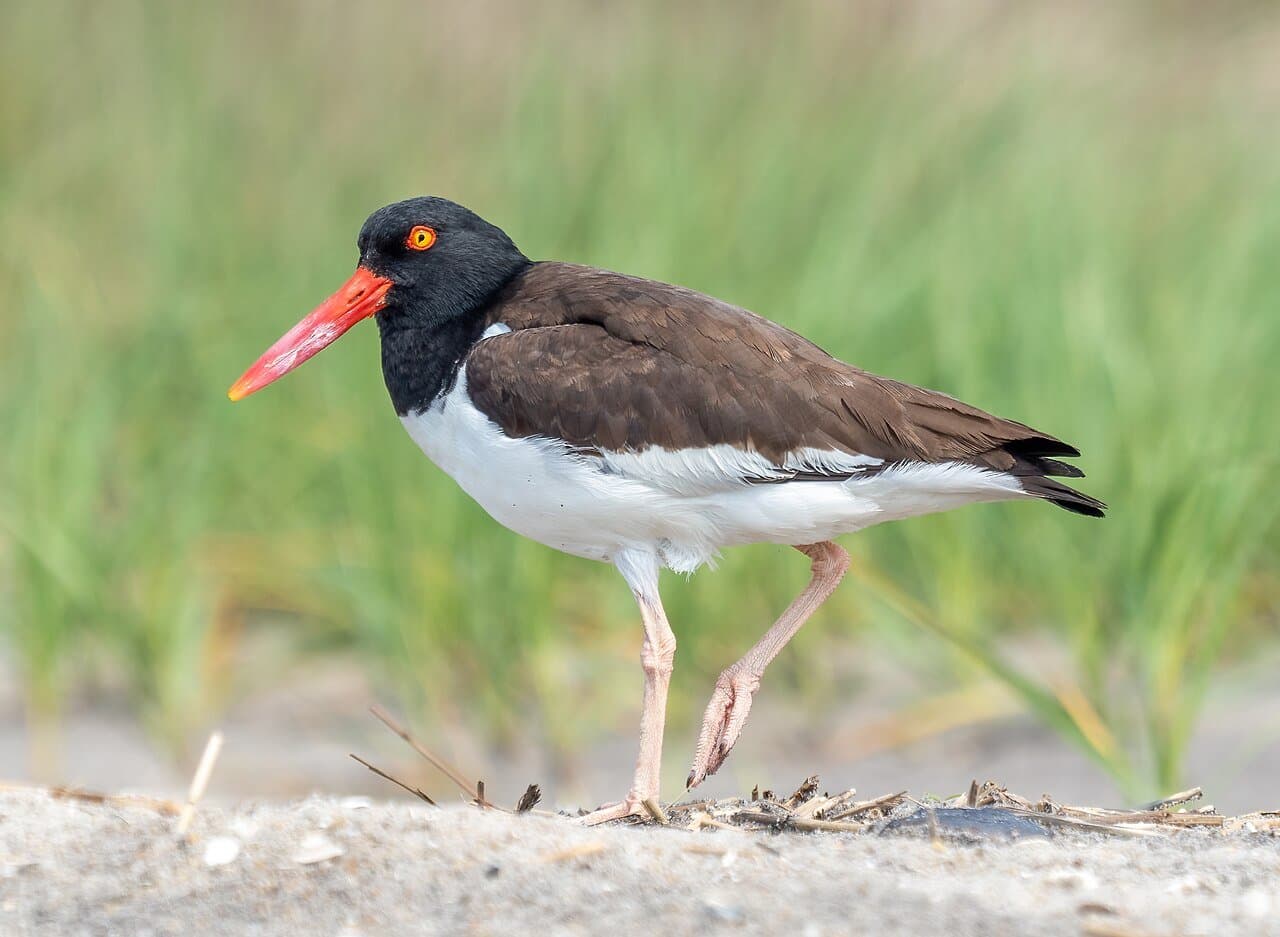
American Oystercatcher
Haematopus palliatus
A chunky black-and-white shorebird with a bright red-orange bill that it jabs into shells to eat oysters and clams.
Checking teacher reviews…
About the American Oystercatcher
American oystercatchers are 17 to 20 inches long, with a black head, yellow eyes ringed in orange and a thick red-orange bill 3 to 4 inches long. They live on sandy beaches, mudflats, barrier islands and salt marshes along the Atlantic and Pacific coasts of the Americas. They eat mostly saltwater mollusks like clams, mussels and limpets, hunting as the tide goes out.[1]
Quick facts
- Scientific name
- Haematopus palliatus[1]
- Size
- 17 to 20 inches long; bill 3 to 4 inches.[1]
- Lifespan
- Ten years or longer.[1]
- Diet
- Mostly saltwater mollusks, such as clams, mussels, limpets and chitons; sometimes fish and crustaceans.[1]
- Habitat
- Sandy beaches, mudflats, barrier islands and salt marshes.[1]
- Where it lives
- Atlantic and Pacific coasts of the Americas.[1]
- Group life
- Pairs in the breeding season; roosting colonies the rest of the year.[1]
- Babies
- 1 to 4 brown-speckled eggs.[1]
- Conservation status
- Least Concern (IUCN Red List, assessed 2025).[2]
Fun facts
Vocabulary
- mollusk
- A soft-bodied animal, often with a shell, such as a clam, snail or octopus.
- bivalve
- A mollusk with two hinged shells, such as a clam or oyster.
- intertidal
- The area of shore that is underwater at high tide and dry at low tide.
- scrape
- A shallow hollow in the ground that a bird uses as a nest.
- least concern
- A conservation label meaning a species is widespread and not at risk of dying out soon.
See it in person
- Smithsonian's National ZooWashington, D.C. · Bird HouseSee this animal on the zoo's website ↗
These zoos had this animal when we gathered our information, but animals sometimes move. Check the zoo's website or contact the zoo before you visit.
Sources
- [1] Smithsonian's National Zoo & Conservation Biology Institute. “American oystercatcher.” https://nationalzoo.si.edu/animals/american-oystercatcher (accessed 2026-10-08)
- [2] IUCN Red List of Threatened Species. “Haematopus palliatus (American Oystercatcher).” https://www.iucnredlist.org/species/22693644/281849747 (accessed 2026-10-08)
Facts last checked 2026-10-08.
More Shorebirds
 American AvocetRecurvirostra americana
 American Golden PloverPluvialis dominica
 Black-necked StiltHimantopus mexicanus
 DunlinCalidris alpina
 Red KnotCalidris canutus
 Ruddy TurnstoneArenaria interpres
 SanderlingCalidris alba
 Semipalmated PloverCharadrius semipalmatus
 Semipalmated SandpiperCalidris pusilla
 Short-billed DowitcherLimnodromus griseus
 Wattled JacanaJacana jacana