
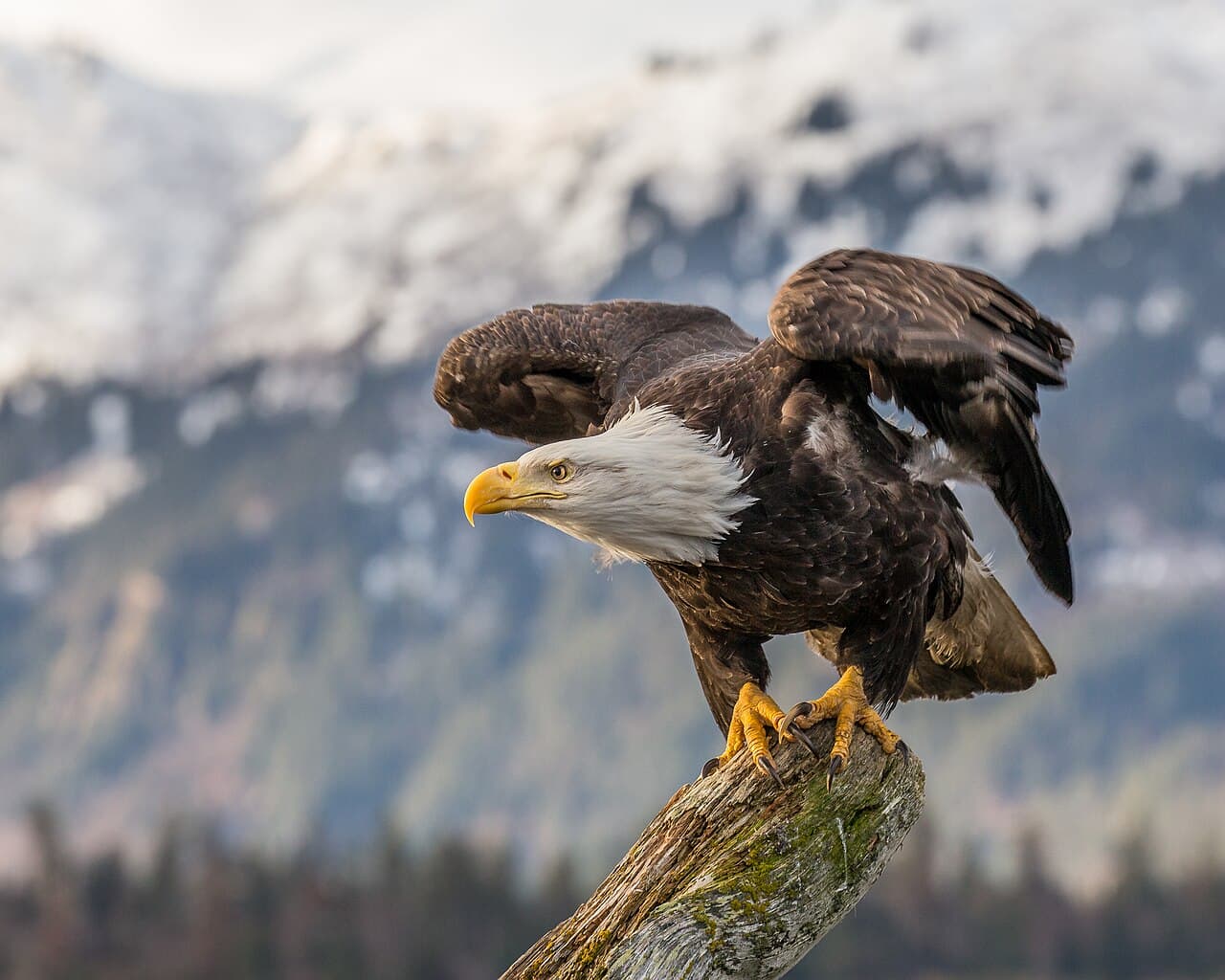
Bald Eagle
Haliaeetus leucocephalus
The national bird of the United States, a fish-eating eagle that came back from the edge of extinction.
Checking teacher reviews…
About the Bald Eagle
Bald eagles live near water such as lakes, rivers, coasts and wetlands, from Alaska and Canada down to northern Mexico. Fish is their main food, but they also eat waterbirds, turtles, rabbits, snakes and animals that are already dead. Females are bigger than males, with wingspans up to 8 feet. Young eagles have mottled brown and white feathers all over. They slowly grow the white head and tail of an adult by about age 5.[1]
Quick facts
- Scientific name
- Haliaeetus leucocephalus[1]
- Weight
- Males: up to 10 pounds. Females: up to 14 pounds. Some Alaskan eagles reach 16 pounds.[1]
- Lifespan
- Up to about 30 years in the wild, and longer in captivity.[1]
- Diet
- Mostly fish. Also waterfowl, shorebirds, turtles, rabbits, snakes, other small animals and carrion.[1]
- Habitat
- Near water: forests, coasts, lakes, rivers, mountains and wetlands, including in cities.[1]
- Where it lives
- North America, from Alaska and Canada to northern Mexico.[1]
- Babies
- Nests are usually 4 to 5 feet wide and 2 to 4 feet deep. Some grow to 10 feet across.[1]
- Conservation status
- Recovered. Removed from the U.S. endangered species list in 2007.[1]
Fun facts
- The bald eagle was adopted as the national symbol of the United States in 1782.[1]
- In 1963 there were only 417 nesting pairs in the lower 48 states. By 2019 there were an estimated 71,467 breeding pairs.[1]
- An eagle's eye has two centers of focus, so it can see forward and to the side at the same time.[2]
- Some bald eagle nests grow to 10 feet across.[1]
Vocabulary
- bird of prey
- A bird that hunts other animals, using sharp talons and a hooked beak.
- talon
- A sharp, curved claw on a bird of prey's foot.
- wingspan
- The distance from the tip of one wing to the tip of the other.
- carrion
- The meat of an animal that is already dead.
- pesticide
- A chemical used to kill insects or other pests.
See it in person
- Montgomery ZooMontgomery, Alabama · North AmericaSee this area on the zoo's website ↗
- Oakland ZooOakland, California · California TrailSee this animal on the zoo's website ↗
These zoos had this animal when we gathered our information, but animals sometimes move. Check the zoo's website or contact the zoo before you visit.
Sources
- [1] U.S. Fish & Wildlife Service. “Bald eagle (Haliaeetus leucocephalus).” https://www.fws.gov/species/bald-eagle-haliaeetus-leucocephalus (accessed 2026-10-01)
- [2] National Park Service. “Bald Eagle.” https://www.nps.gov/articles/bald-eagle.htm (accessed 2026-10-01)
Facts last checked 2026-10-01.


