
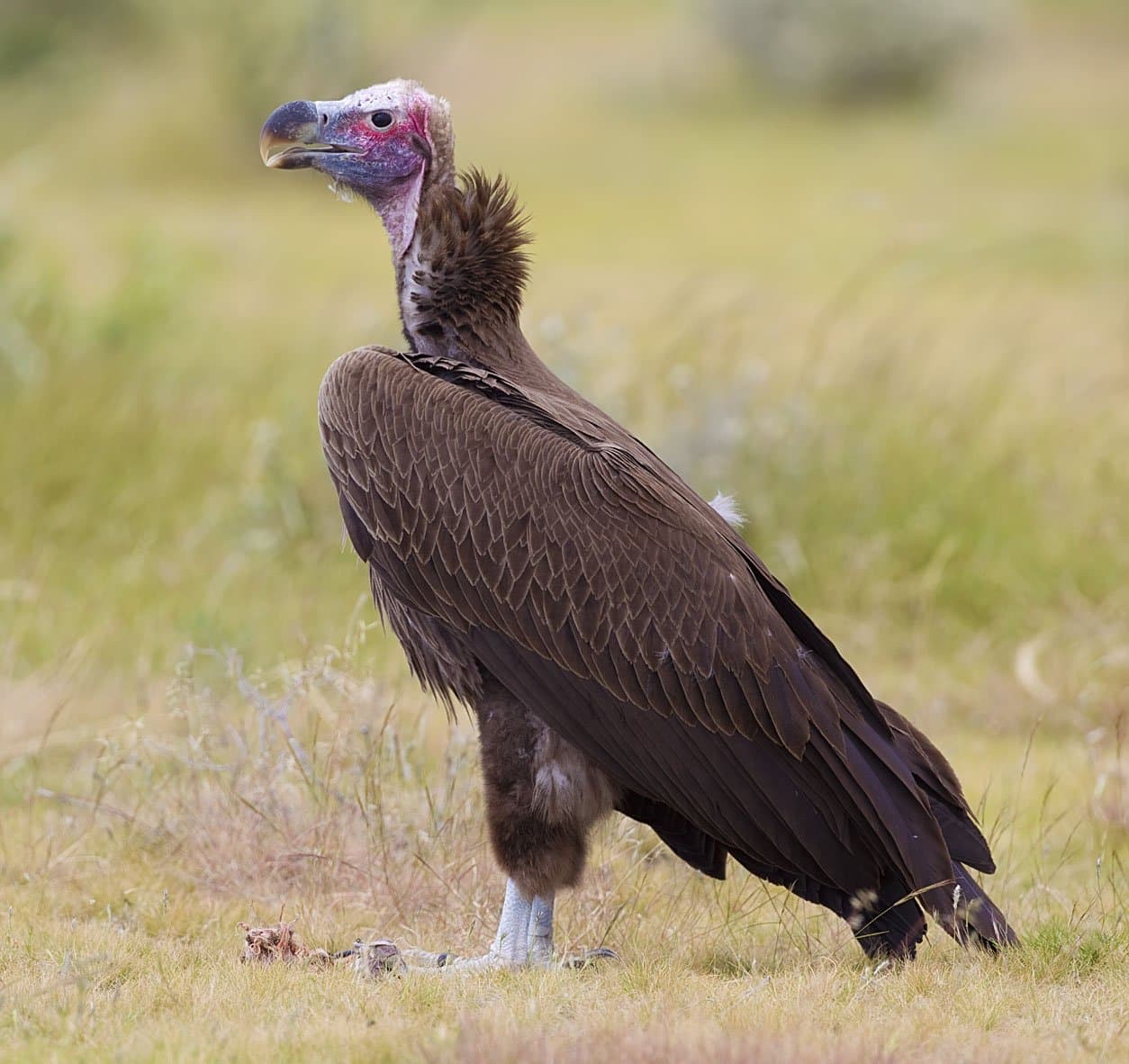
Lappet-Faced Vulture
Torgos tracheliotos
Africa's largest vulture, an endangered scavenger whose strong beak opens carcasses for other vultures.
Checking teacher reviews…
About the Lappet-Faced Vulture
Lappet-faced vultures live in deserts and dry grasslands of sub-Saharan Africa and the Arabian Peninsula. They are the largest vultures in Africa. At a carcass they often arrive first and use their strong beaks to break through tough hide. Vultures find food by smell and by watching for other vultures circling overhead.[1]
Quick facts
- Scientific name
- Torgos tracheliotos[1]
- Lifespan
- Up to 50 years.[1]
- Diet
- Scavenger. Carcasses, plus sometimes small animals or eggs.[1]
- Habitat
- Deserts, dry grasslands and sparsely wooded grasslands.[1]
- Where it lives
- Sub-Saharan Africa and the Arabian Peninsula.[1]
- Group life
- Pairs stay together for several years.[1]
- Babies
- One egg in a loose stick nest on a cliff or tree.[1]
- Conservation status
- Endangered (IUCN Red List, assessed 2016).[2]
Fun facts
Vocabulary
- scavenger
- An animal that feeds on dead animals or leftover food.
- bask
- To lie or perch in the sun to warm up.
- thermal
- A rising column of warm air that birds use to gain height.
- metabolism
- How fast the body uses energy.
- endangered
- A conservation label meaning a species faces a very high risk of dying out in the wild.
See it in person
- Zoo AtlantaAtlanta, Georgia · All AnimalsSee this animal on the zoo's website ↗
These zoos had this animal when we gathered our information, but animals sometimes move. Check the zoo's website or contact the zoo before you visit.
Sources
- [1] Zoo Atlanta. “Lappet-faced Vulture.” https://zooatlanta.org/animal/lappet-faced-vulture/ (accessed 2026-10-02)
- [2] IUCN Red List of Threatened Species. “Torgos tracheliotos (Lappet-faced Vulture).” https://www.iucnredlist.org/species/22695238/155542069 (accessed 2026-10-02)
Facts last checked 2026-10-02.


