
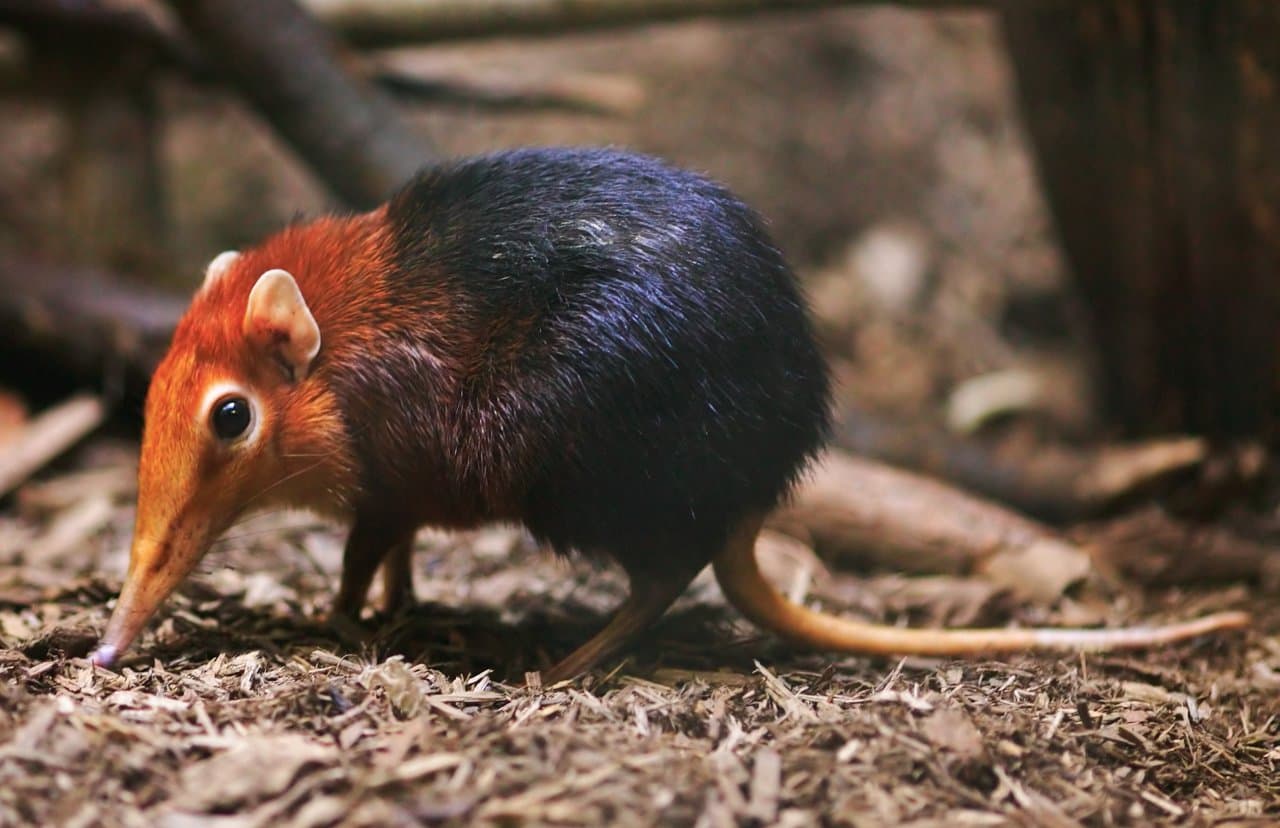
Black and Rufous Elephant Shrew
Rhynchocyon petersi
A speedy East African sengi with a trunk-like nose that is more closely related to elephants than to shrews.
Checking teacher reviews…
About the Black and Rufous Elephant Shrew
Black and rufous elephant shrews, also called sengis, are about 11 inches long plus a tail up to 10 inches, and weigh 1 to 1.5 pounds. They have reddish heads and black back ends. They live in forests and shrublands of southeastern Kenya and eastern Tanzania. They root through leaf litter with their flexible snouts and scoop up beetles, centipedes and ants with their long tongues.[1]
Quick facts
- Scientific name
- Rhynchocyon petersi[1]
- Size
- About 11 inches long, plus a tail up to 10 inches.[1]
- Weight
- 1 to 1.5 pounds.[1]
- Lifespan
- About 4 to 5 years.[1]
- Diet
- Insectivore. Beetles, centipedes and ants, plus some fruit and seeds.[1]
- Habitat
- Dense lowland forests and shrublands.[1]
- Where it lives
- Southeastern Kenya and eastern Tanzania.[1]
- Group life
- Alone or in pairs. Active during the day.[1]
- Babies
- 1 or 2 young after a 45- to 60-day pregnancy.[1]
- Conservation status
- Least Concern (IUCN Red List, assessed 2016).[2]
Fun facts
Vocabulary
- sengi
- Another name for an elephant shrew.
- rufous
- Reddish-brown.
- leaf litter
- Fallen leaves on the forest floor.
- diurnal
- Active mainly during the day.
- least concern
- A conservation label meaning a species is widespread and not at risk of dying out soon.
See it in person
- Smithsonian's National ZooWashington, D.C. · Small Mammal HouseSee this animal on the zoo's website ↗
These zoos had this animal when we gathered our information, but animals sometimes move. Check the zoo's website or contact the zoo before you visit.
Sources
- [1] Smithsonian's National Zoo & Conservation Biology Institute. “Black and rufous elephant shrew.” https://nationalzoo.si.edu/animals/black-and-rufous-elephant-shrew (accessed 2026-10-08)
- [2] IUCN Red List of Threatened Species. “Rhynchocyon petersi (Black and Rufous Sengi).” https://www.iucnredlist.org/species/19708/21286959 (accessed 2026-10-08)
Facts last checked 2026-10-08.


